Jirisan Mountain Village Stays: Rural Korea at Its Most Authentic

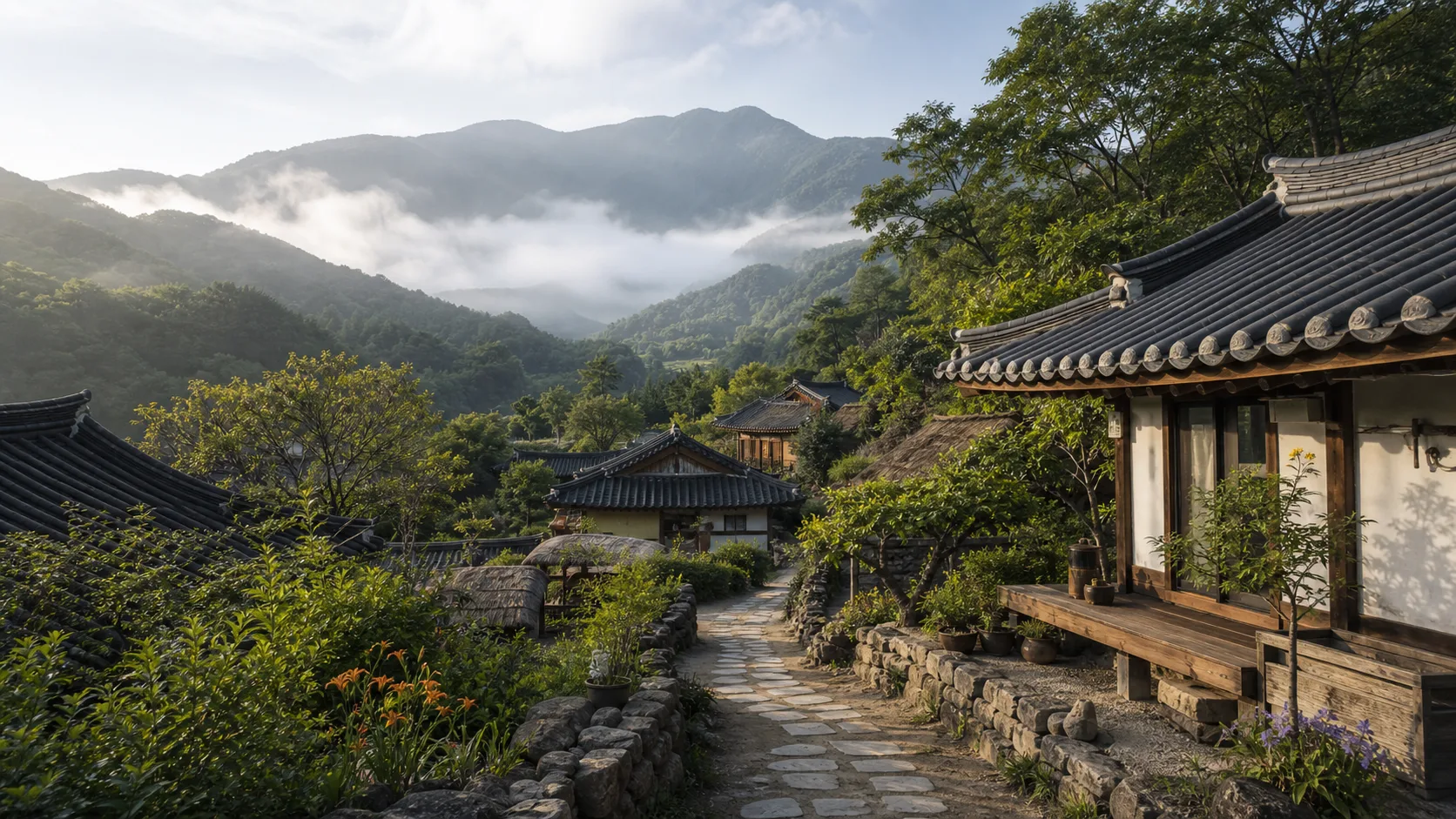
If you want Korea without the gloss of the big-city itinerary, Jirisan is one of the few places where the rhythm of the day still feels set by the mountain, the market, and the weather. Village stays around the park are not polished resort experiences. They are slower, quieter, and more revealing, which is exactly why they work.
Introduction
Jirisan mountain village stays solve a specific travel problem: how to experience rural Korea in a way that feels real, practical, and still manageable for a first-time visitor. Many travelers want more than a day hike but less than a complicated self-drive expedition. They want a base where they can hear morning birds, eat local food, wake up near the trailhead, and see what daily life looks like beyond the city.
That is the sweet spot of Jirisan. The mountain is enormous, the villages are small, and the best stays are usually in the spaces between hiking culture, farming culture, temple culture, and local hospitality. If you picture a polished tourism product with a lobby and a package itinerary, that is not what this article is about. If you want a guesthouse, pension, hanok stay, or temple-linked overnight that gives you direct access to the mountain region, this guide is for you.
In the sections below, you will learn what makes Jirisan different from other rural destinations, which villages are best for different kinds of travelers, how to plan transport and booking, and where the common mistakes happen. If you are building a broader South Korea route, it also helps to compare Jirisan with the rest of the country’s must-see regions in The Ultimate 10-Day South Korea Itinerary for First-Timers, and to see how this kind of trip fits into a wider off-the-grid travel mindset in Hidden Korea: Off-the-Beaten-Path Destinations Worth Visiting.
What Makes Jirisan Village Stays Different
Jirisan is not just a mountain with a few hotels nearby. It is a whole landscape of valleys, temple settlements, farm hamlets, market towns, and trail access points spread across several counties. That means your stay is defined less by a single “attraction” and more by the ecosystem around the mountain.
Jirisan village stays are best understood as low-density, locally run accommodations near Korea’s largest mainland national park. They usually combine simple rooms, home-style meals, and easy access to hiking, temples, and market villages. The appeal is authenticity, quiet, and a slower pace rather than luxury.
The most important thing to understand is that “authentic” in this part of Korea does not mean rustic for its own sake. It means functional. A village stay here is often built around the needs of people who live and work in the area: hikers who arrive late, older travelers who want quiet, families with a car, or visitors coming for temple programs and local festivals. The experience is shaped by actual life, not a tourism script.
Jirisan also has a different emotional tone from better-known Korean destinations. Compared with Seoul, Busan, or Jeju, it feels deeper inland, more weather-sensitive, and less packaged. Compared with a hanok district in a major city, the architecture may be simpler and the meals more rural. Compared with a standard mountain resort, the experience is less anonymous and more tied to the specific valley you choose.
That matters because the mountain is huge. A stay near Gurye is not the same as a stay near Hadong, Sancheong, or Namwon. Each gateway town has its own character:
- Gurye is the easiest place to build a classic Jirisan trip around hiking and countryside scenery.
- Hadong leans toward tea culture, river scenery, and a more southern, green landscape.
- Sancheong is a strong fit for trail access, mountain air, and a quieter inland base.
- Namwon works well if you want a broader Jeolla-side trip with food, history, and a more polished town center.
So when travelers ask for “Jirisan stays,” they usually mean one of three things: a village pension near a trailhead, a small family-run guesthouse in a farming area, or a temple stay that uses the mountain as its backdrop. The right choice depends on what kind of trip you want, not just where the cheapest room is.
Where To Stay Around Jirisan
The best place to stay around Jirisan depends on what you want to do the next day. If your priority is hiking, choose the closest practical trail gateway. If your priority is atmosphere, choose the village that feels most like the Korea you want to slow down in. If you want a mixed trip, choose a town with food, transit, and enough services that you are not stuck if the weather changes.
Gurye: The Most Balanced Base
Gurye is often the most straightforward answer for first-time Jirisan travelers. It sits close to classic access points, has a long association with the national park, and gives you the best mix of logistics and scenery. If you want to combine a mountain stay with a soft landing into rural life, Gurye tends to be the easiest place to do it.
The appeal of Gurye is not only access. It is also pacing. The county feels agricultural without being isolated. That makes it a good choice if you want to sleep near the mountain but still have restaurants, cafes, convenience stores, and transport options that reduce friction. Travelers who want a one-night stay before or after a hike usually do well here.
For many visitors, Gurye is the best compromise between “authentic” and “easy.” You can stay in a pension, a small guesthouse, or a local minbak, then spend the day hiking, visiting temples, or driving through the valley roads. It is not fancy, but it is efficient in the best possible way.
Hadong: Tea Country and River Landscapes
Hadong is for travelers who want the southern, gentler side of Jirisan. The region is known for tea fields and a softer landscape than the more dramatic high-ridge hiking image people often attach to the mountain. If you want your stay to feel restorative rather than itinerary-heavy, Hadong is a strong option.
The village-stay experience here works especially well for couples, slow travelers, and people who are happy to organize their trip around scenery, tea houses, and a few local meals rather than a packed trail schedule. Hadong also pairs naturally with road-trip travel, because the best bits are often spread out enough that a car helps.
Sancheong: Quiet, Practical, and Underrated
Sancheong is less famous in casual travel conversations, which is part of the appeal. It is the kind of place that can feel almost too calm if you are used to city travel, but that calm becomes the point once you settle in.
If your goal is hiking-first travel with a lower-key base, Sancheong deserves more attention than it usually gets. Accommodations here are often simpler, but simplicity is not a flaw when the purpose of the trip is rest, trail access, and mountain air. It is a good place to choose if you care more about getting up early and being on the trail than about having a large selection of nightlife or shopping nearby.
Namwon: Best for a Wider Regional Trip
Namwon works best when Jirisan is part of a broader Jeolla itinerary. It is not the most atmospheric village base in the narrowest sense, but it gives you more urban support while still keeping you close enough to the park for a day or overnight outing.
This is the right place for travelers who want a little more structure: better dining variety, easier transport connections, and a town that can serve as a home base for more than one day. If you are nervous about staying in a very small village, Namwon can be the comfortable stepping stone.
Temple-Linked Stays Near Jirisan
Temple stays are not the same as village pensions, but they are part of the same rural travel ecosystem around Jirisan. They offer a different kind of authenticity: not agricultural daily life, but monastic daily life. If you are interested in quiet routines, mountain silence, and a schedule that is intentionally structured, a temple stay can be the most memorable overnight in the area.
That is why a temple stay belongs in the Jirisan conversation. For some visitors, it is the cleanest way to experience the mountain’s spiritual side without having to organize a fully independent hiking trip. If your broader Korea route already includes a city-based version of that experience, compare the vibe and logistics with Temple Stay in Korea: How to Book, What to Expect & Best Programs.
What The Experience Is Actually Like
Jirisan village stays are not uniform. One place may be a simple floor-heating room above a family’s house. Another may be a newer pension with private bathrooms and a small terrace. Another may be a hanok-inspired stay that feels more atmospheric but less isolated. Yet the core pattern is similar: you arrive, eat, sleep, and wake up close to the mountain rather than in a city hotel.
The most authentic stays are usually the least performative. That does not mean they are uncomfortable. It means they do not pretend to be a museum. You may hear people cooking breakfast, see farm tools stacked in the yard, or notice that the room layout is built around local habits rather than international hotel expectations. That can be a strength if you travel with curiosity.
Meals are often one of the best parts. Around Jirisan, rural dining tends to emphasize mountain vegetables, simple side dishes, tofu, river fish in some areas, seasonal greens, and home-style stews. The food is less about visual flash and more about freshness and timing. If you stay in a place that offers breakfast or dinner, ask what is local that week rather than defaulting to the same tourist menu everywhere.
The atmosphere after dark is another reason people choose village stays. There is not much noise, and in many places there is almost no nightlife in the city sense. But the absence of entertainment is the point. You hear insects, water, maybe a dog barking in the distance, and the mountain feels close even when you are indoors. Travelers who are used to packed sightseeing schedules often do not realize how restorative one quiet evening can be until they are there.
That quiet also changes how you move through the next morning. Instead of rushing out for a train, you may have time for a slow breakfast, a short walk, a market stop, or a temple visit before the day heat or weather shifts. In other words, the overnight stay is not just a place to sleep. It changes the tempo of the trip.
Why Jirisan Fits Slow Travel
Jirisan is one of the best places in Korea to slow down without feeling stranded. That is a rare combination. Many rural destinations are either beautiful but inconvenient, or convenient but not truly rural. Jirisan gives you a workable balance because the region has enough infrastructure to support travelers while still feeling genuinely local.
Slow travel here works for several reasons.
First, the mountain itself encourages a slower pace. You are not trying to “do” Jirisan in a hurried half-day stop if you want the best experience. Even a simple itinerary usually becomes a day-and-a-half trip once you account for transport, meals, weather, and the fact that the best parts are often spread across a larger area than first-time visitors expect.
Second, the villages around the mountain are not built for constant throughput. That makes them ideal for people who want fewer decisions. You do not need to keep switching neighborhoods, and you do not need a different urban attraction every hour. You can let the same base support multiple activities.
Third, the region is naturally modular. A Jirisan trip can be a hiking trip, a food trip, a temple trip, a photography trip, or a recovery trip after a busy city route. That flexibility is what makes it useful in a broader itinerary. If you have already spent time in Seoul, a rural stay here gives you contrast. If you are headed onward to another major city, it gives you a reset.
Finally, the region rewards people who pay attention. Little things matter more here than they do in a dense urban district. Which valley you choose, whether your accommodation has a proper heating system, how close you are to a bus route, whether dinner is available nearby, and whether a taxi can be called easily after sunset all matter. That makes the planning feel more deliberate, but it also makes the trip feel more earned.
Practical Guide
Hours / Admission / Prices
Jirisan village stays are not like a museum or a ticketed attraction, so there is no single admission fee for “the experience.” What you pay depends on the lodging type and season. In practical terms, the costs break down into four buckets: accommodation, food, transport, and any optional activity such as a temple program, private guide, or local shuttle.
For accommodation, expect wide variation:
- Basic minbak rooms are usually the cheapest.
- Family-run guesthouses and pensions are in the middle.
- Hanok-style stays and places with stronger location advantages tend to cost more.
- Temple stays follow their own program pricing and schedule.
The safest way to think about pricing is not by a fixed number, but by relative value. You are paying for proximity, quiet, and local context. A stay near a trailhead may cost more than a room a few kilometers away, but it can save you a taxi ride, an early-morning transfer, and a lot of hassle. That tradeoff is often worth it.
There are also seasonal swings. Spring blossom periods, autumn foliage season, summer weekend demand, and major Korean holidays can all push prices upward or make the best rooms disappear earlier than you expect. If your dates are flexible, a weekday stay is often the better value and the better atmosphere.
For temple-related visits, follow the exact program schedule, as check-in and meal times are usually fixed. For village pensions, the check-in window can be more flexible, but that does not mean you should arrive whenever you want. In small rural areas, late arrivals are a communication issue as much as a logistics issue. Let the host know your estimated arrival time.
How To Get There
The most reliable way to reach Jirisan village stays is usually a combination of intercity bus or train plus a local taxi. A car is useful, especially if you want to move between multiple valleys or stay in a place with limited local transport, but it is not strictly necessary if you keep your route simple.
If you are coming from Seoul, the most common pattern is:
- Take a train or bus to a regional hub such as Namwon, Gurye, or another nearby city depending on your exact base.
- Transfer to a local bus or taxi for the final stretch into the village.
- Check the last return bus or taxi availability before you commit to a remote dinner or evening walk.
If you are coming from Busan or Gwangju, the trip is often easier because you are already closer to the southwest and south-central transport corridors. That makes Jirisan a strong overnight extension from a southern Korea itinerary, especially if you are already exploring Jeolla or Gyeongnam.
The key practical point is that “close to Jirisan” can still mean “not close enough to walk.” Mountain regions are deceptive on a map. A place may look tiny in straight-line distance but still take much longer than expected because of roads, valleys, and the lack of direct transit. Always check the final transfer before booking.
Booking Strategy
Book earlier than you would for a random inland weekend trip, especially in autumn. Rural stays often have fewer rooms than city hotels, so there is less inventory to absorb last-minute demand. If you want a specific room type or a highly rated host, do not assume there will be equivalent alternatives nearby.
Use the booking method that best matches your comfort level:
- Direct booking works well if the place has clear contact details and you can communicate your arrival time.
- Larger booking platforms are better if you want refund rules, review volume, and easy comparison.
- Temple stays should be booked through the program’s own system or the official temple-stay channel when available.
If your goal is convenience more than romance, prioritize lodging that has:
- A clear address that maps correctly.
- Parking if you are driving.
- Late check-in instructions.
- Heating or cooling appropriate to the season.
- A nearby place for breakfast if meals are not included.
That sounds obvious, but it is where many rural trips get messy. Travelers often book the prettiest place and forget to check the one thing that matters most: whether it actually fits the timing of the trip.
What To Expect On Arrival
Arrival is usually simple, but it is rarely polished in the way a city hotel is polished. You may need to call ahead, message the host, or wait for someone to hand over a key in person. That is normal. In a good rural stay, the lack of formality is part of the hospitality rather than a sign of poor service.
Do not expect a front desk with long operating hours. Do expect someone who knows the area well and can tell you where to eat, where to walk, and whether the weather will change by morning. That local advice can be more useful than a dozen glossy photos.
If you are staying in a village with limited convenience stores, buy a few things before you arrive: water, snacks, and any medication you need. You do not want to discover after sunset that the nearest store is farther away than you thought.
Tips & Common Mistakes
The most common mistake is treating Jirisan like a one-stop mountain attraction instead of a region. This leads to bad timing, bad lodging choices, and unnecessary transit stress. If you want the stay to feel authentic, plan around the area rather than around a single landmark.
Another mistake is booking too close to the mountain without checking whether the accommodation is actually practical for your itinerary. A beautiful place can still be the wrong place if it requires a complicated transfer after dark or leaves you far from dinner. The most photogenic option is not always the best base.
Travelers also underestimate how much weather matters. In Jirisan, conditions can change the entire feel of a trip. Fog, rain, and cooler evenings are not exceptions; they are part of the mountain experience. That means you should bring layers, a backup indoor plan, and the patience to enjoy the place even if you do not get perfect visibility.
Do not assume English will be widely spoken in every village stay. That is not a dealbreaker, but it means your trip goes more smoothly if you prepare addresses, booking screenshots, and a few useful phrases. Messaging apps and translation tools can bridge a lot of gaps.
Do not overpack your schedule. The point of a Jirisan village stay is not to cram five attractions into one day. It is to let the mountain shape the day. A strong Jirisan itinerary often includes one main outdoor objective, one meal worth lingering over, and one quiet walk or rest period. That is enough.
If you are combining Jirisan with other destinations, do not force it into an urban sightseeing rhythm. For travelers building a larger route, the mountain can work beautifully as the rural counterweight to city time, especially when paired with a first trip that mixes cities, temples, and countryside.
Another common mistake is skipping local food in favor of convenience-store meals just because you arrived late or are tired. Rural Korea is one of the best places to eat simply and well. Even one good local dinner can transform the memory of a stay.
Finally, some travelers ignore the value of a second morning. One night can work, but two nights usually make the region click. The first night lets you arrive and decompress. The second morning lets you actually feel the place instead of just passing through it. If you can spare the time, that extra night is often the difference between a nice stop and a meaningful one.
FAQ
Is Jirisan better for hiking or for a quiet countryside stay?
It is good for both, but the experience changes depending on where you stay. If you are focused on hiking, choose a base near the trail access you actually plan to use. If you want quiet countryside atmosphere, choose a village with strong local character and enough services that you can relax without worrying about logistics.
Do I need a car for a Jirisan village stay?
Not always, but a car makes the region much easier. If you are staying near a major gateway town and using taxis or local buses selectively, you can manage without one. If you want flexibility, multiple stops, or remote accommodations, driving is the cleaner option.
Are village stays around Jirisan expensive?
They are usually more affordable than major city hotels, but there is no single standard rate. Prices vary by season, room type, location, and whether meals are included. The best value is often not the cheapest room; it is the room that saves time and transport hassle.
What is the best season for a Jirisan stay?
Autumn is the most popular for foliage, but spring is excellent for blossoms and green growth, while early summer and early winter can be beautifully quiet. If you want fewer crowds and a slower atmosphere, aim for a weekday outside the peak holiday windows.
Can I combine a Jirisan village stay with a temple stay?
Yes, and that is one of the strongest ways to structure a Jirisan trip. A village pension gives you flexibility and local life; a temple stay gives you structure and a deeper cultural lens. Used together, they create a very complete rural experience.
Conclusion
Jirisan mountain village stays are not about luxury in the modern sense. They are about access, rhythm, and a more rooted version of travel. The mountain gives you scale, the villages give you texture, and the overnight stay turns a scenic stop into an experience that actually stays with you.
If you want to understand rural Korea in a way that feels lived-in rather than curated, Jirisan is one of the strongest places to do it. Choose the right valley, stay one night longer than you think you need, and let the mountain set the pace. The result is less like checking off a destination and more like briefly joining a working landscape.
For most travelers, the best next step is simple: decide whether your Jirisan stay should be hiking-first, food-first, or quiet-first, then choose a base that matches that goal. If you are still shaping the wider route, keep the mountain in mind as a contrast point to urban Korea and to other off-the-beaten-path places in the country.