Free and Low-Cost Attractions in Beijing, Shanghai & Chengdu

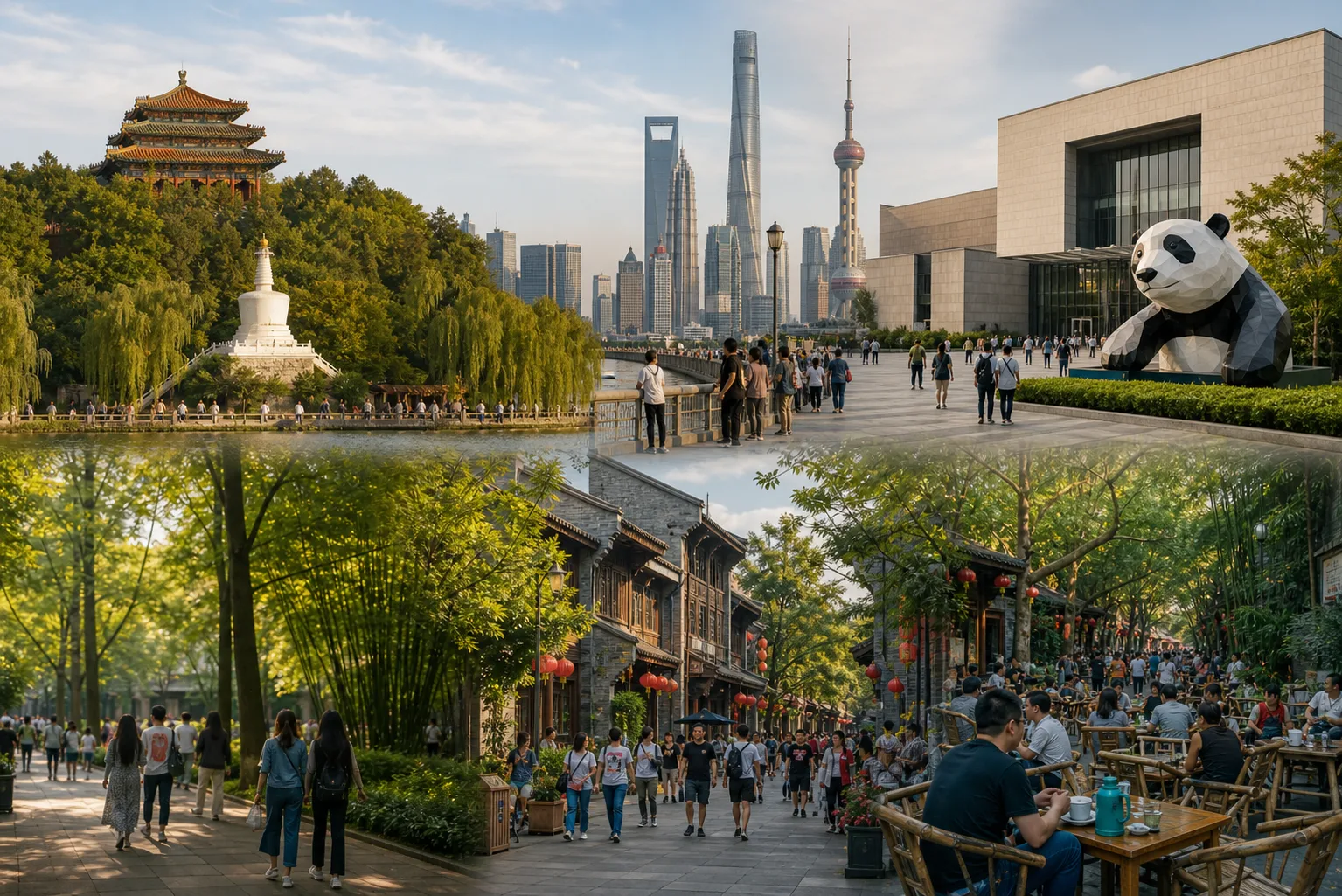
China’s biggest cities can look expensive from the outside. Beijing has imperial landmarks, Shanghai has a polished skyline, and Chengdu has a reputation for food, tea, and easy living that sounds like it comes with a higher daily spend. In practice, all three cities are very manageable on a budget if you build your days around public parks, neighborhood streets, museums with free or low-cost entry, and a few smart paid sights instead of trying to “do everything.”
This guide focuses on the places that give you the most value for the least money. The goal is not to squeeze every yuan out of the trip. It is to help you spend where it matters and save everywhere else. That means choosing destinations that are free to enter, cheap to reach by metro, and rich enough to fill half a day without forcing you into a long line of ticketed attractions.
Introduction
If you are planning Beijing, Shanghai, or Chengdu on a limited budget, the easiest mistake is to copy a luxury-style itinerary from social media. That approach often leads to high entry fees, too many taxi rides, and a long list of “must-see” places that are impressive but not actually necessary for a memorable trip.
The better strategy is to combine one or two paid anchors with a stack of free and low-cost stops. In Beijing, that might mean pairing the Temple of Heaven with a hutong walk and an evening around Shichahai. In Shanghai, you can spend a day between the Bund, People’s Square, a park, and a reservation-based museum without blowing your budget. In Chengdu, the city’s parks, lanes, and tea-house culture do more work than almost any single ticketed attraction.
This article breaks the three cities down in a practical way. First, it shows you which free or cheap attractions are actually worth your time. Then it explains how to group them into simple city plans. Finally, it covers the small details that matter most on the ground: opening hours, reservations, transport, payment, and the common mistakes that quietly raise trip costs.
Beijing: Pair Monumental Parks with Neighborhood Walks
Beijing is the easiest of the three cities to make feel “big” without spending much. That is because so much of the city’s best atmosphere comes from public space rather than from premium tickets. Large parks, temple grounds, lakeside promenades, and old residential lanes all sit close enough together that you can stitch them into a strong day on foot and by metro.
At the center of a budget Beijing plan is the Temple of Heaven park system. The outer park area is itself a major experience, not just a path to the famous halls. People come here for morning exercise, birdwatching, quiet walking, and the scale of the grounds. You can spend a long time just moving between the landscaped paths and reading the architecture from the outside without rushing into a costly “see it and leave” visit. The same logic applies to other green spaces in the city: they are destinations, not fillers.
The second layer is the historic street pattern around the inner city. Hutong walks are not expensive because the value is in the street level: courtyards, local shops, snack counters, small temples, and the contrast between old lanes and modern traffic. A good hutong walk does not need a guide to feel complete. If you pick the right area and keep your route short, you can enjoy one of Beijing’s best experiences for the cost of a drink or a snack.
The third layer is the view. Beijing gives you a lot of visual payoff from parks and hilltops that do not require major spend. Jingshan Park is a classic example because it turns a modest entry fee into a direct view over the Forbidden City roofline and the city center. In a city where many headline attractions are expensive, a low-cost viewpoint that helps you understand the whole urban layout is unusually good value.
If you want a fuller city structure after reading this article, the Ultimate Beijing Travel Guide: Great Wall, Forbidden City & More is the better next step for combining the budget pieces with one or two signature paid sights.
For broader context on how Beijing fits into a full China trip, the China Travel Planning: Visa, WeChat Pay, High-Speed Rail & Practical Guide is useful before you arrive, especially if this is your first visit and you want the logistics to feel predictable rather than improvised.
Best low-cost Beijing ideas
- Temple of Heaven park grounds and surrounding walkways
- Jingshan Park for a low-cost city view
- Ditan Park for a calmer local atmosphere
- Shichahai and nearby hutongs for an easy old-Beijing walking route
- 798 Art District for a free urban-art day with optional cafe spending
These are strong because they solve different traveler needs. Temple of Heaven is about scale and history. Jingshan is about orientation and a skyline view. Ditan is about a more local park experience. Shichahai and hutongs give you the street-level texture that many first-time visitors actually want. 798 adds a modern counterpart so the day does not feel overly historical.
How to think about Beijing value
Beijing becomes cheap when you stop treating every famous place as a mandatory entrance ticket. Many of the city’s most satisfying moments are free or nearly free: watching locals practice tai chi, walking a long shaded route, sitting by the water, or moving through a neighborhood that is still actively lived in. The city rewards patience more than speed.
That matters because budget travel is not only about lower prices. It is also about lower friction. A good Beijing day avoids constant transport hops, avoids unnecessary queueing, and leaves room for spontaneous meals. If you can string together three places that are close to one another, you will usually spend less and enjoy more than if you chase one “big” attraction after another.
For many travelers, the cheapest successful Beijing day looks like this: start in a major park in the morning, walk or metro to a historic neighborhood for lunch, add a second park or viewpoint in the afternoon, and finish with an inexpensive dinner near your hotel or transit line. That structure gives you depth without turning the city into a checklist.
Shanghai: Free Skyline Views, Museum Days, and Classic Neighborhoods
Shanghai is often described as the city where everything costs more, but that is only partly true. The city’s expensive side is obvious because it is so polished. The budget side is less obvious because it is spread across promenades, squares, parks, and public museums. Once you know where to look, Shanghai is one of the easiest places in China to build a stylish day without overspending.
The Bund is the obvious starting point. It is free, iconic, and useful at almost any time of day. You do not need a ticket to enjoy the riverfront, the historic facades, or the contrast between old finance-era buildings and the Pudong skyline across the water. It is one of the few attractions that works for sunrise, daytime, and night, which makes it especially helpful on a budget. You get a lot of visual value for zero entrance cost.
People’s Square is another strong example because it functions as both a transport hub and a sightseeing anchor. From there, you can reach museums, public spaces, and shopping streets without needing a taxi. This is the kind of area that helps budget travelers stay organized. If you sleep near a major metro interchange, you can build a full day around walking and transit rather than private rides.
Shanghai is also one of the best cities in China for low-cost museum time. The important detail is that “free” often means “free with reservation,” not “walk in whenever you want.” That is a good trade-off because it keeps the experience smooth and predictable. A museum day is cheap, climate-controlled, and easy to pair with lunch in the same district. The city’s museum culture gives you a serious indoor option for hot or rainy weather without pushing your budget into premium territory.
The official Shanghai Museum site currently shows free basic access with timed entry rules and branch-specific hours. That is exactly the kind of detail that makes Shanghai useful for budget planning: the attraction is accessible, but you still need to check the reservation flow rather than assuming you can show up casually. The museum model is one reason Shanghai feels expensive on paper but manageable in practice.
If you are trying to keep the whole trip efficient, Shanghai is a place where good logistics matter as much as good attractions. The How to Travel China on a Budget: Cheap Transport, Food & Stays guide pairs well with this city because the savings often come from where you sleep and how you move, not just from which sights you choose.
Best low-cost Shanghai ideas
- The Bund for the city’s most famous free skyline walk
- People’s Square for transit access and easy museum routing
- Fuxing Park for a calm public-space break
- Nanjing Road for a quick urban-energy stroll rather than a shopping binge
- Xintiandi or nearby historic blocks for architecture watching, not expensive dining
- Shanghai Museum when you can secure a reservation
Shanghai works best when you treat it like a walkable sequence rather than a string of separate attractions. The city rewards people who are willing to explore blocks, not just landmarks. A day that moves from riverfront to park to museum to dinner on the metro can feel premium even when the total spend stays low.
Why Shanghai is better than its reputation
Travelers sometimes assume that Shanghai is only for high-end spending. That reputation comes from the hotel and restaurant scene, not from the city itself. Public space in Shanghai is excellent. The city has a strong network of large squares, landscaped parks, pedestrian-friendly riverfronts, and cultural institutions that can absorb an entire day.
That makes Shanghai a good city for travelers who care about pace. If Beijing is about imperial scale and Chengdu is about relaxed atmosphere, Shanghai is about urban comfort. You can move from one low-cost sight to another without feeling like you are constantly “downgrading” the trip. Even a simple route can feel polished because the city itself is polished.
The main money trap in Shanghai is not entrance fees. It is convenience spending. Taxi rides add up. Cafe breaks add up. Impulse shopping adds up. If you keep the core of the day on foot and by metro, the city stops feeling expensive very quickly.
Chengdu: Parks, Alleys, and Slow Travel
Chengdu may be the best city in China for travelers who want a low-cost day that does not feel like a compromise. It is already a city built around lingering rather than racing. That means the things you naturally want to do here are often inexpensive: sit in a park, drink tea, walk a lane, browse a market, or spend time around a square before dinner.
The clearest example is People’s Park. It is free, social, and deeply tied to daily local life. You are not just visiting a park; you are stepping into a public rhythm that many visitors overlook because they are busy chasing one famous attraction after another. For budget travelers, that is ideal. A free public park that still feels culturally specific is one of the highest-value experiences in any city.
Kuanzhai Alley is another useful stop because it gives you a compact, easy-to-understand old-street environment. It is not “free” in the sense that everything inside costs nothing, but it is low-cost to enter and easy to combine with nearby walks. You can decide how much to spend after you arrive. That flexibility matters. A traveler with a tight budget can enjoy the atmosphere without turning the place into a shopping destination.
Chengdu also rewards simple itineraries that lean into food, tea, and neighborhoods. You do not need to overplan the city to make it work. In fact, the city often gets better when the day is lightly structured. A morning in a park, a slow lunch, an afternoon lane walk, and an evening snack route can be more satisfying than a packed sightseeing schedule.
That is why Chengdu often feels “cheap” in a good way. The city’s core pleasures do not demand premium tickets. They demand time. If you are trying to save money while still feeling the city, Chengdu is probably the easiest place in this group to do it.
Best low-cost Chengdu ideas
- People’s Park for public-life atmosphere and tea culture
- Kuanzhai Alley for strolling, snack sampling, and low-pressure browsing
- Tianfu Square for a central urban stop and easy metro access
- Wide sidewalks and neighborhood lanes for unplanned exploration
- Chengdu’s teahouse culture when you want a long, inexpensive pause
The important Chengdu insight is that “doing less” is often the better plan. Many visitors overschedule the city and then spend money compensating for the fatigue. If you leave margin in the day, you can sit longer, eat better, and spend less on transport. That combination is hard to beat.
Why Chengdu feels like a budget win
Some cities make budget travel feel restrictive. Chengdu does the opposite. Because the city’s tempo is slower, low-cost travel feels like the natural version of the trip rather than a compromised one. You do not need to force a low-budget itinerary. The city already supports it.
That does not mean Chengdu has no paid attractions. It means the free or cheap parts are genuinely satisfying. Parks, street scenes, tea tables, and public squares can carry a day in a way that feels complete. If you enjoy atmosphere more than ticking off expensive landmarks, Chengdu can end up being the most cost-effective stop of the three.
Practical Guide
Hours / Admission / Prices
The most useful budget rule in Beijing, Shanghai, and Chengdu is simple: assume that public space is free, assume that major museums may require reservations, and assume that the prettiest or most famous indoor attraction is more likely to have a timing rule than a high ticket price.
In Beijing, park systems such as Temple of Heaven are best treated as hybrid attractions. The grounds themselves are central to the experience, but some interior areas can have separate ticketing or seasonal timing. That is normal in China’s major heritage sites. It is also why you should not build your day around “we will just decide at the gate.” Check the current park and relic-site rules before you go, especially if you are traveling in peak season or on a public holiday.
In Shanghai, the major practical example is the museum model. The Shanghai Museum lists daytime hours by branch and notes that basic displays are free with reservation rules. That makes it a good anchor for a low-cost day because you can plan around a known time window instead of gambling on walk-in entry. If you want an indoor anchor, museums are generally safer than shopping malls because they give you value without forcing purchases.
In Chengdu, free attractions usually stay free, but costs creep in through food, tea, and optional add-ons. A park may be free, but the teahouse table is not. A lane may be open, but a themed exhibit inside may charge. That is not a problem if you expect it. The trick is to keep the “entry” free and decide on-site whether the extra spend is worth it.
For all three cities, admission is only part of the cost. Your real budget is a mix of entry fees, transit, food, and the little extras that happen when a place is crowded or tiring. If you stay close to a metro line and plan around one major paid stop per day, the total spend usually stays very reasonable.
How to get there
Metro is the budget traveler’s best friend in all three cities. Beijing’s network is excellent for central sights and major parks. Shanghai’s metro makes it easy to move between the Bund, People’s Square, museum districts, and riverfront areas. Chengdu’s metro covers the city center well enough that you can avoid unnecessary taxis unless you are going far out.
The other transport rule is to cluster your attractions by district. Do not put a park on one side of the city, a museum on the other, and a late dinner in a third zone unless you really have to. Budget travel gets expensive when every stop becomes a separate vehicle ride.
Think in loops:
- Beijing: park, hutong, viewpoint, dinner
- Shanghai: riverfront, square, museum, park, dinner
- Chengdu: park, alley, tea stop, snack street, evening walk
That style reduces backtracking and makes the city feel less rushed. It also leaves room for weather changes. If a museum has a reservation requirement or a park is too crowded, you can switch the order without wrecking the whole day.
Booking links if applicable
For free attractions, there may be no booking link at all. That is good news, but it does not mean you should ignore planning. In practice, the most important booking tool is whatever system the museum or attraction uses for timed entry. Sometimes that is an official website, sometimes a local app, and sometimes a QR-based reservation flow handled on arrival.
For travelers who prefer to book transport or a bundled city experience in advance, keep the reservation logic simple. Book only the things that genuinely need it. Do not book every movement just because it feels organized. Flexible days are cheaper and often more enjoyable.
As a general China-trip habit, it helps to sort out mobile payment, transit access, and connectivity before the trip becomes busy. If those pieces are already working, free attractions become even easier because you can move, buy snacks, and reserve tickets without standing in extra lines.
The practical takeaway is this: use official or reservation-backed systems when a museum requires them, use metro for city movement, and leave paid add-ons as optional rather than automatic.
Tips & Common Mistakes
The first common mistake is assuming “free” means no planning. In China’s major cities, a free park can still have opening hours, entry screening, peak-time crowding, or separate areas that charge admission. Free is not the same thing as frictionless. Check the basics before you leave your hotel.
The second mistake is overusing taxis because they feel harmless on a short trip. A couple of rides do not ruin a budget. A full week of convenience rides does. In these three cities, the metro often gets you close enough that walking the last ten or fifteen minutes is both cheaper and better for the trip.
The third mistake is building a day around one expensive “headline” stop and then filling the rest with random transport. That usually creates a more exhausting trip, not a better one. A stronger approach is to anchor the day with one major sight, then add free places nearby that extend the same theme.
The fourth mistake is treating each city the same. Beijing rewards historical layering and big outdoor spaces. Shanghai rewards urban polish and efficient routing. Chengdu rewards slowness and long breaks. If you travel all three in the same way, you lose the city-specific value that makes the budget stretch.
The fifth mistake is forgetting that the best budget experiences are often the least Instagrammed. A park bench, a public square, a tea house, a riverfront walk, or a neighborhood lane can be more memorable than a ticketed attraction if you have the time to enjoy it properly.
If you want the highest return on your money, spend on things that solve an actual problem: a rainy-day museum slot, a reservation-only cultural site, or transport that saves several hours. Do not spend just to avoid a little walking. In these cities, walking is often the point.
FAQ
Are free attractions in Beijing, Shanghai, and Chengdu actually worth a full day?
Yes, if you plan them correctly. Free attractions become genuinely valuable when you combine them into a route instead of visiting them one by one. A park, a museum, a street walk, and a low-cost food stop can fill a day very well.
Which city is cheapest overall?
Chengdu often feels cheapest because its natural pace suits low-spend travel. That said, Beijing can also be very affordable if you lean into parks and hutongs, and Shanghai can be surprisingly efficient if you use free riverfront and public-space options instead of convenience spending.
Do I need to book free museums or parks in advance?
Sometimes yes, especially for major museums. Parks are more likely to be walk-in, but museums and certain cultural sites increasingly use timed reservations. Check the official site or booking system before you go.
What is the best city for first-time budget travelers?
Shanghai is often the easiest to navigate because its metro, riverfront, and museum districts are straightforward. Beijing gives you the strongest historical depth. Chengdu is the easiest if your main goal is relaxed, low-cost travel rather than maximum sightseeing density.
How do I keep costs down without making the trip feel too basic?
Choose one paid anchor per day, use free public space for the rest, and group sights by district. Spend money on experiences that add meaning or convenience, not on transportation or random “just because” purchases.
Conclusion
Beijing, Shanghai, and Chengdu all reward budget travelers, but they do it in different ways. Beijing gives you monumental scale and historic atmosphere through parks and old neighborhoods. Shanghai gives you high-quality urban walking, museums, and skyline views without forcing big entry costs. Chengdu gives you the most relaxed low-cost rhythm of the three, where parks, lanes, and tea culture do most of the work.
If you want the simplest possible rule, use this: pay for depth, not for everything. Let free public space do the heavy lifting. Add one or two reservations only when they genuinely improve the day. Keep your route compact, keep your transport simple, and treat each city as a different budget experience rather than a generic checklist.
That approach saves money, but more importantly it gives you a better trip. You see more of the city’s actual life, spend less time managing logistics, and leave room for the kind of small discoveries that make China feel memorable instead of expensive.