Renting a Car in Japan From Singapore: Check the Driving Permit

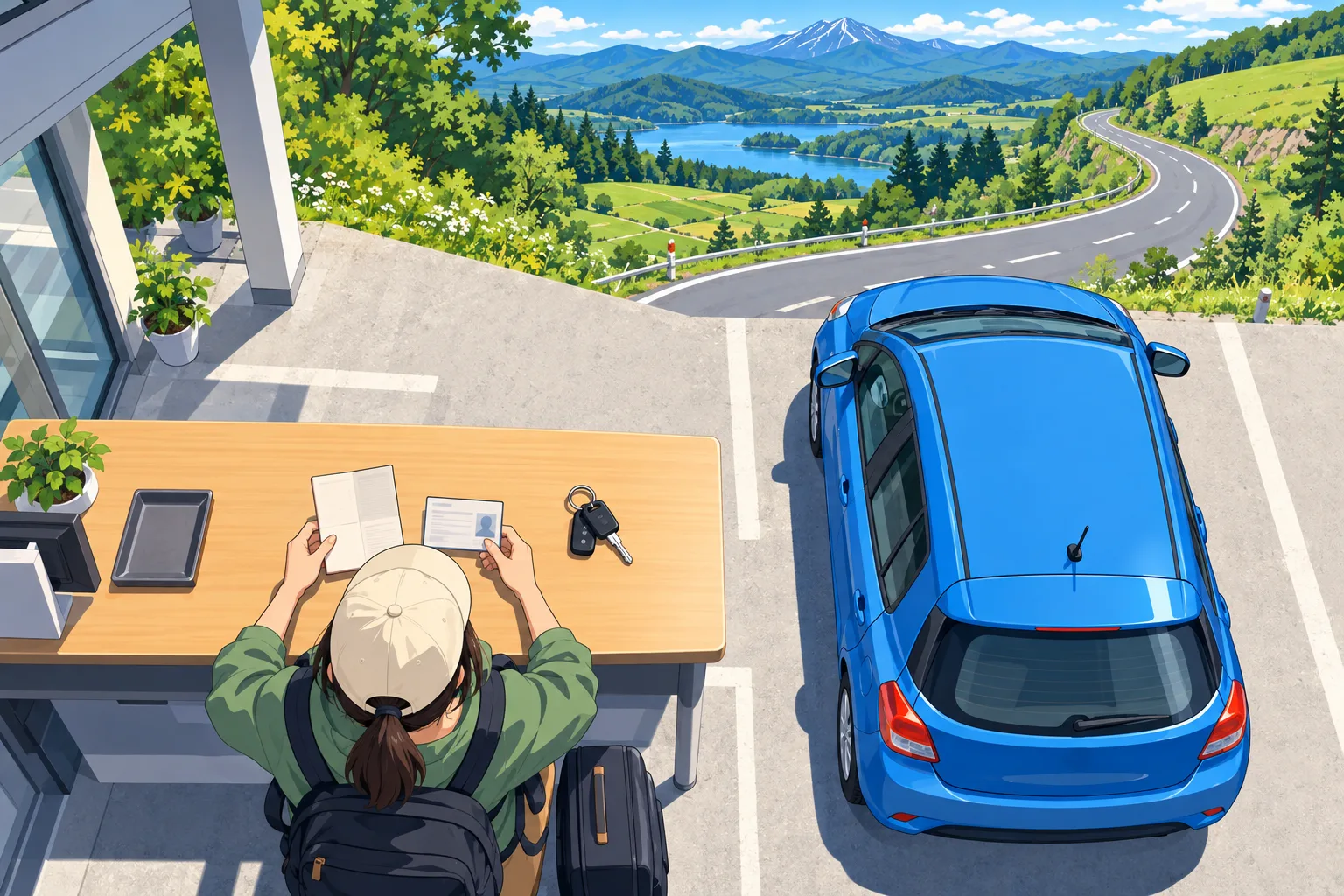
The rental-car page says the vehicle is available, and a rural Japan route looks much easier with your own wheels. Before paying, check a less exciting question: will every planned driver be legally eligible at the counter? A valid Singapore driving licence alone is not the same as the original international permit Japan recognises. A prepaid booking cannot fix a missing or wrong document.
This guide is for a short-stay visitor who holds a Singapore driving licence and is deciding whether to rent a car in Japan. It separates driving-permit eligibility from rental terms and from whether the route actually benefits from a car. It does not cover converting a licence for Japanese residence, transporting a Singapore-registered car, or a permit issued by another country. Rules and rental conditions can change; verify the current official sources and your operator before departure.
Verify the driving permit and original licence requirements
Before reserving, confirm your Singapore licence covers the vehicle class and obtain the original paper 1949 Geneva Convention International Driving Permit from Singapore's authorised issuer. Carry the permit, domestic licence and passport at the rental counter. Check expiry dates for every named driver; an app screenshot is insufficient.
Start with the licence you actually hold
Singapore's Ministry of Foreign Affairs Japan travel page says Singaporeans need an International Driving Permit (IDP) to drive in Japan and warns that rental companies cannot rent a car when the original IDP is missing. Singapore Police states that a holder of a valid Singapore Driving Licence who needs an IDP for overseas driving can apply through the Automobile Association of Singapore and should bring the photocard licence as well. Those statements concern the appropriate Singapore-licence route. A Singapore resident who drives on a licence issued elsewhere must verify that licence's country and Japan's recognition rules; living in Singapore alone does not make an AA Singapore permit the answer.
Check your licence class and validity date before comparing rental prices. If a companion will share driving, repeat the entire document check for that person. A named renter's valid IDP does not transfer driving permission to a second person. The operator may also impose age, driving-history or payment-card conditions beyond legal minimums. Ask for these requirements before prepaying. A traveller with a provisional, expired or mismatched licence should not assume a rental desk will solve the problem on arrival. The simplest decision can be to use rail and local transport if the required paperwork cannot be obtained in time.
The Automobile Association of Singapore's IDP information explains its application route and the 1949 permit it issues. Apply before departing Singapore, allowing time for the original physical booklet to be in your hands. Do not buy an “instant international licence” from an unrelated website and assume it is the recognised permit. Japan's National Police Agency guidance and Japan Automobile Federation guidance distinguish a 1949 Geneva Convention IDP from other treaty formats. A digital image, a card-format product and a 1968 Vienna-style permit are not interchangeable with the recognised original booklet for a Singapore-licence visitor.
Check the clock on both documents
The permit and your Singapore licence need to be valid during the planned driving dates. AA Singapore describes its IDP as valid for one year from issue, while Japanese rules also limit the period a qualifying visitor may drive after entry. JAF explains a maximum one-year period from entry for the 1949 permit route, with additional conditions for residents and repeat entries. Do not add those periods together and assume two years of driving. For an ordinary holiday, verify that neither document expires before return and that the IDP corresponds to the licence and vehicle category. For a longer stay or repeated Japan entries, ask the Japanese licensing authority for your specific case rather than applying a short-visit summary.
The Japan National Tourism Organization's car-rental guidance says the IDP must be issued by the appropriate authority in the driver's country before arrival and that the valid version in Japan is a booklet-type paper permit. It also raises the need to establish the date of arrival when driving on a foreign permit. Automated immigration gates can leave a traveller without an ordinary passport stamp; check the current official arrival procedure and what proof the rental desk or police will accept before using an automated gate if this matters to your trip. Do not assume that an email flight itinerary proves your lawful driving period to every operator.
Keep the original licence, IDP and passport accessible on pickup day and whenever driving as required. Store copies separately as backups for reporting a loss, not as substitutes for the originals. Compare the spelling and document numbers you supplied online with the physical papers. If you replaced your licence after applying for the IDP, ask the issuer and rental company whether the documents still match. Do not alter a booking field to hide a discrepancy. If an IDP is lost after you arrive in Japan, stop the rental plan and ask the issuing organisation and operator about the lawful next step; do not drive on a saved PDF.
Decide before paying, not at the airport counter
Make a small eligibility table for each possible driver: domestic licence issuer and class, domestic licence expiry, original IDP issuer and treaty form, IDP expiry, passport name, arrival-date record, and operator's additional-driver requirements. The table need not contain full licence or passport numbers in a shared chat. Its purpose is to expose a missing permit before a non-refundable booking. If any row is uncertain, contact the official issuing or Japanese authority and the rental operator. A booking confirmation means a vehicle was reserved, not that your documents were approved.
Our Japan travel-planning and logistics guide covers the wider mix of transport decisions. This page handles one narrow gate that must be passed before a self-drive itinerary is real. If the gate fails, choose train, bus, taxi or an organised excursion without treating the car deposit as a reason to drive without proper documents.
Check rental pickup identity and insurance terms
Read the contract as a route document
Once eligibility is clear, compare rental offers with the same pickup time, return time, vehicle class, driver count and protection options. An airport desk may close before your flight lands; a station branch may be easier but close early on the return day. Check the exact branch, not just the company logo. Confirm whether a one-way return is permitted and what charge applies. Ask whether you need a credit card in the lead driver's name and whether a deposit will be held. These are operator terms, not a universal law; get the answer from the company you actually book.
At pickup, show the original documents, listen to the staff explanation, and have every intended driver recorded under the contract. The Japan rental-car association's guidance recommends confirming insurance terms, checking the vehicle's condition together with staff and reporting accidents to the police and rental company. A second driver who was not registered can create a serious contract and coverage problem. Do not hand the keys to a companion because they have driven elsewhere. Ask the company what it needs to authorise another driver before the rental starts.
Photograph the vehicle condition in good light before departure, including wheels, mirrors, windows, roof and existing scratches. Ask staff to mark damage on the inspection form and retain your copy. Check how to operate the lights, fuel or charging system, parking brake and navigation. A right-hand-drive car on Japan's left-side roads may feel familiar to someone from Singapore, but road width, signs, winter conditions and local rules still differ. The National Police Agency's foreign-driver leaflet reminds drivers to keep left and pay attention to local road signs and narrow roads. Leave the lot only when the controls and route are understood.
Separate the types of financial exposure
The rental price is not the total price of driving. Ask for the base rental, mandatory coverage, optional collision damage waiver, excess or deductible, non-operation charge, toll device and toll use, fuel or charging, parking, child seat and any one-way fee. The Japan rental-car association's consumer explanation distinguishes an insurance deductible from a non-operation charge, which can compensate the operator when a vehicle is unavailable after damage or cleaning. Amounts and waiver products vary by company. An add-on called “full cover” should not be treated as proof that every deductible, non-operation charge, tyre, glass or roadside event is included. Read the exact contract and exclusions.
Ask which events require police and rental-company notification, even when nobody appears hurt or a scrape looks minor. The association says failure to contact them after an accident can affect coverage. Follow the operator's instructions and local emergency procedure rather than privately settling an incident at the roadside and hoping the car can simply be returned. If you are unsure how to report a damage event, call the operator before moving on. Keep the contract emergency number offline. Travel insurance, a credit card benefit and a rental-company waiver are different contracts; do not assume one duplicates or replaces another without reading each policy.
Check the fuel rule and return-hour policy. A late return can be charged differently from one extra planned day. A car that must be returned full may require a fuel stop near the branch, and a rural station may close before you arrive. Confirm whether an electronic toll card or ETC device is included, separate and billable later. JNTO's rental-car guidance notes that expressway tolls depend on route and distance. Do not compare only the daily car rate with a rail fare while leaving out tolls and parking.
If a child is travelling, ask the operator about the suitable child restraint before reserving the car. Do not rely on a generic checkbox if you need a particular size or several seats. A vehicle with enough passenger seats may still have too little luggage room once restraints are installed. If mobility needs matter, check entry height, boot loading, accessible parking, and whether the named driver can manage the full route. A car can improve access on one road while making city-centre parking or narrow lanes harder.
Counter example
Suppose two Singapore-licensed adults reserve a car at a Hokkaido airport. One holds the original AA Singapore IDP and valid domestic licence; the other has only a photo of an IDP application. They must not treat the first person's papers as permission for both to drive. At the counter they register the eligible driver, ask the operator whether the second can be added later after lawful documents are obtained, inspect the vehicle and confirm the excess and non-operation terms. If the eligible driver is unwilling to drive the whole route alone, they change the itinerary. The vehicle's availability does not override driver eligibility.
Change one fact: both drivers have the right original documents, but the booking was made through an agency with a cheaper non-refundable rate that excludes a second driver and has a different return branch. The legal gate is now passed, yet the operational booking may still be poor. Compare the final contract and cost of changing branches with a rail alternative before accepting the keys. A small price difference is not worth an impossible return or an unregistered driver.
Decide whether driving beats rail for the route
Identify the trip a car actually improves
Japan's dense urban rail network makes a car unnecessary for many Tokyo, Osaka or Kyoto days. JNTO's transport overview says driving can be more useful outside major cities, especially for groups or places with limited public transport. That is a route-specific proposition, not a rule that every rural holiday needs a car. Map the exact places you want to visit, the train or bus departure times, walking distance from stops, parking location and vehicle return deadline. A car is worth considering when it gives access to several dispersed stops with safe roads and predictable parking, not merely because it appears cheaper than a rail pass.
For a Hokkaido or Okinawa itinerary, list the legs where public transport would force a long wait or omit an important place. JNTO's car-rental page specifically notes that Hokkaido and Okinawa can be more accessible by car. Our Hokkaido seasonal nature guide helps choose outdoor destinations; a rental car may connect them, but only after you verify road conditions and opening seasons. The car does not make a closed trail, storm-affected road or distant viewpoint safe to reach.
Build a full door-to-door comparison. A train itinerary needs fares, station transfers and local bus or taxi costs. A car itinerary needs the rental, tolls, fuel, parking, insurance choices, pickup and return travel, plus the driver's time and fatigue. For one traveller based near a city station, rail may win decisively. For four travellers visiting several spread-out sites in a day, a car may be more efficient even after parking. Make the comparison for your travel dates and actual route; published sample prices age quickly. Do not assume a rail pass covers every local bus or that a rental allows free one-way drop-off.
Check seasonal road issues before committing. Mountain routes can close or become difficult in snow, heavy rain or other adverse weather. A confident Singapore city driver may not be prepared for a narrow icy mountain road. Ask the rental company about tyres, chains, winter driving requirements and route restrictions if your dates warrant them. For a scenic road, identify fuel or charging stops and places to turn back. Never override a closure sign because a navigation app still offers the route. If only one member of the group can drive, budget rest and a shorter day.
Make pickup and return part of the itinerary
The drive is not over when you reach the final attraction. Work backwards from the return branch closing time, fuel stop, toll road, possible congestion, car inspection and onward train or flight. Leave buffer between car return and a non-refundable connection. If a flight is delayed on pickup day, contact the branch promptly rather than expecting it to hold a vehicle after closing. If your arrival is late enough that a counter cannot serve you, spend the first night near transport and start driving the next day. A comfortable plan has no need for a tired traveller to learn unfamiliar controls in the dark after a long flight.
At the other end, inspect the car with staff and keep the final receipt, fuel record and toll statement. Ask when any deposit or later toll charge will settle. If a damage claim appears, compare it with the departure inspection and the contract's process; do not assume an optional waiver answers every dispute. Keep the booking and insurance terms until charges are reconciled. Treat documentation as part of a calm rental transaction, not as evidence that you expect something to go wrong.
A simple yes-or-no test
Before clicking “pay,” answer five questions. Do all drivers have valid original domestic licences and the correct original 1949 Geneva IDPs? Has the actual rental branch confirmed pickup identity and additional-driver terms? Do you understand the deductible, non-operation and return rules? Does the route have enough dispersed stops to justify parking and tolls? Can the driver complete the day comfortably and return the car before the branch closes? If any answer is no or unknown, fix that point first or use rail and local transport. A car is a useful tool for the right Japan route, but it is not a shortcut around documents, contracts or safe driving.