Earthquake in Japan: What Visitors Should Do in the First Hour

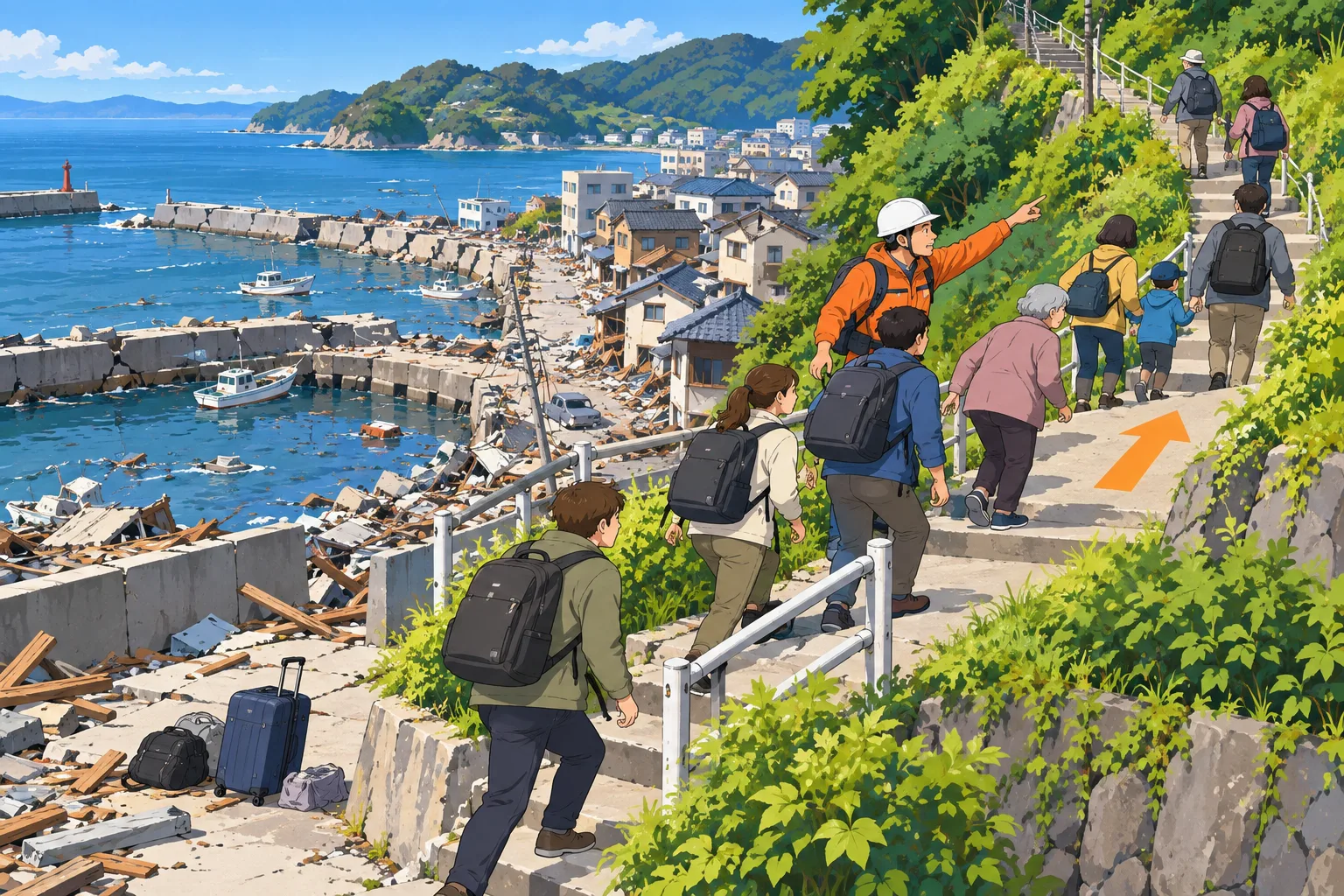
A Japan earthquake alert sounds while you are in a hotel, station or street. The first decision is not whether the day's trains will run. Protect yourself where you are, then check whether the place you are in faces an immediate secondary danger, especially a tsunami at the coast. The first hour is a sequence of safety checks, not a race back to the hotel or airport.
This guide is for a visitor based in Singapore who experiences shaking during a Japan trip. It explains how to respond during shaking, how to read official warnings and staff instructions afterward, and how to decide whether to stay, evacuate or postpone movement. The correct action depends on location and damage. Follow Japan Meteorological Agency (JMA), local authority and onsite staff instructions for the actual event; this article cannot replace a live warning.
Protect yourself during shaking and immediate aftershocks
During shaking, protect your head and shelter without rushing outside. Indoors, use a sturdy table if nearby; outdoors, avoid walls, glass and signs. On public transport, hold a handrail and follow crew instructions. After shaking stops, check for injuries and falling debris before moving.
If you are in a hotel room or other building
The JMA earthquake and tsunami safety guidance says to protect your head and shelter under a table at home, and not to rush outside during shaking. In a hotel, put distance between yourself and large windows, tall furniture and objects that could topple. If a sturdy table is close, shelter there and hold on. If it is not, protect your head and use the safest spot you can reach without crossing a room full of falling objects. Do not run down stairs while the building is moving.
If you have a few seconds of early warning, use them to get away from windows and shelves, not to gather a suitcase. An earthquake early warning can precede strong shaking only briefly, and in some circumstances you may feel the motion first. The action is the same: secure your safety in the place you are. Staff may give local instructions over an announcement system. Listen, but do not cross an unsafe corridor simply because a recorded message tells everyone where an exit is.
After the shaking pauses, put on shoes if glass is on the floor, check for injuries and look for obvious building damage. Ask hotel staff whether the building is being evacuated and which route is safe. A damaged lift is not a good way down; use the directed route and help a companion according to your abilities. If you smell gas, see smoke or notice structural damage, move away and alert staff or emergency responders as appropriate. Do not stop to photograph damage at a doorway that others need to use.
The JMA guidance also shows that an elevator should be stopped at the nearest floor and exited if possible during shaking. If you are trapped, use the lift's emergency communication system and follow rescue instructions. Avoid forcing doors or climbing through a hatch. The reason to pause and assess after a tremor is that aftershocks and secondary hazards can follow; a room that looked normal at first glance may have broken glass or loosened fixtures.
If you are outside
JMA advises awareness of collapsing concrete-block walls, falling signs and broken glass outdoors. Look up and around before moving. Shopfront glass, roof tiles, utility lines and signs may present immediate hazards. Move to a clear space if there is one nearby and the route is safe, rather than standing beneath a façade or stopping in a road. Protect your head with your arms or a bag if debris is falling; do not focus on filming the event.
At a station entrance or busy crossing, the crowd may surge in several directions. Do not follow a stream into a narrow stairwell without checking what it leads to. Station staff may hold people in a safer concourse or direct them outside. Follow their onsite assessment. A blanket rule such as “always leave the building” is not safe; during shaking, rushing outside can take you past falling objects, and after shaking the safe choice depends on damage and local instruction.
If you are near a coastline, harbour, beach or river mouth, the situation changes. Strong or long-lasting shaking there can signal a tsunami danger even before an alert reaches your phone. JMA's guidance says to leave coastal areas and go to higher ground when you feel strong shaking by the sea, feel long slow shaking, or see or hear a tsunami warning. Move inland or upward along the marked route. Do not wait to see a wave. A hotel balcony or a seawall is not a place to watch for it.
If you are on public transport
JMA's visitor guidance tells people on a train or bus to hold a strap or handrail. A train may brake or stop suddenly, while luggage can shift. Remain seated if instructed, keep away from doors and follow staff directions about evacuation. Do not open a train door or step onto a track because the vehicle has stopped. Railway staff may need to check the line and arrange a safe exit. On a platform, move away from the edge and watch for fixtures or signs that can fall.
A train interruption can be frustrating, but it is a separate decision from immediate safety. The fact that a service has stopped does not prove the station building is unsafe; conversely, a resumed departure board does not override an evacuation instruction. Use the operator's official notices only after you and those with you are safe. Our Japan travel logistics guide covers normal rail choices; during an earthquake, station and emergency instructions take priority.
If you use a wheelchair or have a mobility limitation, tell staff what assistance is actually needed. Do not allow strangers to lift you in a way that risks injury merely to clear a platform quickly, unless an immediate danger leaves no safer option. Ask for the accessible evacuation route and the location of a safe waiting area. If communications fail, stay visible to staff rather than trying an unknown staircase alone. A companion should carry essential medication and contact information, not just the tickets.
Check for injuries and a safe waiting point
Once shaking stops, look for immediate injuries in your party. If someone needs urgent medical help, ask staff to call emergency services; in Japan, 119 is the ambulance and fire emergency number. JNTO's emergency guidance identifies visitor support resources, but its visitor hotline is not an ambulance dispatch line. If you cannot communicate easily, show your location on a map or ask onsite staff to call.
Choose a waiting point away from glass, unstable walls and obstructed exits. Account for everyone in your group, including anyone who went to a different floor or shop. Send a short message to a trusted contact once you can do so safely: your location, whether you are injured and your next check-in time. Text may work when voice lines are congested. Avoid repeated calls that drain a low battery while you still need current warning information.
Check official warnings and local instructions before moving
After the first tremor, consult JMA and local authority warnings for your exact location. A tsunami warning is a reason to leave a coastal danger area promptly for higher ground; a normal-looking street does not cancel it. JNTO's visitor information helps translate and locate updates, but its earthquake page has display thresholds. Listen to hotel, station or municipal staff who know the local evacuation route, and keep checking for aftershocks.
Distinguish shaking from tsunami risk
Earthquake intensity describes how strongly the ground shook at a place. Tsunami danger depends on the earthquake and the affected coast; the same alert does not mean every city street is at risk. JMA's warning information explains that tsunami warnings call for immediate evacuation to safer places such as high ground or a designated tall building. If you are in a coastal danger area, act on that warning. Do not debate whether the tremor felt strong enough compared with another earthquake you experienced.
JMA's safety booklet also says to remain alert until tsunami warnings are lifted and not to return to a coastal area while a warning is in effect. Waves can arrive more than once; the first visible change in water level is not a signal of safety. Follow marked evacuation signs and local instructions. If you are staying by the shore, leave your luggage. A passport can be replaced; time spent retrieving it could put you back in a danger zone.
If you are inland, your immediate concern may instead be damaged buildings, fire, debris, landslide risk or broken transport. Do not infer that you must flee to the coast or to a distant airport. Ask where local authorities want people to shelter or evacuate. The correct location may be a hotel assembly point, a designated evacuation area or a safe indoor place. Conditions can differ from one district to another after the same earthquake.
Use a short list of official information sources
Start with JMA for earthquake and tsunami warnings, then check the city or prefecture's instructions and the operator responsible for your building or transport. JNTO's Japan Safe Travel earthquake page tells visitors to protect their head during shaking, follow staff after the tremor and consider aftershocks and secondary disasters before returning to lodging. JNTO notes its public earthquake map displays only events meeting a specified intensity threshold. If you felt shaking but do not see it there, do not conclude that no earthquake occurred; use JMA and local notices.
JNTO's emergency page links to Japan Safe Travel Information, Safety Tips and NHK WORLD-JAPAN. The Japan Tourism Agency supervises Safety Tips, an app that can push earthquake and tsunami alerts and show multilingual information. Prepare one or two channels before travel, but do not spend the first seconds of shaking searching for an app. A nearby staff member's immediate direction and visible hazard may matter sooner than a phone screen.
Check timestamps and geography. A message about a nearby prefecture is not necessarily an instruction for the street where you stand. Conversely, a warning for your coast matters even if a friend elsewhere in Japan reports no problem. Screen captures and social-media forwards can be stale. Use the linked official source when data service works; if it does not, listen to local broadcasts, station announcements or trained staff.
Follow onsite directions with awareness of hazards
Hotel staff may know which staircase is clear. Station staff may know whether a platform is being evacuated. Municipal staff may know the correct tsunami evacuation building. Their instructions can be more specific than a generic national article. If two messages appear to conflict, tell staff your exact location and the alert you saw; ask whether the instruction applies to that part of the building or district. Do not ignore a live evacuation order because a map app suggests a shorter path.
A staff instruction is not a reason to walk into an obvious hazard without asking. If the proposed exit is blocked by debris, smoke or water, point it out and request another route. Stay with your group where possible, but do not delay an urgent coastal evacuation to reunite with someone who can independently reach higher ground. Agree on a check-in point once you are safe. If you are in an unfamiliar city, ask staff to show the route on a map rather than relying on a street name you may not recognise.
The Singapore Embassy in Tokyo's contact page gives channels for Singaporeans needing assistance. Consular staff can help with contact and document problems, but they do not replace Japanese emergency services or local evacuation leaders during the first minutes. Contact them after immediate safety needs are addressed, especially if you are injured, separated from your party or unable to access documents.
Choose a safe next step for accommodation and transport
Once officials say the immediate area is safe, decide whether to stay where you are, move to a designated shelter or return to lodging. Check building condition, coastal warnings, aftershocks and the operating status of the route. Do not leave a safe location merely because a ticket is booked or because a hotel room is paid for. Tell a trusted person where you are, conserve phone power and make travel changes only when official information supports them.
Decide whether the lodging is usable
If you are at the hotel, ask staff whether the building remains open and which rooms or exits are restricted. Do not re-enter a damaged structure to recover belongings without permission. If the hotel evacuates, follow its designated route and ask where guests should regroup. If you were away from the hotel, do not automatically walk back through debris or a coastal warning zone. Call or message the hotel when possible and ask whether access is safe and services are functioning.
An earthquake can disrupt water, power, lifts and communications even when a building stands. Tell staff about mobility needs, medication that requires refrigeration or another urgent requirement. A designated public shelter may be the better immediate option if the hotel cannot operate. Ask local authorities or onsite staff which shelters are open; do not rely on a pre-trip map pin whose building may be closed or already full.
If you need to leave the district, find out why and where you are going. A taxi may not be available, roads may be blocked and trains may need inspections. Do not buy the first expensive ride offered by an unofficial driver solely because a map shows an open highway. Use verified transport information and follow local movement restrictions. Preserve enough battery for warnings, accommodation contact and family messages.
Treat transport as a later decision
Airlines and railways may suspend service while checking infrastructure. An operator's app can tell you whether your booked service is running, but it may not reflect a closure announced minutes ago at the platform. Ask staff, check official operator channels and avoid travelling to an airport or station until the route and destination are safe. A missed sightseeing reservation is a lower priority than avoiding a damaged route.
If a flight is tomorrow, document the disruption and contact the operating airline once communications stabilize. Ask about rebooking policies, but do not assume every weather or earthquake cancellation has the same refund rule. Contact your travel insurer if extra hotel nights or replacement transport may be covered. Save receipts and official notices. Make the financial decision after the physical safety decision; insurance can be dealt with later, while a tsunami evacuation cannot wait.
Our Japan passport-loss guide explains consular documents if identity papers actually disappear. Most visitors after an earthquake still have their passport and should keep it secure, not report it lost because they cannot immediately access a hotel room. If the passport is inside a closed or unsafe building, ask staff about later retrieval and keep a photo or copy for identification where possible.
Keep a compact first-hour sequence
The sequence is simple enough to remember under stress. First, protect your head and shelter during shaking. Second, check for injury and immediate hazards where you stand. Third, if you are near the sea or see a tsunami warning, move to higher ground by the instructed route without waiting to retrieve luggage. Fourth, check JMA and local updates and listen to onsite staff. Fifth, choose a safe place to wait and let one trusted person know your status. Only then rebuild the itinerary.
This sequence is not a clock. The “first hour” can be longer when a warning remains active, or shorter when local staff direct an immediate evacuation. It also changes with place: a train passenger follows crew instructions, a hotel guest follows the building's safe route, and a coastal visitor may need to move uphill at once. The common principle is to respond to live hazards and official instructions, not to a fixed schedule from a travel blog.
Before a future trip, save the JMA and JNTO links offline, note your hotel's evacuation route at check-in, and agree on a family check-in method. You do not need to predict an earthquake to prepare. In the actual event, stay calm enough to do the next safe thing and update the plan when reliable information changes.
Official sources checked
- JMA: Earthquake and Tsunami Safety Guidance — immediate protection, transport and tsunami safety.
- JMA: Emergency Warning System — warning significance and action.
- JNTO: Earthquakes — visitor response and public map limits.
- JNTO: Staying Safe in Japan — visitor information and support channels.
These official sources were checked on 5 October 2026. During an incident, follow the current JMA warning and local instructions for the exact place you are in.