Guilin Karst Landscape: Best Spots for Misty River and Rice Terrace Shots

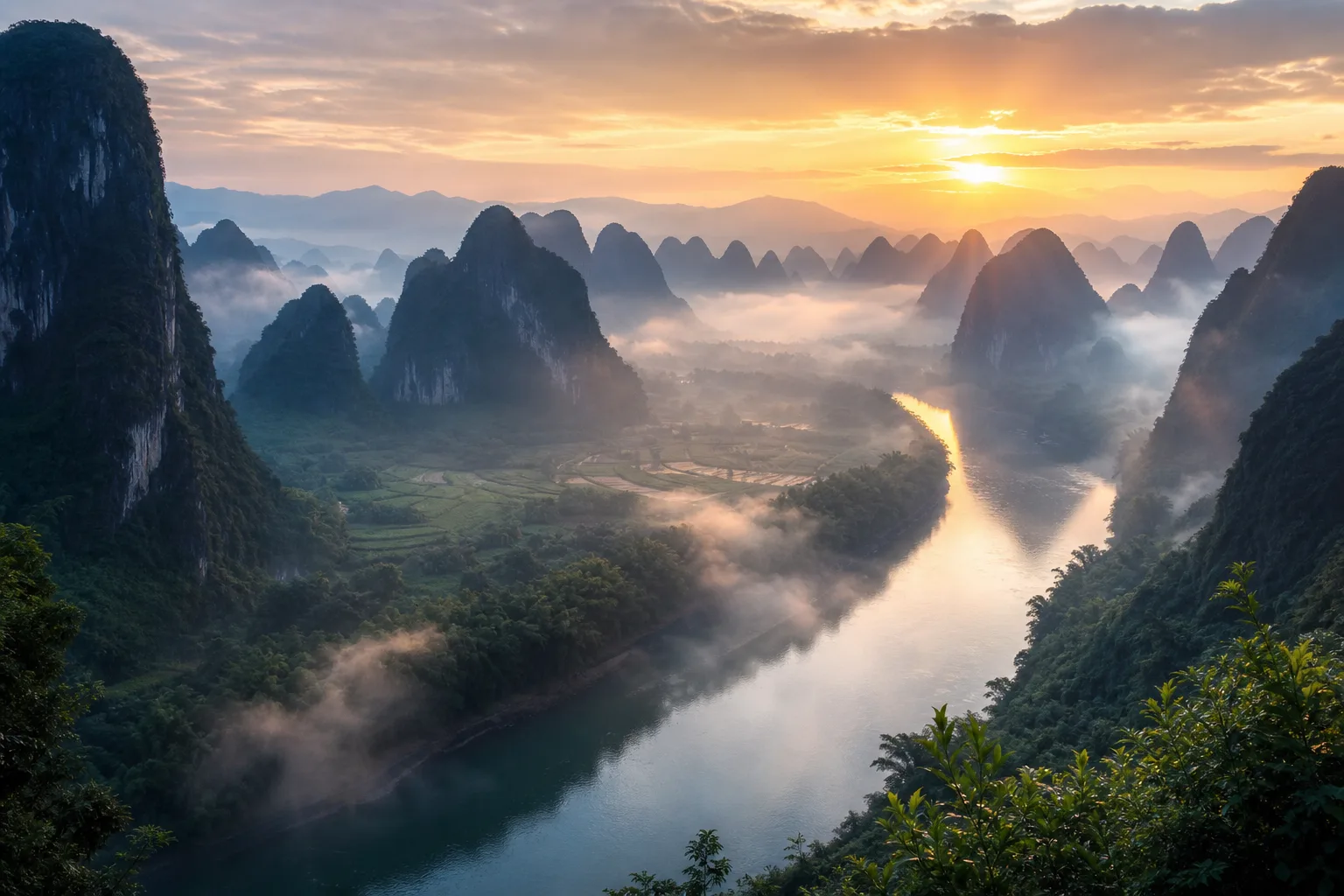
Guilin is one of those places that can look ordinary for five minutes and then turn cinematic the moment the light shifts. The karst peaks are already dramatic, but mist, wet stone, and layered terraces are what give the landscape depth. This guide focuses on the places and timing that actually help you get those images.
Why Guilin Works So Well For Misty River And Terrace Shots
Guilin works because the scenery is built in layers. Narrow river corridors, steep limestone towers, and stepped rice fields all create foreground, middle ground, and distance in a single frame. If you want mist, plan around dawn, rain, and shoulder-season humidity rather than hoping for a fixed viewpoint to do the work for you.
The karst shapes the frame
The Guilin area is famous because the mountains are not broad, rounded ranges. They are steep karst towers that rise abruptly from water, fields, and village edges. That makes composition easier than in many other mountain regions. You do not need to search for a dramatic summit. The drama is already at eye level, and the landscape naturally stacks itself into layers.
The Li River is the classic example. Its bends, reed banks, and cliff faces create leading lines that feel almost designed for landscape photography, even though the scene is entirely natural. When the weather is humid, the towers fade into the background in soft bands. That atmospheric perspective is what turns a good photograph into a memorable one.
The rice terraces add a second visual language. Instead of vertical drama, they give you curves, repetition, and tiny changes in tone. From a distance, they read as ripples or contour lines. Up close, they give you reflections, irrigation channels, farmers at work, and narrow paths that help break up the frame. Together, the river and the terraces show two sides of the same karst region.
Mist is part of the subject, not a bonus
Many travelers treat mist as a lucky accident. In Guilin, it is better to treat it like a scheduled element of the shoot. Warm, wet air after rain, sunrise over the valley, and cooler mountain shadows all help produce the gauzy look people expect from the region. If you arrive in clear midday sun and expect the same effect, the landscape can still be beautiful, but it will look harder and flatter.
That is why the best photography trips here are flexible. You want a base in Guilin or Yangshuo, a weather forecast that is not locked into a strict timetable, and enough time to return to a site when the conditions change. A single morning can produce completely different results depending on whether the fog stays low, lifts early, or rolls back in after sunrise.
If you are planning a broader China landscape itinerary, it helps to compare Guilin with other photo regions so you know what mood you want from each stop. For that, see Best Photography Spots in China: Ancient Towns to Modern Skylines.
Best Spots For Misty River And Rice Terrace Shots
The most reliable Guilin images come from places where the landscape gives you clear foregrounds, layered distance, and a reason to wait for better light. For river scenes, the Li River corridor between Guilin, Xingping, and Yangshuo is the classic stretch. For terrace scenes, Longji is still the most efficient choice because it concentrates several viewing angles into one mountain system.
Xingping for the classic karst-river composition
If you want the image most people picture when they think of Guilin, Xingping is the place to start. It is the section associated with the famous river scenery on the 20 yuan note, and it remains one of the best places to combine water, karst towers, and morning haze in one frame. The appeal is simple: the river bends, the peaks overlap, and the riverbank activity adds scale.
What makes Xingping especially useful for photography is the range of angles. From the town side, you can work with boat traffic, reflections, and layers of peaks disappearing into the mist. From a higher viewpoint, you can compress the river bend and stack the towers into a dense pattern. From the water itself, you get quieter foregrounds and a slower sense of movement that suits long exposures or very deliberate framing.
The biggest mistake here is rushing through on a day trip and assuming the famous viewpoint is enough. Xingping rewards patience. The most interesting light often appears before the tour boats fully spread out, or after a brief weather shift when the mist is thin rather than opaque. If you are shooting on foot, arrive early enough to scout both the riverfront and any elevated paths before the day gets busy.
Yangdi and the quieter Li River corridor
Yangdi is useful if you want the Li River without the most obvious postcard repetition. The scenery is still unmistakably Guilin, but the mood is calmer and more spacious. That makes it a good place for wider compositions, isolated fishermen, and frames where the river itself becomes more important than the famous skyline of karst peaks.
This stretch is ideal when the weather is moody. A low ceiling of cloud can flatten the mountain tops in a bad way, but in Guilin it often works because the river channel becomes the main visual line and the peaks emerge and disappear like shapes in a watercolor. If you like a less polished, more atmospheric result, Yangdi is worth a stop before you commit to the busier river sections.
The practical advantage is also important: Yangdi gives you a different pace. If you are moving between Guilin city and Yangshuo, the corridor helps you see how the landscape evolves rather than treating the river as a single attraction. That perspective matters if you want your final images to tell a journey instead of simply repeating the same profile from multiple viewpoints.
Huangbu and the open bend views
Open bends along the Li River are useful because they let the water act as a compositional guide rather than just a reflective surface. The wider sections near Huangbu are especially good when the river is calm and the weather leaves a thin layer of mist over the peaks. In those conditions, you can separate each ridge more cleanly and build a scene with clear depth.
This is a strong stop for photographers who prefer broader compositions. Instead of focusing on a single peak, you can show how several towers rise from the same river basin. That makes the image feel more geographic and less like a single postcard moment. It is also a useful place to experiment with different focal lengths. A wider lens gives you context and shoreline texture, while a longer lens isolates the layered silhouettes.
If you are shooting after rainfall, watch the edges of the river for subtle tonal differences. Wet stones, darker reeds, and small fishing platforms often create the foreground structure that prevents the frame from feeling too empty. The landscape is already beautiful. Your job is to avoid making it feel too smooth.
Yulong River for reflection, movement, and close atmosphere
Although the Li River gets the fame, the Yulong River around Yangshuo is often better for quiet, intimate photography. It is less about grand scale and more about rhythm: bamboo rafts, small bridges, water plants, and soft reflections. When the weather is humid, the river can feel almost enclosed by vegetation and low mist, which gives you a more personal, grounded mood than the larger Li River scenes.
The Yulong River is especially useful when the main Li River viewpoints are crowded or the weather has not delivered the sweeping visibility you hoped for. Instead of forcing a grand panorama, you can focus on detail and movement. A raft crossing the frame, a farmer walking the edge of the bank, or mist hanging in the early reeds can carry the photo without needing a huge mountain backdrop.
The key is to respect scale. The Yulong River works best when you do not overcomplicate it. Keep one strong subject, give the water room to breathe, and let the karst peaks sit as a secondary layer. That restraint usually produces a stronger image than trying to make every frame look like the famous Li River panorama.
Longji for the terrace patterns
Longji is the most obvious answer for rice terraces, but it is still the right answer. The area is about 100 km from Guilin and has been shaped by centuries of farming, which means the scene is both practical and visually rich. The terraces are not a single overlook. They are a whole mountain system, so the reward comes from moving between viewpoints and matching the light to the season.
The terraces work in different ways throughout the year. When the paddies are flooded, they act like mirrors and can turn the mountain into a grid of sky reflections. When the rice is young, the fields become bands of bright green. In harvest season, the slopes shift to gold and ochre. In winter, mist and frost can simplify everything into texture and contour.
Longji is also ideal because it lets you photograph both wide scenes and human-scale moments. You can frame a whole valley, then turn around and capture a farmer on a path, a village roofline, or a terrace edge with water trickling through it. Those smaller details matter because they give the larger scenery credibility.
Ping'an for structure and symmetry
Ping'an is one of the best places to start if you want terraces that are easy to read in a photograph. The shapes are clean, the trails are manageable, and the viewpoints are arranged in a way that helps you build a sequence rather than gamble on a single angle. It is the better option if you want a controlled composition and do not want to spend all day hiking between distant viewpoints.
The best moments at Ping'an usually come when the weather is unstable but not severe. A little cloud cover can soften the shadows and make the terrace contours more visible. Too much sun can create harsh contrast, while too much fog can flatten the slope. The sweet spot is when the valley still holds some moisture and the hillside remains readable.
If you are shooting during the flooded or transplanting season, look for repeating curves that lead the eye upward. That is what makes Ping'an so strong. The terraces do not just sit in the landscape. They point through it. You can use that to create an almost calligraphic image, especially if you keep the frame simple and let the slope dominate.
Dazhai and Jinkeng for scale and drama
Dazhai, in the Jinkeng terrace area, usually delivers the more expansive version of Longji. The slopes are larger, the viewing points feel higher, and the landscape often reads as a broader system rather than a neat terrace pattern. If Ping'an is about clarity, Dazhai is about scale.
This is where early morning can be especially rewarding. The terraces may sit below a band of cloud while the upper ridges brighten first, creating layers of shadow and light across the hill. That contrast gives the image more drama and helps separate the terraces from one another. It also makes the area more suitable for panoramic work, because the composition benefits from breadth rather than tight framing.
The downside is that Dazhai can feel more demanding if you are short on time or not prepared for the walking involved. The reward is a stronger sense of immersion. You are not merely looking at the terraces; you are moving through a lived-in mountain landscape where the paths, village structures, and fields all matter to the shot.
The real photography strategy: combine weather, season, and elevation
The best Guilin landscape photos usually come from combining the right season with the right elevation and the right weather. Flooded terraces at dawn can be more valuable than a famous viewpoint in bright afternoon sun. A lightly misted river bend can outperform a postcard-clear river because the mood feels more layered and more personal.
If your trip is short, prioritize one river base and one terrace base rather than trying to cover every famous spot. A logical pairing is Xingping or Yangshuo for the river, then Longji for the terraces. That gives you two very different but complementary expressions of the same karst region. For a broader sense of how Guilin fits into the country’s landscape circuit, you can also read China's Natural Wonders: Zhangjiajie, Li River & UNESCO Nature Sites.
Practical Guide
This is where planning matters more than inspiration. Guilin’s best photo spots are still travel sites, and travel sites reward timing, transport choices, and a realistic approach to tickets and weather. If you want the images rather than just the check-in, treat the region like a short field assignment, not a casual sightseeing stop.
Hours, admission, and prices
For the Li River and Longji, do not assume a single universal ticket model. Some parts of the experience are viewpoint-based, some are scenic-area tickets, and some are packaged as transport plus admission. Boat departures, shuttle buses, and access controls can change by season and operator, so the most reliable rule in 2026 is to check the exact route you want before the day of travel.
In practical terms, the river viewpoints are usable from early morning to dusk, but the photos you want usually happen near sunrise or in the hour after sunrise. The terraces are also best at daybreak and late afternoon. If you are buying a cruise or scenic-area entry, think in terms of time windows rather than open-ended access. The best sessions are often tied to the first departure, the first shuttle, or the quiet period after the day-trippers leave.
Admission at Longji is typically bundled at the scenic-area level rather than paid one terrace by one terrace, and there may still be separate shuttle or transfer costs once you arrive. River cruising is more operator-specific, with price differences based on route length, meal inclusion, seating class, and whether you are booking a public departure or a private arrangement. If a site or agent quotes a price that seems unusually low, check what is actually included.
For current logistics, try to book with a reputable platform or your hotel the day before you go, especially in holiday periods and summer weekends. That is the easiest way to avoid landing at a ticket desk only to discover that the slot you wanted is gone. If you prefer a bundled booking flow, compare the scenic operator with Klook and choose the option that fits your timing and cancellation comfort.
If you are also handling transport, tickets, and payment setup for the broader trip, it helps to review China Travel Planning: Visa, WeChat Pay, High-Speed Rail & Practical Guide before you lock in your itinerary. Guilin is not difficult, but it is easier when your payments, transfers, and intercity connections are already sorted.
How to get there
Most first-time visitors will reach the Guilin area by air or high-speed rail, then split the trip between Guilin city, Yangshuo, and Longsheng. That is the simplest way to think about the region because each base serves a different kind of shoot.
Guilin city is the best base if you want flexibility, a wider range of hotels, and easier access to the Li River departure points. Yangshuo is the better base if you want to wake up closer to the river scenery and spend more time around Yulong River and Xingping. Longsheng is more remote and best used as a one- or two-night photo stop if you want dawn and sunset at the terraces without long daily transfers.
For the river, the best access is often by arranged transfer to a specific bank, ferry point, or cruise departure rather than by random walk-in logistics. For the terraces, private transfer or a small group day trip usually saves enough time to matter. Public bus options exist, but they are slower and less predictable when your main goal is to catch a sunrise or a short weather window.
If you are planning a dedicated photo route, the cleanest sequence is often Guilin city first, then Xingping or Yangshuo, then Longji. That gives you urban orientation, river scenery, and terrace shooting in a logical order without forcing you to backtrack too much. If you only have two full days, choose either river focus or terrace focus instead of splitting your time so thinly that both locations feel rushed.
Booking and timing strategy
Book the must-have transport first, not the “maybe” activities. In practical terms, that means confirming your long-distance train or flight, then the transfer that gets you to the river or terraces, and only then choosing optional add-ons. If you build the schedule backward from the most important sunrise or cruise departure, the whole trip becomes easier.
For photography, the most useful booking pattern is simple. Reserve the night before the shoot if possible, stay close enough to the site that you can leave very early, and avoid stacking too many stops into the same day. A sunrise at Longji followed by an afternoon Li River cruise sounds efficient on paper, but in real conditions it often turns into a rushed and foggy day with no time to reset your gear or rest.
Weather apps are helpful but not decisive. In Guilin, microclimates matter. A forecast can say overcast while one valley clears at dawn and another stays foggy until late morning. That is why flexible bookings matter. If you have only one non-refundable time slot, you are betting against the landscape itself.
What to bring
Bring a lens range that lets you work both wide and tight. A wide or standard zoom helps with terraces and broad river scenes, while a telephoto is useful for separating peaks or compressing layers of mist. A lightweight tripod can be valuable for dawn, but only if you are actually comfortable carrying it up slopes and setting it up quickly.
Weather protection matters more than extra accessories. A rain cover for the camera, a microfiber cloth, and shoes with grip will matter more than a flashy specialty filter if the path is damp. A small headlamp can also help at sunrise or on terrace trails before dawn. If you are moving through villages, keep your kit compact so you can step aside quickly and avoid blocking paths.
Most importantly, bring patience. Guilin is not a place where every angle is instantly ideal. The light often improves after you have already reached the viewpoint. That is normal. The landscape rewards people who wait, reframe, and keep enough energy in reserve to shoot again when the weather changes.
Tips & Common Mistakes
The biggest mistake in Guilin is assuming that the scenery will do all the work. It is beautiful, but the quality of your photos still depends on timing, placement, and what you leave out of the frame. The second biggest mistake is overpacking your itinerary and arriving at the best light already tired.
Shoot the shoulder hours, not the middle of the day
The simplest rule is also the most ignored. If you want mist, dawn is more reliable than noon. If you want richer reflections, the hour after rain often beats a clear blue sky. If you want terrace texture, side light in the early morning or late afternoon is more useful than overhead sun. Guilin is a landscape where the edge of the day matters much more than the center.
Do not chase every famous spot in one trip
Many first-time visitors try to photograph Guilin, Yangshuo, and Longji in a compressed schedule and end up seeing all of them in the weakest possible conditions. It is better to commit to one mood. If your goal is misty river scenes, focus on the river corridor and keep Longji as a second trip or a separate morning if the logistics allow it. If your goal is terraces, spend enough time at one viewpoint to understand how the light moves across it.
Use weather to choose your subject
If the weather is clear, the terraces may give you cleaner geometry and more color separation. If the weather is humid or rainy, the river may become the stronger subject because the mist can soften the hard lines of the karst. If the morning is uncertain, build your plan around flexibility rather than trying to force a single shot. In Guilin, the weather often tells you which landscape should win.
Respect the local landscape and the people working in it
The terraces are not a film set. They are working agricultural land, and the riverbanks are part of everyday life for local communities. Stay on marked paths, avoid stepping into planted or flooded fields, and be careful about where you set up a tripod. If a path is narrow, wait your turn and keep your gear compact. You will get better photos when you are not fighting the environment.
Common compositional errors
The first is making the frame too busy. Guilin already has enough layers. You do not need to include every peak, every raft, and every tree in one image. The second is shooting too wide without a clear foreground. A good foreground log, bank, path, or terrace edge helps the eye enter the picture. The third is forgetting scale. A human figure, raft, or roofline can make the landscape feel real rather than abstract.
Treat Longji as a light study, not just a viewpoint stop
People often arrive at Longji, walk to one famous viewing platform, and leave. That is enough to say you saw it, but not enough to photograph it well. The terraces change appearance as the sun moves and as the mist lifts. If you have time, return to the same spot once or twice during the day. The slope may look completely different in morning haze, midday texture, and late-afternoon warmth.
FAQ
When is the best time of year to photograph Guilin?
Spring and early summer are usually best if you want mist, bright greens, and flooded terraces. Autumn is excellent if you want golden rice fields and warmer tones. Winter can also be strong if you want cleaner silhouettes and more dramatic fog, but the look is moodier and less colorful.
Where should I stay if I want the best shots?
Stay in Guilin city if you want transport flexibility and a wider hotel choice. Stay in Yangshuo if you want earlier access to the Li River corridor and easier sunrise logistics. Stay near Longji if terraces are your main goal and you want to be on site before dawn without a long transfer.
Is the Li River cruise enough, or do I need extra viewpoints?
The cruise is a strong overview, but it is usually not enough on its own if you are serious about photography. The best images often come from combining the cruise with one or two land viewpoints, because that lets you control angle, timing, and foreground more precisely.
Do I need a tour guide?
Not always, but a guide or local driver can save time if you are trying to hit a sunrise slot or multiple sites in one day. If you are comfortable with your own transport planning and can tolerate some uncertainty, you can do parts of the route independently. For the terrace area, local logistics are easier when someone else handles the transfers.
What if I only have one day?
Choose one theme. For river mood, focus on Xingping or a short Li River corridor day. For terraces, go directly to Longji and spend the day moving between viewpoints. Trying to do both in one day usually gives you more transit than photography.
Conclusion
Guilin is best when you stop treating it like a checklist and start treating it like a light-and-weather project. The Li River gives you the mist, curves, and karst towers that define the region. Longji gives you the repeating structure and seasonal color of the rice terraces. Together, they show why Guilin remains one of China’s most rewarding landscape destinations.
If you want the strongest images, keep the trip simple. Pick one river base, one terrace base, and enough time to wait for the weather to change. Shoot early, book flexibly, and do not expect the famous view to be best at the moment everyone else arrives. Guilin rewards travelers who plan for atmosphere, not just location.
If you are still building the trip itself, keep the transport and payment basics in order first, then let the landscape do the rest.