China High-Speed Train Luggage: Measure Your Suitcase Before Leaving Singapore

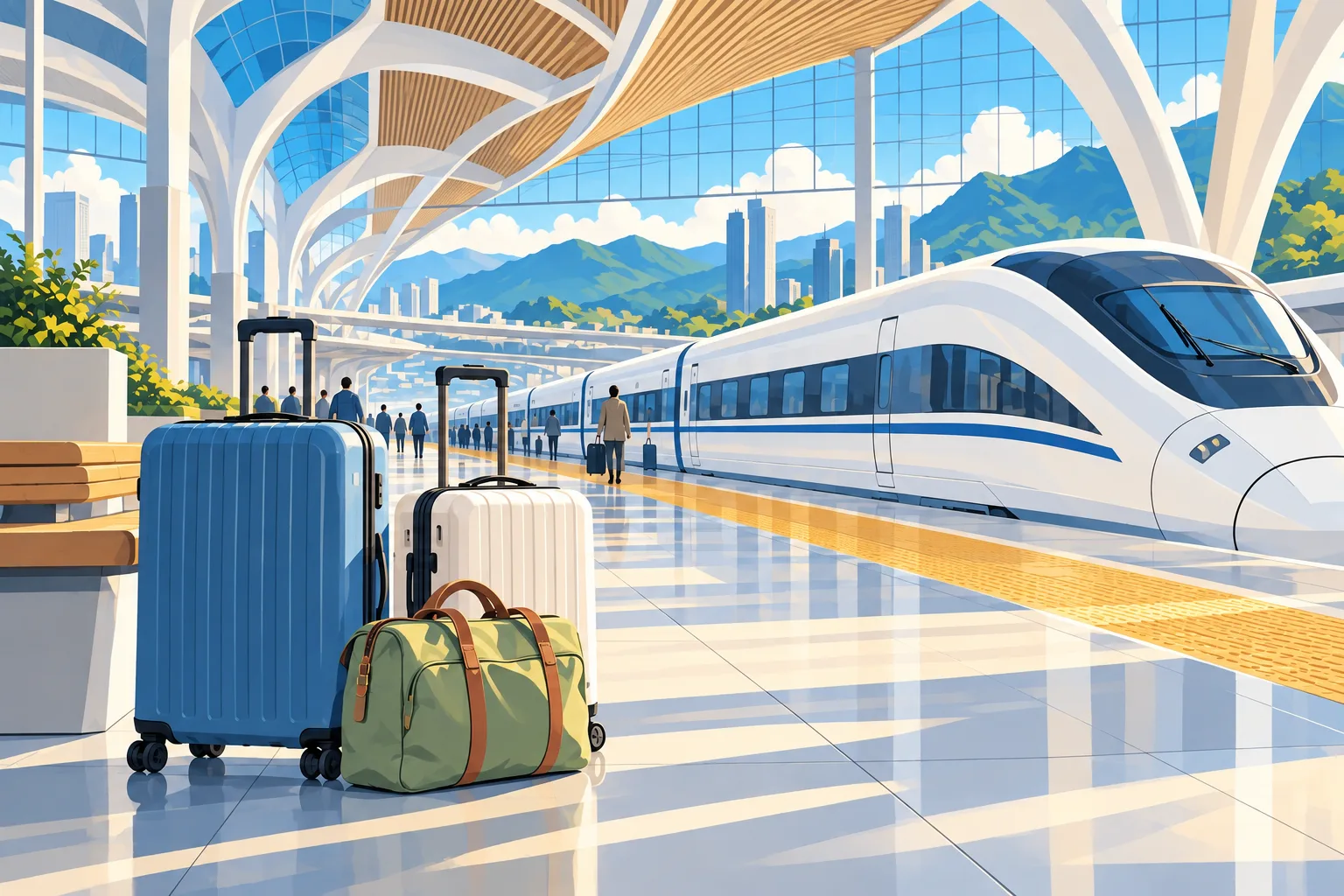
The suitcase that works for your flight from Singapore may be the wrong suitcase for your next train. Check its actual measurements before building a China itinerary around several railway transfers, especially if Hong Kong West Kowloon is part of the route.
Check two limits before choosing a suitcase
For China high-speed trains, check both baggage weight and size: the usual adult free allowance is 20 kg, while each item on an EMU train must total no more than 130 cm in length, width and height. Measure your packed case and weigh your bags together before departure.
Those checks answer different questions. A case can be light but too large. Several small bags can fit individually yet leave you carrying too much altogether. Buying a smaller case solves only the first problem; packing fewer items solves the second.
China Railway's English FAQ lists a 10 kg allowance for children, including children travelling free, and a maximum weight of 20 kg for an individual item. This guide focuses on ordinary holiday luggage rather than the separate diplomatic allowance.
The higher dimension figures you may see in general railway advice concern conventional trains. Do not use those figures to justify a large case on an EMU journey. When looking at your itinerary, check the service you have booked rather than assuming every train has the same conditions.
For ticketing and station selection, use our China high-speed rail booking guide. Here the decision is narrower: whether the bags you intend to carry make that journey workable.
A short pre-purchase test
Before buying luggage, ask the seller for the external dimensions of the exact model. Compare those with the dimensions after expansion, if the case expands. Ask about the empty weight too: a heavy shell uses part of your budget before you add anything for the trip.
A retailer's description such as cabin, medium or large is a shopping category. It is not evidence of rail compliance. The same applies to an inch label. Your useful number is the sum of the actual three dimensions, supported by measurements of the case you will take.
Avoid choosing a case exactly at a limit if your packing plan depends on squeezing another jacket or several souvenirs into it. A little physical and weight headroom gives you room to change the contents without rebuilding the luggage plan midway through the holiday.
Measure the case you actually packed
The 12306 carry-on FAQ in Chinese specifies external dimensions. For your own check, use the furthest points of the packed case, including protruding wheels and fixed handles, with the telescopic handle retracted. This conservative method avoids measuring only the usable box inside the shell.
Stand the case upright and use a tape measure. Record height, width and depth separately; then add them. Repeat after fastening the zip and attaching anything you intend to carry on the outside. For a soft bag, measure its filled shape rather than the dimensions of an empty, flattened bag.
The following examples are arithmetic illustrations, not approved suitcase models:
| Packed external measurements | Sum | Planning result |
|---|---|---|
| 55 × 35 × 25 cm | 115 cm | Below the dimension ceiling |
| 65 × 40 × 25 cm | 130 cm | At the ceiling, with no expansion margin |
| 70 × 45 × 30 cm | 145 cm | Above the dimension ceiling |
The second example shows why expansion matters. If its depth rises from 25 cm to 29 cm, the sum becomes 134 cm. The luggage label has not changed, but your packed case has.
Photograph your measurements or put the three numbers in a phone note. This is mainly useful for your own repacking decisions. A photograph does not oblige railway staff to accept a bag, and it should not become the basis of an argument at a gate.
Accessories can change the problem
A jacket draped over the case, a shopping bag balanced on its handle and an attached shoe pouch may make it harder to judge what you are actually carrying. Put loose items into their intended travel bags for the final check. If you plan to bring a folded tote for purchases, include the purchases in your return-day weight calculation.
A backpack that looks compact when lightly filled can become deep and awkward once you add a laptop, snacks and a camera. Check it as an actual item of luggage. Choosing soft luggage gives you flexibility, but it does not create an exemption from the published dimension rule.
Build a bag budget for the whole journey
Treat the adult allowance as a budget for everything you carry in ordinary luggage, rather than assigning the full amount to the suitcase and forgetting the backpack. The simplest home check is to weigh each packed bag separately and add the results.
For example, imagine your suitcase weighs 14 kg, your backpack weighs 3 kg and a separate shopping tote weighs 2 kg. Your planning total is 19 kg. Adding another 2 kg of gifts takes it to 21 kg even though none of the bags looks unusually heavy. These are illustrative numbers, not recommended packing targets.
Weigh after adding the things you tend to remember last: charging equipment, toiletries, a spare pair of shoes and whatever you carry for the train itself. A scale reading from the previous evening is useful only if the contents are still the same.
Do the calculation for your heaviest train day. A traveller arriving in Shanghai with little luggage may leave Beijing with several purchases. A plan that passes only on departure from Singapore is incomplete if the final railway leg comes after your shopping days.
Start with the itinerary, then pack
Lay out the number of hotel changes, the expected weather and the opportunities to wash clothes. This helps decide what earns its place in the case. A single-city stay can accommodate a different packing strategy from a route with several trains and short overnight stops.
For clothes, create complete outfits rather than a pile of possible choices. Decide which shoes you will actually use. If a second bulky coat exists only for one uncertain activity, reconsider that activity or how you will dress for it before committing the space.
For shared equipment, agree who carries each item. Two people do not necessarily need two large sets of cables, two full toiletry kits and duplicate travel accessories. Keep personal necessities accessible, while checking that the designated carrier can manage the resulting bag independently.
This is a practical packing method, not a claim that allowances can be pooled freely between passengers. Check each person's situation. Avoid building the plan around shifting everything into a companion's bag at the last moment.
Children and mobility equipment
The children's allowance deserves its own calculation. Do not assume an adult-sized suitcase becomes permissible because a child has a ticket. Parents also need enough free hands to supervise children while carrying the family's actual bags.
The current Chinese FAQ describes exemptions for qualifying folding wheelchairs used by travellers who need mobility assistance and folding strollers used by accompanying infants. These are specific provisions, rather than an exemption for every piece of family equipment. Ask the operator about an unusual device before making it essential to the journey.
Our China rail guide for families covers the wider station and seating decisions. Use it alongside the bag calculation, particularly when a child cannot carry their own luggage through the full transfer.
Treat Hong Kong West Kowloon as a separate baggage check
A mainland-only rail leg and a journey through Hong Kong West Kowloon need separate checks, even when their basic size and weight figures look alike. MTR's baggage regulations confirm the 130 cm limit per item and adult and child weight allowances. They also state that high-speed rail does not provide baggage consignment.
That last point changes your fallback plan. Do not arrive at West Kowloon expecting to hand over an oversized suitcase as airline-style checked luggage. Arrange a compliant packing plan or a suitable alternative before the travel day.
MTR also points travellers to exit and entry restrictions. Passing a railway dimension check does not establish that food, alcohol or another purchase is permitted across the boundary. Check the relevant customs requirements for the direction you are travelling and the particular goods you carry.
Consider a Singapore–Hong Kong–Guangzhou trip. Your flight, any local Hong Kong transport, the cross-boundary train and a later mainland train are separate stages. One stage's acceptance of your bag does not settle the next stage's rules. Check the whole chain before deciding what to bring from home.
An excess charge is not a reservation for extra luggage
The 12306 cross-boundary FAQ describes how overweight or oversized belongings discovered onboard are handled. That is an enforcement procedure. It should not be read as an advance offer to buy extra baggage capacity.
Do not budget for a possible charge and assume that payment guarantees boarding. A luggage plan should pass before you reach the station, particularly when missing the train would disrupt onward accommodation or a flight.
If you have a specialised item, send the operator the actual dimensions, weight, packaging and route when seeking advice. A question such as “Can I bring sports equipment?” leaves too much unspecified. A clear description lets staff identify what needs checking without guessing what is inside the bag.
Keep the bag manageable through screening and boarding
The English 12306 FAQ says passengers and belongings undergo security checks and advises allowing time for queues. Pack so you can respond to an inspection without unpacking the entire suitcase in a crowded area.
Keep travel documents, medication you need during the journey, valuables and the essentials for your next few hours in an accessible bag. This is practical advice about access and loss prevention; it does not replace the current prohibited and restricted items list.
Before the trip, look up that list for anything that might need special treatment. Avoid applying an airport liquid rule automatically to a railway station. Equally, do not assume an item is acceptable on the train just because it was accepted on your flight.
The English FAQ includes older-looking detailed restrictions alongside its baggage answer. For specific substances, batteries or unusual objects, follow the current official restricted-item information and obtain clarification where needed. This article deliberately does not give a universal toiletries or power-bank limit.
Test whether you can handle the bags yourself
At home, try moving with the exact combination you plan to take. Lift the case, carry it for a short distance and hold the smaller bag at the same time. If travelling with someone who needs help, repeat the test while keeping a hand available for that person.
This exercise exposes a different failure from size or weight. A compliant case may still be impractical for your strength or balance. Plan for transfers without assuming there will always be a nearby trolley, porter or perfectly positioned lift.
Choose a luggage arrangement you can safely manage across a change in level and a short walk. If it is already awkward in a quiet hallway, reduce it before relying on it during a busy departure.
Keep placement considerate and flexible
China Railway says passengers must look after their belongings and place them without affecting shared space or safety. Follow staff directions when storing bags. Keep aisles and access clear, and avoid planning to occupy an additional seat with luggage.
Available storage can depend on the train. A dimension-compliant bag does not reserve a particular rack or guarantee that a preferred storage location will be empty. Be ready to place it in an appropriate available area and keep essentials with you.
Before your destination, identify everything you brought onboard. Count bags and check the immediate seating area. A small pouch or umbrella is easier to miss when you are concentrating on extracting a suitcase and reaching the door.
Resolve a failed luggage check before train day
The current 12306 carry-on rules prohibit noncompliant luggage from entering the departure station and boarding. Resolve a failed size or weight check before travelling to the station.
If the case exceeds the dimension ceiling, removing clothes may not solve it. A rigid shell remains the same size when nearly empty. Borrowing or buying a smaller case can be more useful than spending time rearranging the contents of an oversized one.
If the shape is compliant but the total is too heavy, remove nonessential items or reorganise the trip. Leave room to eat, drink and buy necessities without turning every small purchase into another repacking problem.
A different itinerary can also reduce what you need to carry. Returning to the same hotel after a side trip may allow you to ask about storing a larger bag there. Obtain the hotel's agreement, confirm collection hours and charges, and take only what the side trip requires.
Do not leave valuables or essential documents in stored luggage. Check what the hotel accepts and keep an inventory of what you leave. Storage works only if the return arrangement fits your actual schedule.
Compare alternatives by the complete cost
If you consider sending luggage separately, confirm that the service accepts the route and your contents, establish delivery timing and collection arrangements, and understand what happens if delivery is delayed. Do not assume a mainland service can handle a Hong Kong boundary crossing.
If you consider another transport mode, check its baggage terms before booking. Compare the extra fare, transfer costs, journey time and inconvenience with the cost of changing luggage. Avoid solving one stage by creating a new baggage problem on the next.
For ordinary holiday packing, the cheapest decision may be to leave an unnecessary item at home. For a trip requiring equipment, the better decision may be to simplify the route. The useful comparison depends on why you need the item and what would happen without it.
Make your final check at the hotel
On the evening before the train, close every bag as you will carry it, check its dimensions if you have expanded or repacked it, and weigh the full combination. Include shopping acquired since the previous journey.
Write down the station name, confirm the bags assigned to each traveller and keep the documents needed for the journey accessible. For the wider preparation beyond luggage, our China travel planning guide brings the logistics together.
Your final decision should be straightforward: the bags satisfy the published limits, you can move them safely, their contents have been checked against applicable restrictions, and any separate storage or delivery arrangement is confirmed. If one of those conditions fails, fix that particular problem before leaving for the station.
Official baggage sources checked on 3 October 2026. Recheck the operator's current rules before travel, especially for unusual equipment or a Hong Kong cross-boundary leg.