Busan to Incheon Airport With Kids: Plan the Return Journey

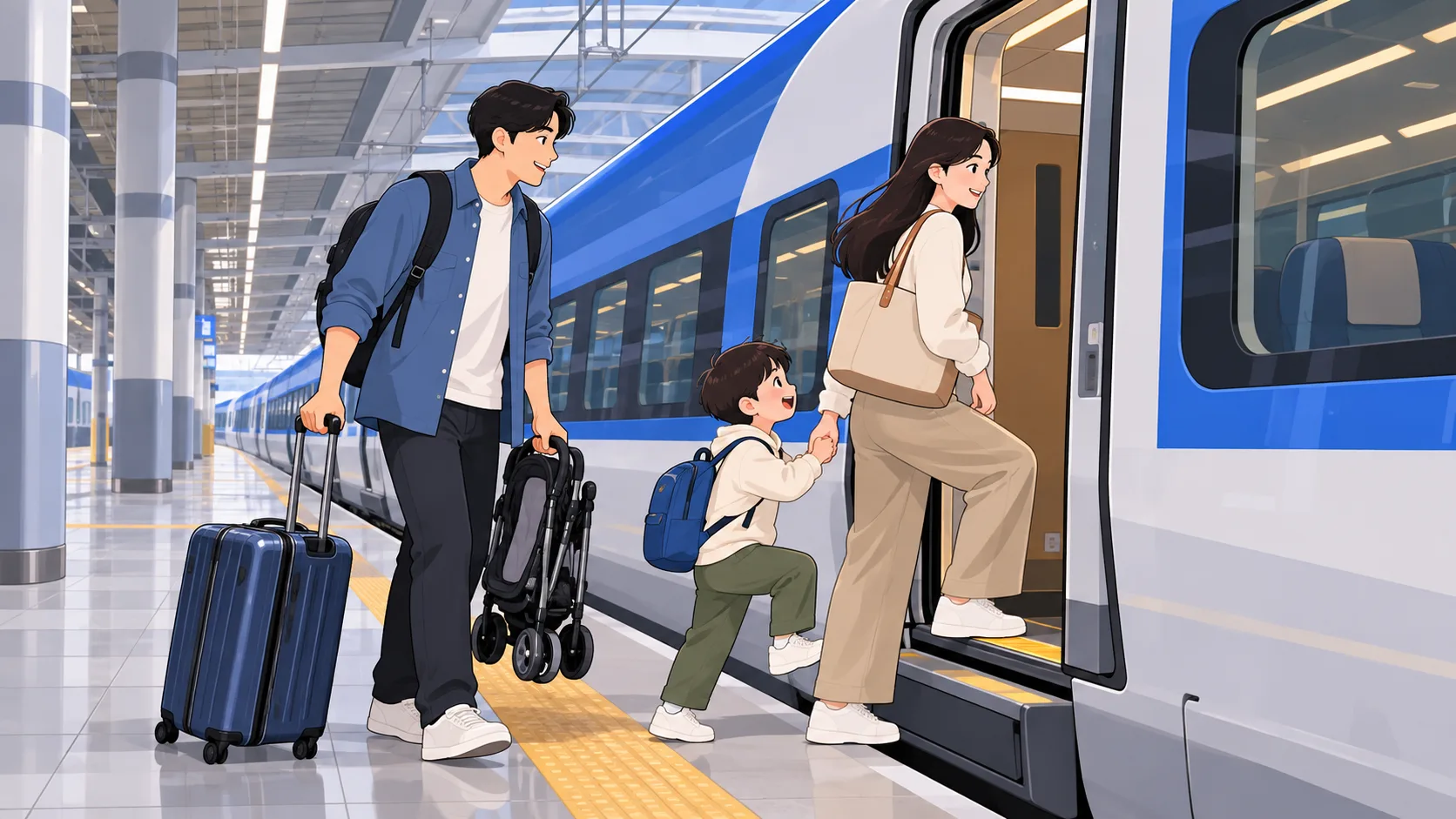
The return from Busan to an international flight at Incheon Airport is a chain of journeys, not one train ride. Your family may need to get from the hotel to Busan Station, take KTX to a Seoul-area station, change to airport rail or another transfer, and then reach the correct airline counter. Work backward from the flight and give each change room to go wrong.
Plan the complete journey backward from check-in
For Busan to Incheon Airport with children, work backward from the airline's check-in and baggage deadlines. Add the airport transfer, KTX arrival and hotel-to-station leg. Book each journey separately, since KTX does not take you directly to the terminal, and leave time for children, bags and delays.
This route closes the journey begun in our South Korea family travel guide. The outward KTX trip required decisions about seats, stroller and boarding. For the return, the main question is timing: how much margin do you need between independent operators before an international flight? The answer depends on your airline, flight time, children and tolerance for a missed connection, not a universal minimum printed on a blog.
Write down four times: the airline's earliest useful check-in or bag-drop time, its final bag-drop deadline, when you want to arrive at the correct Incheon terminal, and the latest airport train or road transfer that still leaves a comfortable margin. Then work backward to a KTX arrival in Seoul that allows for a normal transfer and one reasonable delay. Finally, choose a departure from Busan that leaves time to reach Busan Station without rushing. Do not use the advertised rail running time as the entire door-to-counter time.
Check your airline's current rules directly. A family with checked luggage may need to reach the bag-drop desk sooner than a traveler with only cabin bags. A child traveling on a different document or with special assistance may require extra verification. Terminal assignments can change, so use the flight details and airline notice rather than a saved screenshot. If the flight is very early, traveling from Busan on the same morning may be a poor choice; consider spending the previous night closer to the airport.
Busan to Seoul: reserve the right KTX leg
Use KORAIL's current booking information to find a train from Busan to the Seoul-area station that best connects with your next leg. Confirm the exact destination station on the ticket. “Seoul” on an itinerary is not enough when the airport transfer starts from a particular station. Check train number, date, departure time and operator before paying. Keep the whole family's tickets and booking reference available offline.
Book each child's fare and seat deliberately, following KORAIL's current age and seat conditions. A child who had no separate seat on the outbound train may need one on the return if everyone will be tired or carrying more shopping. Conversely, do not pay for an adult fare because the booking form was filled quickly. Check the fare breakdown before payment. Choose seats together if possible, and leave enough time at Busan Station for a toilet stop and to locate the correct carriage.
The hotel-to-Busan-Station transfer is often underestimated. A Busan Metro trip with children may be easy on a sightseeing day but harder with suitcases. Check the first metro service if leaving early, the elevator route from your hotel side to the platform, and the walk from the final platform to the KTX concourse. A taxi may be worth considering with several bags, though road traffic is another variable. Choose the option that lets you arrive at the KTX station calm and on time.
Keep the departure morning simple. Pack the previous evening, check out without a complicated breakfast booking and place passports, airline details, train tickets and medication in one small bag. Count large pieces of luggage before leaving the room and again before boarding. If a stroller will be folded for KTX, remove hanging bags while still at the hotel. A loose shopping bag can delay boarding or leave a toy behind.
If a KTX is delayed or canceled, contact the operator for current options immediately. Do not assume a ticket for one train can be used on the next service. At the same time, check the airline's latest check-in window and your onward airport-rail choices. If the remaining margin is too small, ask the airline about options rather than hoping every subsequent transfer will be perfect. Travel insurance terms may matter, but coverage depends on the policy and cause of disruption; keep evidence of delays and communicate with the providers.
The Seoul transfer is a separate journey
Incheon Airport's airport-rail guide explains the rail connection from Seoul toward the airport. Check whether the express or all-stop service best fits your station and terminal, its current schedule, ticket type and the time it takes to reach the platform from your KTX arrival. A fast airport train does not help if you miss it while crossing a large station with children and luggage.
On arrival in Seoul, regroup before moving. Let passengers leave the KTX, count your bags, check that each child has a jacket and then follow signs to the airport railroad. Do not split the family by sending one adult running for tickets while the other is lost on another level. Decide in advance which adult carries the travel documents and who is responsible for the stroller. If one child needs a toilet, take the pause rather than creating a hurried platform change later.
There may be a walk, escalator or lift between rail systems. Use the lift route if a loaded stroller and luggage make escalators unsafe. Check whether you must pass out of one paid area and buy or validate a new ticket for the airport rail. Do not assume the KTX ticket includes this leg. Likewise, a local transport card or pass used in Busan should not be assumed to cover an express airport rail product. Read the operator's current ticket options.
If Seoul Station is not the practical interchange for your selected KTX, compare alternatives using the exact station names and current airport transport information. A taxi or bus from another Seoul-area station may be possible, but traffic and terminal access must be included in the timing. The airport's ground transport guide lists the available modes. Choose an option because it improves your real door-to-terminal route, not because it appears shorter on a map.
When a road transfer makes sense
For a family with many bags, a direct vehicle from a Seoul-area station to Incheon Airport may avoid a difficult rail interchange. It can also be useful if a child cannot manage another platform walk. However, road traffic is less predictable, and a vehicle large enough for the family and luggage may need booking. Confirm a suitable child-restraint arrangement before relying on a taxi or transfer service. A quoted travel time without a traffic margin is not a safe basis for an international departure.
If the flight window is tight, a road transfer may not solve the underlying problem. Move the KTX to an earlier departure or travel toward the airport the previous day. Extra time at an airport with food and seating is usually easier to handle than a missed check-in deadline. The right buffer is a family decision based on cost and risk, but it should be visible in the itinerary rather than an optimistic assumption.
Arrive at the right Incheon terminal
Confirm Terminal 1 or Terminal 2 with the airline close to travel. They are not interchangeable walking entrances. The airport train and road signs distinguish terminals, and a mistaken exit can consume the margin you saved elsewhere. Keep the flight number and airline desk information accessible. When you leave the airport-rail platform, follow current signs to your airline rather than an old guide to a different terminal.
The airport provides services for infants and children. Locate toilets, nursing facilities or family services if they will help after the long journey. A child who has been on two trains may need food and a quiet break before check-in. Save time for this rather than planning to rush directly from the platform to security. Keep a small supply of snacks that complies with your airline and security rules; check current restrictions for liquids and infant food directly with the airport and carrier.
Incheon Airport also describes priority departure procedures for eligible young children. Do not assume the family can simply join a priority lane. Check age eligibility, companion limits and any airline-counter verification required on the day. If eligible, ask at check-in how to use it. This can help with a young child, but it should be a useful option rather than the justification for a too-tight arrival time.
If the child uses a stroller, ask the airline where it must be checked and whether gate checking is available for your flight. Different carriers and aircraft may handle strollers differently. Remove valuables and essential items before handing it over, photograph its condition if needed and retain the claim tag. If you will not have the stroller after bag drop, plan how to move the child to the gate. Airport trolleys and family facilities may help, but confirm what is available at your terminal.
Choose the right day for the long transfer
For a midday or evening flight, a same-day Busan departure may be workable with a generous sequence of trains and airport time. For an early flight, the family may be better off traveling toward Seoul or Incheon the day before. That adds a hotel change, but it reduces the chance that a small rail disruption becomes a missed international flight. Compare the overnight cost with the cost and stress of changing flight tickets for the whole party.
An overnight near the airport is not automatically best. It may require a separate hotel transfer and unpacking for one night. A Seoul hotel with an easy airport-rail connection may be more pleasant if your flight is not extremely early. Check the exact first train or shuttle schedule and the hotel's baggage and check-in arrangements. Do not select a room labeled “airport hotel” without mapping its actual transfer to your terminal.
If spending the last night in Busan, finish sightseeing early enough to pack and sleep. Keep souvenirs within your airline's baggage limits, and weigh bags before the departure morning if you are close to the allowance. A forgotten purchase that must be repacked at the station or airport can consume the time margin. Charge devices and download tickets while hotel Wi-Fi is available.
A realistic timing exercise
Imagine a family of two adults, one school-age child and a toddler with a stroller. Their flight is in the evening. They first check when international bag drop closes and choose an airport arrival comfortably before that time. They then check the current airport-rail schedule and choose a Seoul transfer with enough space for a lift, tickets and a toilet stop. Only then do they select a Busan KTX that arrives in Seoul well before the airport connection. They leave the Busan hotel with a separate buffer for check-out and the ride to the station.
This exercise does not produce one universal departure time. A family with no checked baggage, an older child and a hotel beside Busan Station may need less transfer time. A family with a stroller, two large cases and a child who needs regular breaks should add more. A flight during a holiday peak or a day of severe weather warrants extra caution. What matters is that every segment has a named provider and a time allowance, with no invisible jump between “arrive in Seoul” and “check in at Incheon.”
For a morning flight, run the exercise and see whether the resulting Busan departure is actually practical. If it requires leaving a hotel before the first convenient local transport or gives almost no room for a missed KTX, move the long-distance journey to the previous day. Do not force a same-day plan because it avoids one hotel night on paper; the risk may be much larger than the saving.
What to do when the plan changes
If the outbound KTX or airport railroad timetable changes before travel, rebuild the whole sequence. A ten-minute shift can matter if it removes a comfortable station transfer. Check the airline's flight status as well, but do not treat a possible flight delay as permission to arrive late: check-in deadlines may not move. Keep the official operator links in one phone note so the adults can verify changes without searching through messages.
If a child is ill on departure day, reassess the route and the flight rather than pushing through a long sequence automatically. Ask the airline, railway and insurer about the applicable options. Medical advice and documentation requirements vary; seek appropriate care when needed. Keep prescriptions and essential medication in hand luggage, subject to airline and security rules, so a checked case does not separate the child from them.
Our Korea with toddlers guide covers the broader routine of meals, naps and supplies. Apply that routine to the return day too: a well-rested child with familiar essentials is easier to guide through a long station transfer than one who has been asked to manage a final sightseeing stop before the flight.
If a bag or stroller is lost during a transfer, preserve the claim or ticket details and report it to the responsible operator promptly. Keep travel documents and a change of child clothing out of checked or stowed luggage for this reason. If the party becomes separated in a station, stop at a pre-agreed meeting point and contact station staff; do not have both adults run in different directions with luggage.
Final family checklist
Before booking: confirm the flight terminal and check-in window, exact KTX arrival station, airport transfer operator, child ticket and seat conditions, and a realistic disruption buffer. Before leaving Busan: check train status, pack tickets and documents together, count bags, fold or prepare the stroller, and allow time to reach the platform. At Seoul: regroup, check the onward service and move together to the airport leg. At Incheon: confirm the terminal, airline counter, stroller handling and any family assistance that applies.
The return day is successful when it is uneventful. Build an itinerary with time to pause, ask for help and recover from a missed connection without threatening the flight. That is more valuable for a family than a timetable that looks efficient only when every train, child and bag behaves perfectly.