Busan Metro With Kids: Fares, Elevators and Easy Transfers

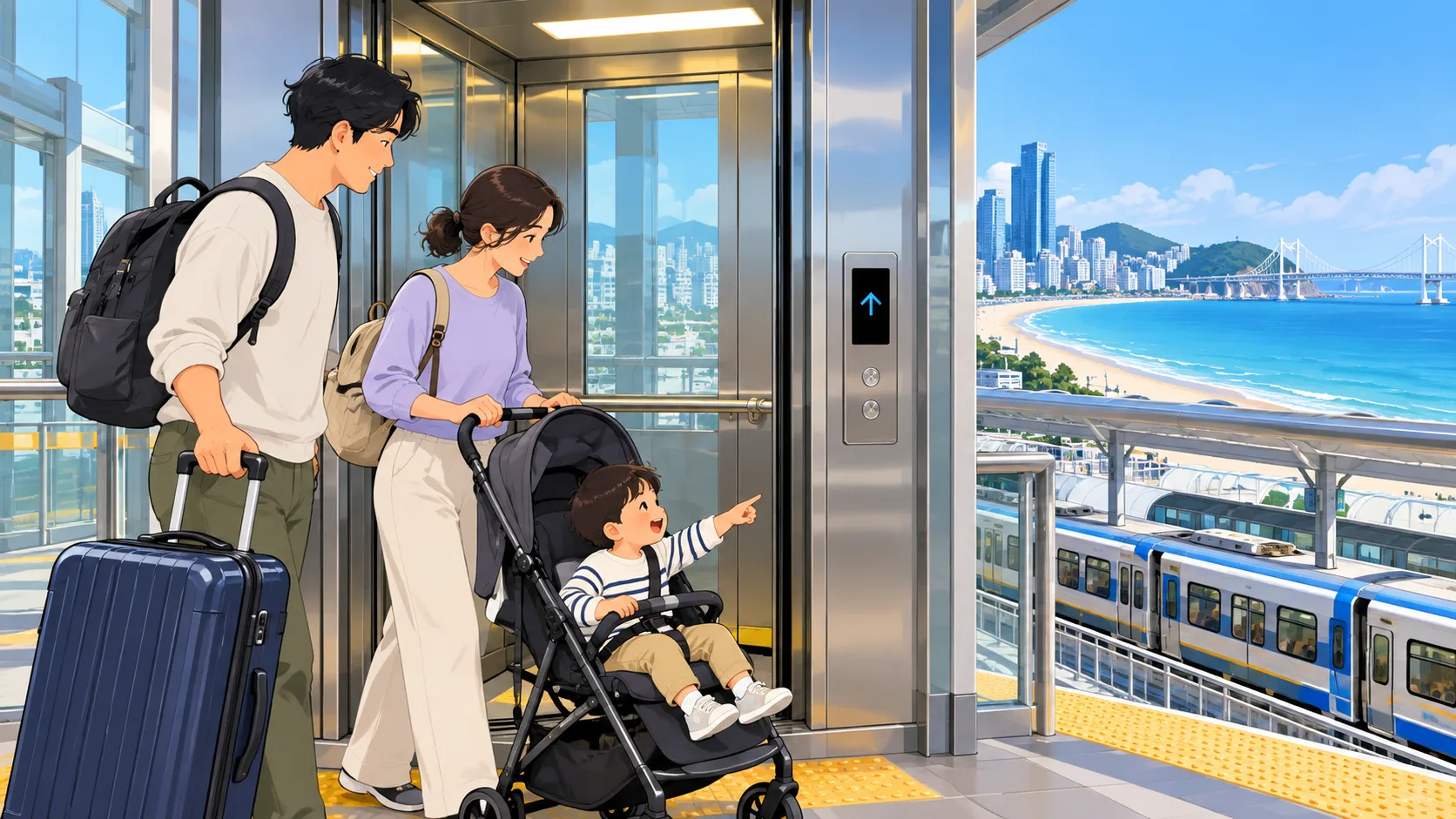
Busan's metro can move a family between the station, beaches and neighborhoods without road traffic, but arriving from Seoul creates an easy trap: assuming the same child fare and card setup works in exactly the same way. Check Busan's current fare medium, child registration and elevator route before your first ride, especially if a stroller and luggage are still with you.
Treat Busan as a new fare system
For Busan Metro, check each child's age, ticket or card, and the current fare table. Child-card and QR-ticket conditions can differ. With a stroller, identify the correct station entrance, elevator and transfer path before tapping through the gate. Recheck the route if a lift is unavailable.
The family journey may have started with a South Korea trip plan and a Seoul-to-Busan KTX ride. The train ticket ends at the intercity station. Busan Metro is a separate local journey with separate payment and access decisions. Even if you have a transport card used in Seoul, check that it is accepted on the particular Busan service and that the child's discount is registered correctly. A card logo does not prove the age setting is right.
Start with the official Busan Metro fare page. It gives the current fare table, including differences between fare media. The how-to-use guide explains tickets, cards and registration. Read both before converting a headline “child fare” into your family budget. A no-fare or reduced-fare condition can depend on age, the card's registered birth date and the number of accompanying adults. Verify the condition that applies to your party.
Do not build a travel day around a price quoted by an old article. Fare tables can change, and a QR ticket may not have the same child treatment as an eligible card. If you are unsure at the machine, ask staff before purchase. It is easier to fix the payment method at Busan Station or a quiet stop than at a busy barrier with children waiting in line. Keep each paying traveler's ticket or card separate so you can tap in and out correctly.
Set up a child's payment before the first busy trip
The Busan Metro usage guidance says child fare on a card can depend on age registration at an authorized convenience store. Check the current process, supported cards and age band. Bring a way to show the child's date of birth if the retailer or staff require it. Do not assume the card automatically “knows” who is holding it because its design looks child-friendly.
For a family making only one local ride, a single-use ticket may be easier than sourcing and registering a card. Compare the actual fare and the time needed to purchase it. For several days of metro rides, correctly registered cards can reduce machine stops. Add only a practical balance, especially to a card carried by a child. Keep a record of which card belongs to which traveler, and do not let two children swap cards if their fare eligibility differs.
At the first gate, let one adult go through and wait where the children can see them. The second adult supervises each child's tap and the stroller. Use a wide or accessible gate if appropriate, following staff instructions. A child who has a fare card should use their own card, even if an adult holds it and taps on their behalf. Do not pass one card backward to admit multiple people. If the gate shows an unexpected fare or refuses the card, step aside and ask staff rather than repeatedly tapping.
Tap on exit as directed. One missed exit tap can affect a later charge or transfer. Keep cards accessible until the whole family has left the paid area. If a child is carried, confirm whether a separate ticket is needed under the current age rule instead of guessing from whether the barrier can physically fit both people. Physical access and fare eligibility are two different questions.
Map the elevator route from street to platform
Busan Metro publishes a station elevator list. Use it to check the specific station and entrance, then compare with current signs when you arrive. An elevator icon on a broad route map does not tell you whether the lift connects your preferred street corner, the ticket hall, the correct platform and your interchange. The route may require a longer walk through a concourse than the map suggests.
Begin with the hotel address, not simply the station name. Find the accessible entrance on the correct side of the street. If your hotel is across a wide road from the lift, a legal crossing may add more distance than the station map implies. Check the destination exit as carefully as the departure entrance. A stroller route that works at one end but ends at stairs at the other is not a step-free route.
If the route includes a line change, trace the transfer corridor and lifts. Some stations have different elevators for street-to-concourse and concourse-to-platform travel. They may not be beside each other. A transfer that looks quick for an unencumbered adult can be slow with children and a stroller, especially if you have to wait for a small lift. Allow time and avoid promising children a precisely timed arrival at an attraction.
Lift service can change. On the day, look for maintenance notices and ask station staff for an alternative if a lift is out. Do not carry a child in a stroller down stairs. Remove the child and fold the stroller only if the adults can safely handle both; otherwise choose another station or mode. Safety and an unhurried arrival matter more than preserving a planned route.
Stroller and escalator decisions
A folded stroller can be useful when a lift route is temporarily unavailable, but only if one adult can carry it while another secures the child. Do not balance a loaded stroller on an escalator. If traveling alone with a toddler, the lift is generally the practical route even when it means an extra corridor. Park away from the gate and platform edge while you prepare tickets, bags and the stroller fold.
On the train, leave doors and priority spaces clear. If the carriage is crowded and the stroller can be folded without waking a child or losing control of belongings, folding may make the ride easier. If not, wait for a less crowded train where possible and follow staff guidance. A school-age child should know where to stand and which adult to follow at each stop. Decide this before the doors open.
Transfers, buses and the light rail are separate checks
A Busan itinerary can mix metro, city bus and the Busan-Gimhae Light Rail. They are not one identical service. Busan Metro has a separate light-rail information page. Check the operator, fare and transfer conditions for your actual route, especially if heading toward the airport or changing systems. Do not infer that a metro child-card condition or a transfer discount automatically applies everywhere.
When transferring within the metro, follow the signs for the line and direction you need. Use the station name on a route map, then confirm the next stop on the platform display. If you take a wrong platform, regroup in a safe area before moving again. Children can become disoriented in a large interchange; have one adult lead and the other count the party. Keep the tickets and cards with the people who need them, not in a bag that has already gone ahead.
For a bus connection, check the stop location, boarding door, tap instructions and whether a stroller must be folded. A bus stop near a metro exit may still be across a large intersection. If the family has just completed a long KTX ride, a taxi from Busan Station to the hotel can be more sensible than combining metro and bus to save a small amount. Transport choices should fit the child's energy and the luggage you actually carry.
If you plan a beach day, consider the return trip as well as the outbound trip. A child who walked happily to the metro in the morning may be tired, wet or sandy by evening. Identify the nearest accessible exit at the beach end, a reasonable meal or rest stop, and an alternative ride home. Keep an extra dry layer in the day bag. The easiest metro route is the one you can still manage after several hours out.
Three common family route decisions
Busan Station to a hotel near a metro stop: check whether the platform-to-hotel path is step-free and how many lifts it uses. With light bags and an older child, metro may be easy. With large luggage and a toddler, a direct taxi may save the difficult last kilometer. Compare the whole route rather than the station-to-station travel time.
Hotel to a beach district: metro avoids road traffic, but the station may be a walk from the sand. Decide where to store or carry a stroller, where children can use a toilet, and whether the return route has a lift at the right exit. If an outing includes several bags, simplify what you bring rather than assuming the train has unlimited room.
Hotel to an airport-related connection: do not assume every rail line on a map is Busan Metro. The Busan-Gimhae Light Rail and the long-distance journey to Incheon Airport are different choices. Check operator, fare, interchange and luggage suitability. A family flying internationally from Incheon needs a deliberately planned return journey, not a last-minute guess based on a colored route line.
The first example may favor a taxi after the KTX but metro on later sightseeing days. That is not inconsistent; the bags and child's energy have changed. Reevaluate each day. The cheapest fare per person is not always the lowest-stress family choice, and paying for a short direct ride once can keep the rest of the trip pleasant.
A calm station routine
Before entering a station, check the line, direction, destination exit and ticket balances. Give children a simple instruction: hold a hand, wait behind the line and follow the adult who leads. Enter through a gate that works for the stroller, using each required fare medium correctly. Count the party again after the barrier. On the platform, stand away from the edge and let people leave the train before boarding.
If you need to change lines, leave time for the elevator route. Do not rush for a closing train with a stroller. A missed train normally costs less time than recovering from a separated child or a fall. If one adult goes ahead by mistake, agree to stop at a clear place, such as the next platform sign, rather than having everyone run in different directions. Keep the hotel address saved offline in case phone data is slow underground.
At the destination, tap out properly and follow the correct exit. If you emerge on the wrong side of a road, use a safe crossing rather than trying to carry the stroller up a staircase to save a few minutes. Take a short pause to put away cards and orient the children. A well-chosen rest stop near the station can make an afternoon outing much easier.
What to verify before each travel day
Review the official fare and card guidance if the family has changed its plan or a child is close to an age threshold. Check the station elevator list and current station notices for both ends of the route. Confirm whether an interchange uses a different operator, especially for light rail. Charge the phones but keep the route, hotel address and a family meeting point available offline. Carry a small backup payment method and enough time to ask staff if a gate rejects a card.
For toddlers, combine these transport checks with the pacing in our Korea with toddlers guide. A metro trip that is easy for adults can still feel long to a child who needs food or a nap. Choose fewer stops and more time in each neighborhood. Then Busan's local transport becomes a useful tool for the family rather than another task to manage.
Once the Busan stay is ending, plan the return to Incheon Airport as a new multi-leg trip. A KTX ticket, a Seoul airport rail ticket and the flight check-in window each have their own conditions. Leave a buffer for all three rather than treating the metro ride to Busan Station as the only timing question.
Small choices that prevent a difficult ride
Choose a station entrance with enough clear pavement to organize the party before entering. If a child needs help with a coat or ticket, handle it beside the station wall rather than in the moving stream of commuters. Put one adult at the front and one at the back when there are two adults. If traveling alone with children, tell the older child exactly where to wait while you fold the stroller or consult a machine. Agree on a simple meeting point if anyone becomes separated, such as the staffed ticket gate, rather than an unfamiliar exit number.
Keep a compact day bag with water, wipes, a dry layer, any essential medication and a phone charger. That is different from bringing the entire hotel bag onto every train. A child's hands should be free to hold an adult's hand near stairs and platforms. If the trip spans a meal, identify a place to stop before hunger makes a transfer harder. Not every station will have a convenient place to sit, and an elevator queue is a poor place to unpack food.
Check the journey again before the return leg. A lift that worked in the morning can be temporarily unavailable later, and the nearest exit after dark may not feel as straightforward with tired children. If the family is exhausted, a direct licensed taxi or a shorter metro journey followed by a surface ride may be better. Confirm a safe child-restraint arrangement when choosing a car. The goal is not to prove that every journey can be made by metro; it is to make the day's transport fit the people using it.
For a day with several stops, group nearby places together. Repeatedly crossing the city adds gate transactions, platform waits and stroller lifts that do not appear in an attraction list. A beach, a nearby meal and one park may be a fuller family day than three distant sights. Keep enough uncommitted time for a child to rest. Busan's metro is most useful when it supports this kind of manageable route.