Great Wall section choice: Mutianyu vs Badaling, logistics first

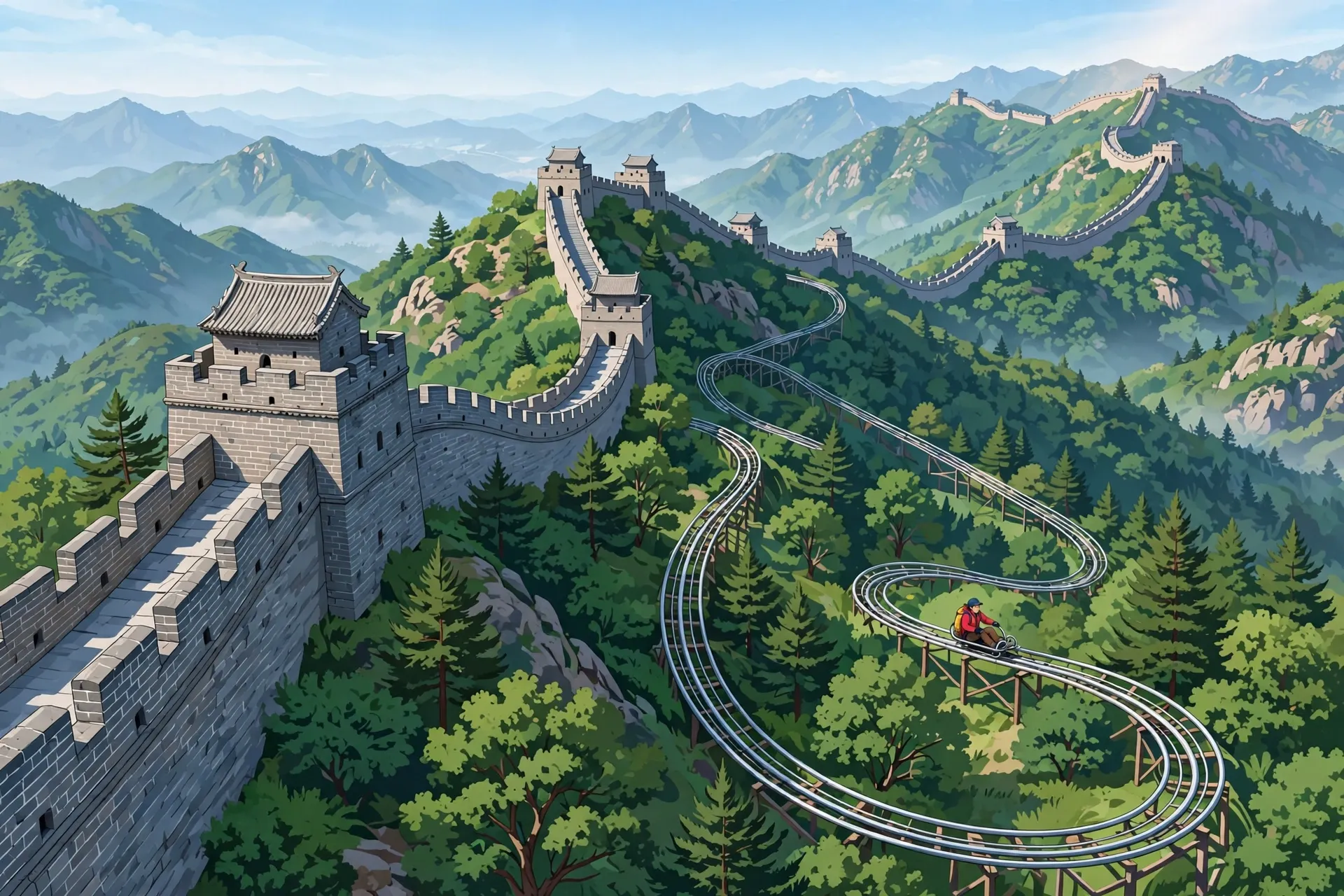
Choosing between Mutianyu and Badaling is less about which stretch of wall looks better in photos and more about how you plan to get there and how much crowding you are willing to accept. Badaling is the easy option: direct trains from Beijing put you at the wall with no taxi and no tour markup. The trade-off is crowds, especially in peak season, when the most convenient section is also the busiest. Mutianyu feels quieter and more forested, with a toboggan descent that makes the visit memorable, but reaching it takes transfers and planning. There is no direct train, so you need a bus-to-taxi route, a group tour, or a private driver. This guide compares the sections on logistics alone, so you can pick the section that fits your transport mode and your tolerance for crowds, then plan your morning around it.
The decision in 30 seconds: crowds vs transport
Pick Badaling if getting there with zero transfers matters most. The S2 suburban train runs direct from Nankou to Badaling, and the Jingzhang high-speed rail runs from Beijing North or Qinghe stations to Badaling Great Wall station in about 30 minutes for roughly 20 RMB. You pay for that convenience in crowds: Badaling entry is 40 RMB and the site's published daily capacity is 65,000 visitors, which is 5–8x Mutianyu's 8,000–12,000.
Pick Mutianyu if a quieter walk matters more than a direct train. Mutianyu sits 73 km from Beijing, and the trip takes 75–90 min by road. There is no direct train, so budget for transfers or a tour. In return you get forested ridges, smaller crowds, and the toboggan descent.
How to choose
- Choose Badaling when you want the simplest public-transport trip and you can arrive early or visit on a weekday.
- Choose Mutianyu when you are willing to arrange a bus-to-taxi route, a group tour, or a private driver in exchange for a quieter section.
Badaling logistics: the direct train route
Badaling has the best public transport of any wall section. Take the S2 suburban train direct from Nankou to Badaling, or take the Jingzhang high-speed rail from Beijing North or Qinghe stations to Badaling Great Wall station in about 30 minutes for roughly 20 RMB. Either way, you arrive without a taxi and without paying a tour markup.
The bus option is Bus 877 from Deshengmen, which costs 12 RMB each way and takes about 90 minutes. It is cheaper than the train options, but slower, so the train is the better pick when your morning is tight.
Crowd-beating rules matter here because the convenience draws visitors. Arrive for the 6:30am opening (Apr–Oct), choose a weekday, avoid Oct 1–7 Golden Week, and consider the less-visited south section. Badaling entry is 40 RMB, and the Badaling Slide costs 120 RMB round trip.
Mutianyu logistics: how to actually get there
Mutianyu is 73 km from Beijing, and the road trip takes 75–90 min. The DIY public-transport route is Bus 916 express (12 RMB, ~75 min) to Huairou plus a taxi (30–50 RMB) or H23/H24 minibus (10 RMB). Allow about 2.5 hours total from the city, at 40–60 RMB each way.
Simpler options cost more but remove the transfers. Group tours run 350–500 RMB per person with hotel pickup, and a private car runs 800–1,500 RMB per day. If you go DIY, aim to arrive by 8am, since tour buses arrive around 10am and the quiet morning window closes fast.
Picking your Mutianyu route
- DIY bus plus taxi or minibus: cheapest, but allow about 2.5 hours each way including transfers.
- Group tour: simplest if you want hotel pickup handled for you.
- Private car: most flexible on timing, and the best fit if you want to arrive by 8am without worrying about bus connections.
Cable car, chairlift, and the toboggan question
At Mutianyu, entry is 45 RMB. The enclosed cable car costs 100 RMB one-way or 140 RMB round trip to Watchtower 14, and the open chairlift costs 100 RMB one-way to Watchtower 6. The signature descent is the metal toboggan: 100 RMB for a single descent (1,680 m, ~5 min), or 140 RMB for the chairlift-up and toboggan-down combo. Note that the toboggan closes on rain and snow days, so have a cable-car descent in mind as a backup if the weather turns.
At Badaling, the comparable descent is the Badaling Slide at 120 RMB round trip. If a slide or toboggan ride is the highlight you want, Mutianyu's toboggan is the more distinctive option; if you only want a straightforward up-and-down ride, Badaling's slide covers it.
Your half-day plan at each section
At Badaling
Take an early train from Beijing North or Qinghe stations and aim for the 6:30am opening (Apr–Oct). With the train taking about 30 minutes and entry at 40 RMB, the morning stays simple: arrive early, walk the main stretch, and consider the less-visited south section when the main route fills up. Avoid Oct 1–7 Golden Week if you can, and pick a weekday over a weekend.
At Mutianyu
Leave early enough to arrive by 8am, before tour buses arrive around 10am. DIY travelers should allow about 2.5 hours from the city via Bus 916 express plus a taxi or minibus, at 40–60 RMB each way. Once there, entry is 45 RMB, and the chairlift-up and toboggan-down combo at 140 RMB makes for a satisfying loop: ride up to Watchtower 6, walk the ridge, and toboggan down. If rain or snow closes the toboggan, use the enclosed cable car instead.
Back in Beijing, dinner is the easy part of the day compared with the wall logistics. If menus are a worry, read Ordering food in China when you can't read the menu: a practical playbook before you sit down to eat.
Prices and timetables in this guide were checked on 2026-10-20; reconfirm before travel, since fares and schedules can change.