Tokyo Disney With Kids: Ticket Types, Queue Strategy and Stroller Tips

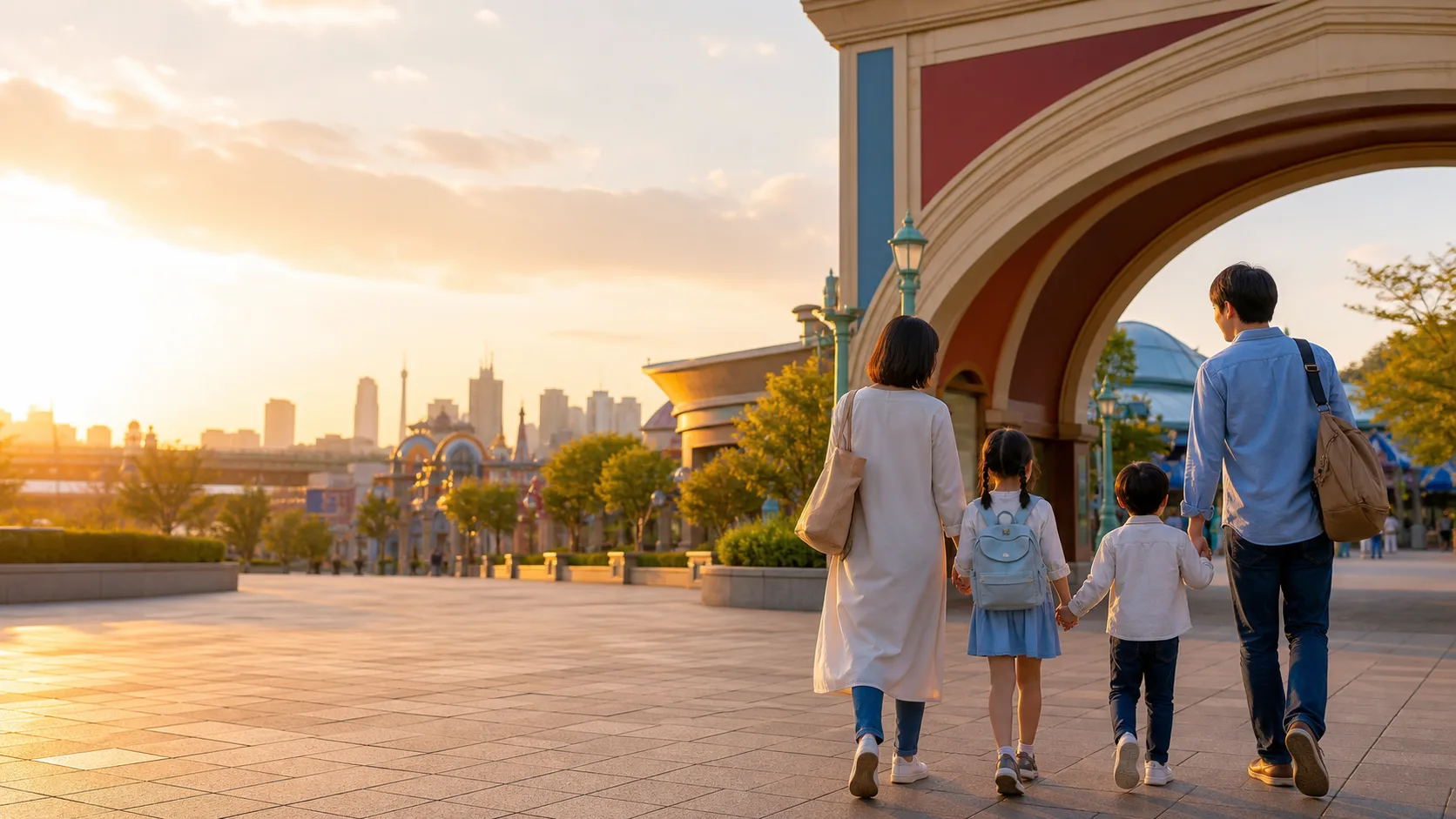
Tokyo Disney works wonderfully with children when you plan for their energy rather than trying to reproduce an adult’s perfect attraction list. The useful decision is not ‘how do we do everything?’ but ‘which few experiences would make this child’s day feel magical, and how can we reach them without spending the rest of the day hungry, lost or exhausted?’
Start with one park, one date and three family priorities
For a first family visit, choose either Tokyo Disneyland or Tokyo DisneySea for the full day. Tokyo Disney Resort’s standard 1-Day Passport is tied to both a date and one park, and its official ticket calendar uses variable pricing. Check the actual date, opening hours and ticket availability on the official site before paying; do not calculate your trip from an old price screenshot.
Write down three priorities before comparing tickets: the one ride or land each child cares about, the kind of day your adults can sustain, and the point at which your family needs to leave. A preschooler who loves characters, gentle rides and parades needs a different plan from a teenager who wants coasters and detailed themed lands. A good plan can include both, but it cannot make both groups happy by moving continuously all day.
Tokyo Disneyland is often the simpler first choice for families who want classic character stories, a more familiar fantasy atmosphere and a broad mix of gentle experiences. DisneySea has a more unusual setting, strong visual atmosphere and attractions that may appeal especially to older children and adults. Neither is objectively ‘better with kids.’ Choose the park whose headline experiences match your particular group, then stop comparing the other park for that day.
Choose a ticket for the day you can actually use
A full-day ticket is normally the clearest family choice when you have only one park day, have young children, or need room for a midday reset. Tokyo Disney Resort also sells certain fixed-time and limited-period tickets at different times of year. Those can make sense when you live locally, arrive late, or only want an evening atmosphere, but they are rarely a substitute for a full family park day after an international flight. Check the official ticket page for the current period, eligible dates and park selection; ticket names and availability can change.
Do not buy a limited-time park hopper merely because it sounds efficient. The official 2026 Park Hopper Passport permits entry to a selected starting park and hopping from 11 a.m., during its stated July-to-September sales period. That is potentially useful for confident repeat visitors with older children and two clear reasons to change parks. For a family with a stroller, a nap need, a first visit or one child who wants to repeat a favourite ride, moving parks is often a costly interruption. One park with a relaxed lunch is usually more valuable than two park gates in the same day.
Children aged three and under are admitted free according to the official ticket page, while child categories and eligibility should always be checked for your date. Carry the booking confirmation and keep all tickets accessible in the Tokyo Disney Resort App if you are using it. Give one adult responsibility for the digital tickets, but make sure another adult can access a screenshot or shared group information if the first phone battery dies.
Build the morning around one scarce thing
The first hour is not the time to race blindly. It is the time to secure one experience that matters, understand the day’s operating conditions, and establish a rhythm your child can follow. Arrive with food, water, sun or rain protection and a simple meeting point in mind. Then check the official app for attraction status, show times and any available services. Operational details can change during the day, so the app is more reliable than an itinerary printed weeks earlier.
Choose one scarce item: perhaps a popular attraction, a timed entry need, a character greeting or a show. Go there first if it is open and suits the whole party. If it is temporarily unavailable, do not let disappointment consume the morning. Switch to a nearby low-wait attraction and review the app later. Children do not experience a queue strategy as a spreadsheet; they experience whether the adults remain calm and whether the next thing is fun.
Avoid beginning with a queue that is longer than your child can tolerate simply because it is famous. A twenty-minute wait before breakfast can feel longer than a forty-minute wait after a parade and a snack. Use the first few attractions to learn your child’s real tolerance, then adjust. A five-year-old who manages one indoor queue may still melt down in an outdoor switchback in heat.
Understand free and paid queue tools before the gate opens
Tokyo Disney Resort offers different services, and availability can be attraction- and day-specific. Disney Premier Access is a paid service for eligible experiences; the official resort pages direct guests to the app for current availability. The resort also has a free 40th Anniversary Priority Pass for select experiences, subject to the day’s operation and distribution. These are not guarantees that every attraction can be scheduled exactly when you want.
The family rule is simple: use a queue tool to protect a genuinely important moment, not to fill every minute with reservations. If a paid return time lets a child experience their one must-do attraction before a planned nap or dinner, the premium may be worthwhile. If the family is flexible and the child is enjoying low-wait rides, a paid product may add pressure rather than value. Check the exact attraction, return window, price and restrictions in the official app before purchase.
Do not plan to hold several adults’ phones with separate, conflicting schedules. Create one shared decision-maker, explain the next step aloud, and leave enough unbooked time for toilets, snacks and spontaneous favourites. A reservation system should reduce arguments. If it turns the adults into people staring at screens while children wait, simplify.
Use height, fear and sensory needs as planning inputs
Review the official attraction pages with your children before the visit. Height requirements, health warnings, darkness, loud effects, sudden drops and motion can matter more than a ride’s name. Do not promise an attraction before you know whether the child meets the requirement and actually wants it. A child who decides not to ride at the gate should not be treated as ruining the plan.
For mixed-age families, create a split-and-rejoin plan. One adult can take an older child to a high-thrill attraction while another uses a nearby gentle ride, shop, playground-style area or snack break with the younger child. Agree on the rejoining location before separating. This is smoother than making a younger child wait through an attraction they cannot enter or asking an older child to abandon every thrill ride.
Some children need lower sensory intensity. Indoor queues, dark scenes, loud parades and crowded exits can all be tiring even when a child likes the ride itself. Pack familiar ear protection if your child uses it, identify quiet corners early in the day, and give permission to step away. The goal is not to prove resilience. It is to preserve the child’s capacity for the experiences they enjoy.
Treat the stroller as a logistics tool, not a storage locker
A stroller can be extremely useful for toddlers and young children at a long park day, even if they normally walk well at home. It provides a predictable rest point, keeps small legs from being spent in queues and makes a late-afternoon exit easier. But it also changes how you move through crowds and where you pause. Use a light, identifiable stroller, and learn the park’s current rental and return rules from the official site if you plan to rent.
Put only replaceable items in the stroller basket. Keep passports, payment cards, phones, medicine, tickets and one warm layer in a small bag that stays with an adult. Crowded stroller parking areas are not a secure luggage service, and cast members may need to reposition strollers to keep pathways clear. Tie a bright ribbon or luggage tag to the handle so you can recognise yours quickly without blocking the aisle while searching.
Plan stroller parking before a timed attraction. Arrive a few minutes early, park where directed, take the essential bag, and explain to the child that the stroller will be waiting after the ride. Do not promise it will be in precisely the same spot. After a parade, use a calm route away from the biggest crowd rather than trying to thread a stroller through people who are all leaving at once.
Protect lunch, toilets and naps
The midday meal is a queue strategy. A family that eats before everyone is desperate has more patience for the afternoon. Look at restaurant options and mobile-order availability in the official app, but keep a backup: a familiar snack, water and a realistic place to sit. If a child has allergies or strict dietary requirements, research the official menu and allergy information beforehand and speak directly with staff; do not assume a visible ingredient list resolves cross-contact concerns.
Schedule toilets before a show, parade, long queue or transport ride. It sounds obvious, but it prevents a surprising number of family crises. Make a small ritual: toilet, refill water, apply sunscreen or add a layer, then join the next activity. Older children can help carry a small pouch with wipes and tissues, which gives them responsibility without making them manage the whole day.
A stroller nap can recover a day, but do not build the entire itinerary around forcing one. Give the child a quiet route, a familiar snack and a slower stretch after lunch. If the nap does not happen, lower the ambition for the next two hours instead of trying to compensate by rushing. A hotel break is worth considering only if the room is genuinely close and the return process will not consume most of the rest period.
Make parades and shows family-friendly
Parades are a wonderful way to let tired legs rest, but viewing position is a trade-off. The best curb-side spot can require a long wait in sun, rain or crowd pressure. For a child who is happy seeing the parade from a less perfect position, choose a location with shade, toilets and a fast exit nearby. For a child for whom a character parade is the day’s main dream, arrive earlier and make that wait the day’s anchor rather than squeezing it between two distant rides.
Show schedules, entry procedures and weather disruptions are operational facts, so check the app on the visit day. Bring a small ground sheet only if park rules permit it, and avoid spreading into walkways. While waiting, use quiet games, snacks and a clear time expectation. ‘We wait until the music begins, then we watch’ works better for many children than an abstract promise of ‘soon.’
A practical one-day rhythm
Aim to arrive before your chosen first priority, then do one or two nearby attractions before a snack. Late morning is a good time for a show, indoor attraction or a lower-intensity experience. Eat early or late enough to avoid the most stressful lunch window. Use the early afternoon for a stroller rest, indoor attraction, character experience or a flexible reservation. Choose one final anchor for late afternoon, then decide whether the child has energy for a parade, evening lights or an early hotel return.
This rhythm deliberately leaves room for the unexpected: rain, a favourite ride requested twice, a closed attraction, a nappy change, a toddler nap or a child who suddenly wants to shop for one small souvenir. The plan succeeds when it can absorb those events. It fails when every ten minutes depends on the previous ten minutes going perfectly.
Decide when to pay more
A closer hotel, a private airport transfer, a paid queue product or a character meal can be worth more to a family than another attraction ticket. Judge each upgrade by the friction it removes. Does it avoid a dangerous rush after an overnight flight? Does it secure the one experience a child will talk about for months? Does it make a medical, sensory or mobility need easier to manage? If yes, it may be a sensible family purchase.
Skip upgrades bought from fear. You do not need a premium service for every ride, every meal or every hour. A child’s best memory may be a gentle attraction with no queue, sharing popcorn while watching a parade, or choosing a postcard in a shop. Spend deliberately, and keep money and energy for the moments your family actually values.
Final checklist for a calmer Disney day
The night before, confirm tickets, park selection, opening hours, weather and the official app. Pack a charger, water, wipes, medicine, spare clothes for young children, weather protection and a small snack reserve. In the morning, name the day’s one must-do experience and one child-led choice. At the park, make every booking decision against energy, not fear of missing out. Before leaving, choose an exit time that still permits a peaceful journey back.
With children, Tokyo Disney is not a test of speed. It is a long, detailed family day that rewards clear priorities, well-timed breaks and the confidence to skip something. A ticket gets you through the gate; the calm structure around it is what turns it into a good memory.
A weather-proof family reset
Rain, heat and an unexpected closure do not have to spoil the visit, but they should change the next decision. Keep dry socks and a towel in a sealed pouch, cover the stroller seat, and choose a nearby indoor attraction or show rather than repeatedly crossing the park. In heat, schedule the most physical queueing early, refill water whenever practical, and use indoor dining as real recovery. Review the official app because weather-related operating information can change during the day.
When an attraction closes, use a replacement rule: choose the nearest option with a wait your youngest child can tolerate, or take the snack break early. If a child refuses a ride, offer a real alternative such as watching the exit, choosing a shop or staying with another adult. A calm pivot prevents one disappointment from defining the day.
Give children a small role
Let each child make one bounded choice: select the next gentle attraction from two options, carry the map, choose a snack, or name a favourite character to find. Small agency helps children manage a long, unfamiliar day without turning every decision into negotiation. For siblings, take turns. At bedtime, ask what each child loved before discussing what was missed. That is a better measure of success than any ride-count scorecard.
Keep the plan visible
Put the next meeting point, hotel name, and one adult’s phone number in a form older children can use without unlocking a phone. Decide in advance what happens if the group splits for a toilet break or a calmer ride. This small preparation is more valuable than a dense attraction list: it gives every adult permission to slow down, solve a problem, and reunite without turning a normal family pause into a stressful park emergency.
Related: japan-tokyo-short-trip-theme-park-and-family-ticket-guide