Japan Theme Park Hotels: When an Official Hotel Is Worth the Price

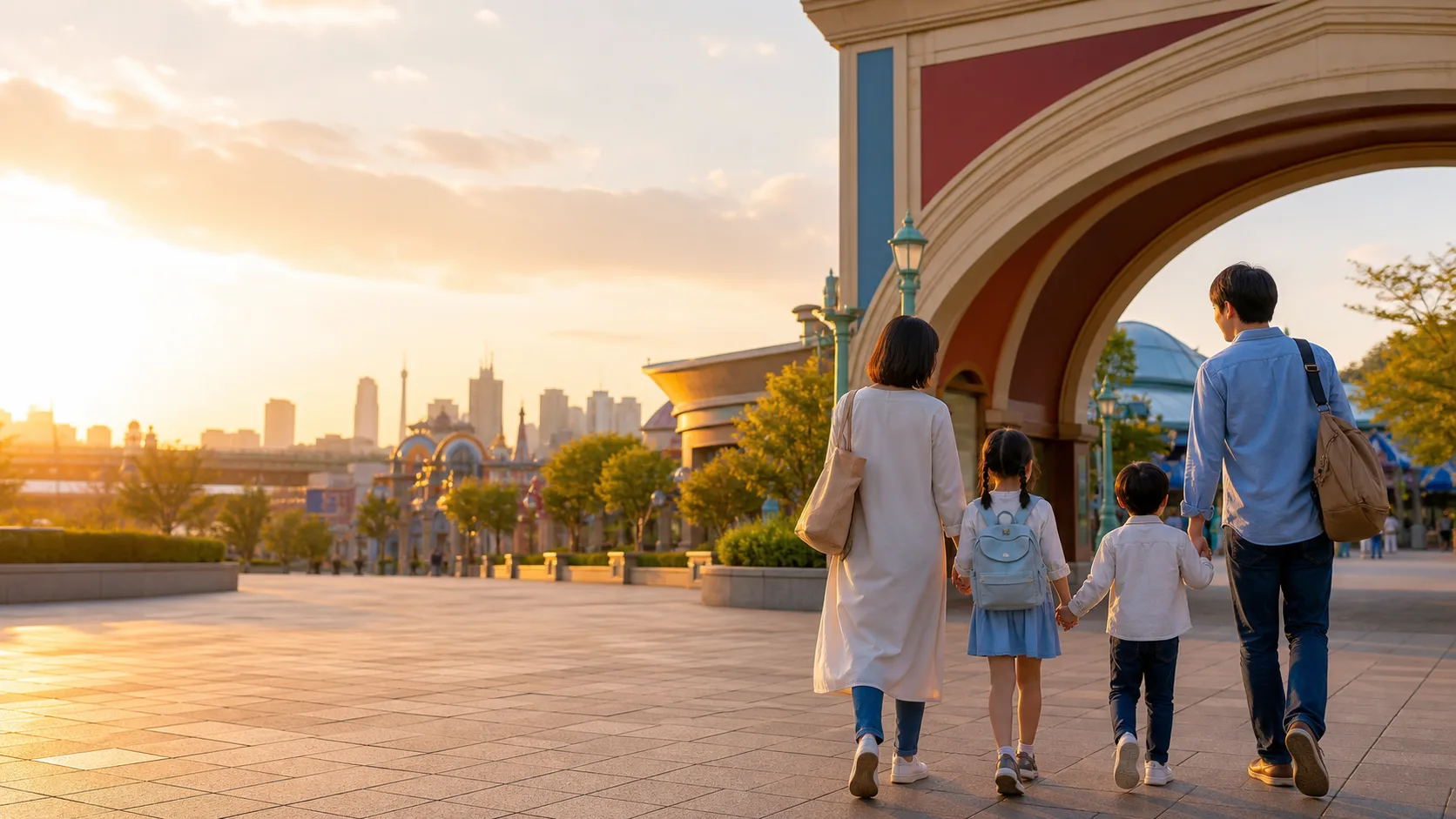
The glossy lobby is rarely the best reason to pay more for an official theme park hotel in Japan. The stronger reason is that the room can remove the most fragile parts of a park day: an early transfer, a tired child, an unexpected downpour, a late exit, or the problem of carrying bags across a city before check-in. That benefit is real for some trips and almost imaginary for others.
Start with the park day you are actually buying
An official hotel should be judged as a logistics purchase, not a souvenir. Ask what will happen from the moment the first person wakes up until the last person reaches bed. A family visiting for one full day may need breakfast, toilets, sunscreen, a jacket, phone charging, a stroller decision, and a reliable route to security before the first queue. A couple staying for four Tokyo nights may instead want restaurants, neighbourhood walks, and an easy train to museums on the days before and after the park. Those are different holidays, so they should not produce the same hotel choice.
At Tokyo Disney Resort, for example, a property may be inside the Disney hotel ecosystem, near Bayside Station, or simply convenient to Maihama. Those descriptions do not guarantee the same park access, package eligibility, room inventory, or guest rules. Universal Studios Japan has a similarly broad mix of official and nearby options. Treat every claimed benefit as a question with four parts: which hotel, which rate, which dates, and which named guests. The official hotel page and the booking confirmation matter more than a listicle written for a previous season.
Calculate the premium as a whole-trip number
Do not compare one headline nightly rate with another. Put the complete amount for each option in a note: room, tax, breakfast, extra beds, child policy, resort or service charges where applicable, cancellation deadline, and the cost of getting to the park. Then add the small costs that get forgotten. A city hotel might require a train fare for every person, a taxi when everyone is exhausted, station lockers before check-in, coffee and breakfast bought on the run, and a longer transfer if rain begins at closing time.
The official option wins only if its higher total buys something your party will use. For a parent travelling with a preschooler, being able to return to a nearby room after lunch can be more valuable than an attraction upgrade. For two adults who plan to stay in the park until close and sleep in the next morning, a compact nearby room may be sensible. For adults who will leave the park early and want a lively dinner neighbourhood, the same premium may be a poor trade. The arithmetic should include time and stress as well as yen, but it should still be arithmetic.
Measure door to gate, not distance on a map
“Next to the resort” can hide a long sequence of lifts, corridors, ticket machines, monorail platforms, bag checks, and walking. Open a map and trace the route from the room building to the exact security entrance. If you have luggage, a wheelchair, a stroller, or a sleeping child, consider the route at the end of a hot or rainy day rather than at 8 a.m. with everyone excited.
The Disney Resort Line, for instance, is a useful connection around Tokyo Disney Resort, but it is still a paid transport step and requires time. Some hotel access arrangements also depend on proof of stay, named entrances, park tickets, and operating conditions. Those details can make the hotel genuinely convenient without making it magically adjacent to every attraction. Confirm the current route through the resort's official access page before deciding that a hotel saves an hour.
Benefits are conditional, not a blank cheque
Guests often hear about early entry, special entrances, restaurant access, package inclusions, or priority booking and translate the headline into “we will skip all queues.” That is never a safe assumption. A benefit may be attached to a specific product, room category, date, operating period, or guest identity. It may also solve only one part of the day. A special entrance does not replace a valid park ticket; a package restaurant reservation does not guarantee that every desired attraction will be available; and a room close to the resort does not make a wet, tired child happy at 10 p.m.
Read the official wording before you treat a benefit as value. At Tokyo Disney Resort, access through particular hotel-related entrances has explicit proof-of-stay and time conditions, and operation can change. That does not make the benefit unhelpful. It means that the sensible buyer asks how it applies to the exact booking, saves the relevant confirmation, and prepares a normal public-route fallback. The same caution applies to any official hotel in Japan: if the feature is the reason for paying more, it must appear in terms you can verify.
Families gain the most from proximity—but not always
For young children, proximity can transform the day. A nearby bed means a realistic nap, dry clothes after a water ride, a private place for medication, and less pressure to stay until closing simply because the journey home feels difficult. It also gives adults a way to divide the day: one adult can take a child back while another continues with an older sibling. That flexibility is a genuine product, not an indulgence.
Yet a family hotel is not defined by a cartoon theme. Check the maximum occupancy, bed configuration, bathroom arrangement, breakfast seating, laundry, fridge, microwave access, cot availability, and the distance to a convenience store. Japanese rooms can be efficient rather than spacious, and a listing that says it sleeps four may mean two fixed beds plus a sofa bed or floor bedding. A larger city room with laundry and a direct train can be better for a five-night family holiday than a small official room that is only ideal for the park night.
Arrival day is where expensive mistakes begin
An overnight flight from Singapore can make an official-hotel first night feel essential, but it is worth drawing the arrival timeline honestly. Immigration, baggage, train changes, hotel check-in, and a child who has not slept can turn a planned afternoon in the resort into a late arrival. Paying the resort premium for that night may be worthwhile when it prevents a next-morning move. It is not worthwhile merely because the hotel is near a park you will not have energy to use.
A more balanced plan can be to sleep in Tokyo or near the airport, sightsee lightly, then transfer once to the resort before the full park day. Conversely, a two-night resort stay may be the easiest plan for a short weekend where every transfer steals scarce time. Neither approach is universally best. The decision turns on whether avoiding a hotel change is more valuable than being near the city on the arrival day.
Compare a city base without dismissing it
City hotels are often better at the rest of Japan travel. They may provide larger rooms, more restaurant choices, easier airport connections, and a neighbourhood that remains interesting after the park closes. This matters when the theme park is one day in an itinerary that also includes temples, shopping, food markets, and day trips. A hotel near a major station can also make a family feel less isolated if a plan changes.
The city-base tradeoff is concentrated at the edges of the park day. You must leave earlier, navigate the transfer, and decide how much energy remains for the journey back. Put the park visit in the middle of the trip rather than immediately after arrival or immediately before an early departure. That creates room for a delayed train, rain, or a decision to leave earlier without making the entire itinerary collapse.
The first decision checklist
Before opening a booking page, write one sentence describing the constraint you are paying to solve. It might be: “Our four-year-old needs a midday reset”; “we have only one full day and want to stay until the evening show”; or “we need a flexible room after a late flight.” Then compare every hotel against that sentence. If the official hotel solves it clearly, its premium may be justified. If it does not, choose the better room, location, or cancellation policy instead.
Also decide who carries the operational risk. If one adult is expected to manage tickets, app reservations, meals, navigation, and a tired child, reducing transfers has a value that does not show on a booking screen. If every traveller is comfortable with trains and the group has two flexible days, a city base may create more choices for less money. A good hotel decision makes the complicated part of the holiday smaller; it should not create a new set of rules that only one person understands.
That is the practical benchmark.
Put a value on the first hour
The first hour inside a theme park has an outsized effect on the rest of the day. It is when queues are often easiest to understand, when the party still has patience, and when a carefully chosen app-based plan is most useful. An official hotel can be worth the premium if it lets the group arrive calm enough to use that hour well. That does not necessarily mean a special entry benefit. It can simply mean that breakfast happened in the same district, coats were put on without a station rush, and no one had to decide between a toilet break and a train connection.
Be suspicious of an itinerary that depends on a hotel advantage with no margin. If the benefit is important, identify the official source, the arrival procedure, any proof required, and the fallback route. A good plan still works if a lift is busy, a child spills a drink, or an attraction pauses. The room should reduce risk, not become another condition that must go perfectly.
Decide whether the evening matters more than the morning
Some travellers pay for a resort hotel because they want to be first at the gate. Others receive more value at the opposite end of the day. After a parade, nighttime spectacular, or a long final queue, a nearby hotel can turn an exhausting journey into a short walk and a shower. That is particularly valuable for a child who has reached their limit, a guest with limited mobility, or a party travelling in summer rain. The price is easier to defend when a late exit is a real priority rather than a vague possibility.
There is a counterargument. Resort areas can be quieter after the park closes. A city hotel may give a couple or adult group a better dinner, a convenience store selection, and a neighbourhood to explore when they decide to leave early. Look at the desired evening, not just the desired morning. A hotel cannot be called better without considering both.
Read room descriptions like a contract
Room photographs are poor evidence of how a family will function. Open the detailed room description and record the number and size of beds, whether the bathroom and toilet are separate, where suitcases can open, and whether every guest has a proper sleep surface. A hotel may classify a room as suitable for several people while expecting some guests to use a sofa bed or floor bedding. That can be perfectly comfortable for one night and frustrating for several.
The same level of care applies to breakfast. Confirm whether it is included, whether children are charged differently, what time service starts, and whether a departure deadline will make it impractical. Laundry, a refrigerator, vending machines, and a nearby convenience store are not glamorous features, but they can save a family from buying duplicate clothes or searching for food after closing. Official theming should be the last item on this checklist, not the first.
Treat packages as constrained products
Packages can be useful because they reduce separate bookings. They can also hide inflexibility. Break a package into its parts: room, tickets, dining, merchandise, experiences, transport, and any stated benefits. Ask whether you would independently purchase each item at the supplied time and date. An included meal is not a saving if it forces the group across the park during a desired show. A ticket component is not extra value if the family already holds a suitable ticket.
Compare cancellation and change rules at the package level. A room-only reservation and a package can have very different consequences when a flight is delayed or a child becomes ill. Keep the confirmation emails, note deadlines in the time zone used by the supplier, and understand whether a partial change invalidates another part of the booking. This is especially important for a short Singapore-to-Japan trip, where a single changed flight can affect a large share of the holiday.
Choose the right night, not necessarily every night
The most economical compromise is often to split the stay. Use a city hotel for the sightseeing portion, then move to a resort hotel only for the night before and, if useful, the night after the park day. This can preserve the morning and evening convenience without paying a premium for every day. It works best when the move is simple and luggage can be handled without sacrificing an attraction day.
Do not split merely because the spreadsheet says it is cheaper. Changing hotels has its own cost: packing, checkout, transfer, waiting for a room, and the chance that one bag goes missing. For a family with a stroller and multiple suitcases, one calm base may be worth more than the theoretical saving. For a couple travelling light, a one-night resort stay can be an elegant way to make the park day easier.
Booking channel and confirmation checks
It is reasonable to compare direct and third-party prices, but only after verifying that the products match. A lower rate can exclude breakfast, have a different cancellation rule, assign a different room category, or omit a benefit that matters to you. Read the final booking screen rather than relying on a search-result label. If an official benefit is central to the decision, make sure the room and rate are eligible under the hotel’s current wording.
After booking, save the hotel confirmation, the park ticket confirmation if separate, and a screenshot of the current access instructions. Add the hotel’s address in Japanese and English to a map. If the party is using the official resort app, ensure everyone who needs a ticket can see the plan before travel. This simple preparation prevents the common arrival-day problem where one person has the booking email, another has the tickets, and neither has a charged phone.
A final decision framework
An official theme park hotel is usually worth the price when it solves a specific constraint: a very short trip, young children, a critical early start, a late finish, a mobility need, or a hotel benefit that is clearly confirmed for the exact stay. It is usually not worth the price when the group has several flexible city days, will not use the named benefits, prefers independent dining and neighbourhood life, or would have to accept an unsuitable room to stay in the resort.
Make the choice with a written comparison, not a feeling. List the total cost, the real door-to-gate time, the room’s sleeping arrangement, the applicable benefits, the arrival plan, and the exit plan. Choose the hotel that makes the hardest part of the trip easier. That is a stronger definition of value than a branded lobby, and it is the one most likely to leave the group with energy for the park itself.
Related: japan-tokyo-short-trip-theme-park-and-family-ticket-guide