Street Art in Ihwa Mural Village: Seoul's Most Instagrammable Neighborhood

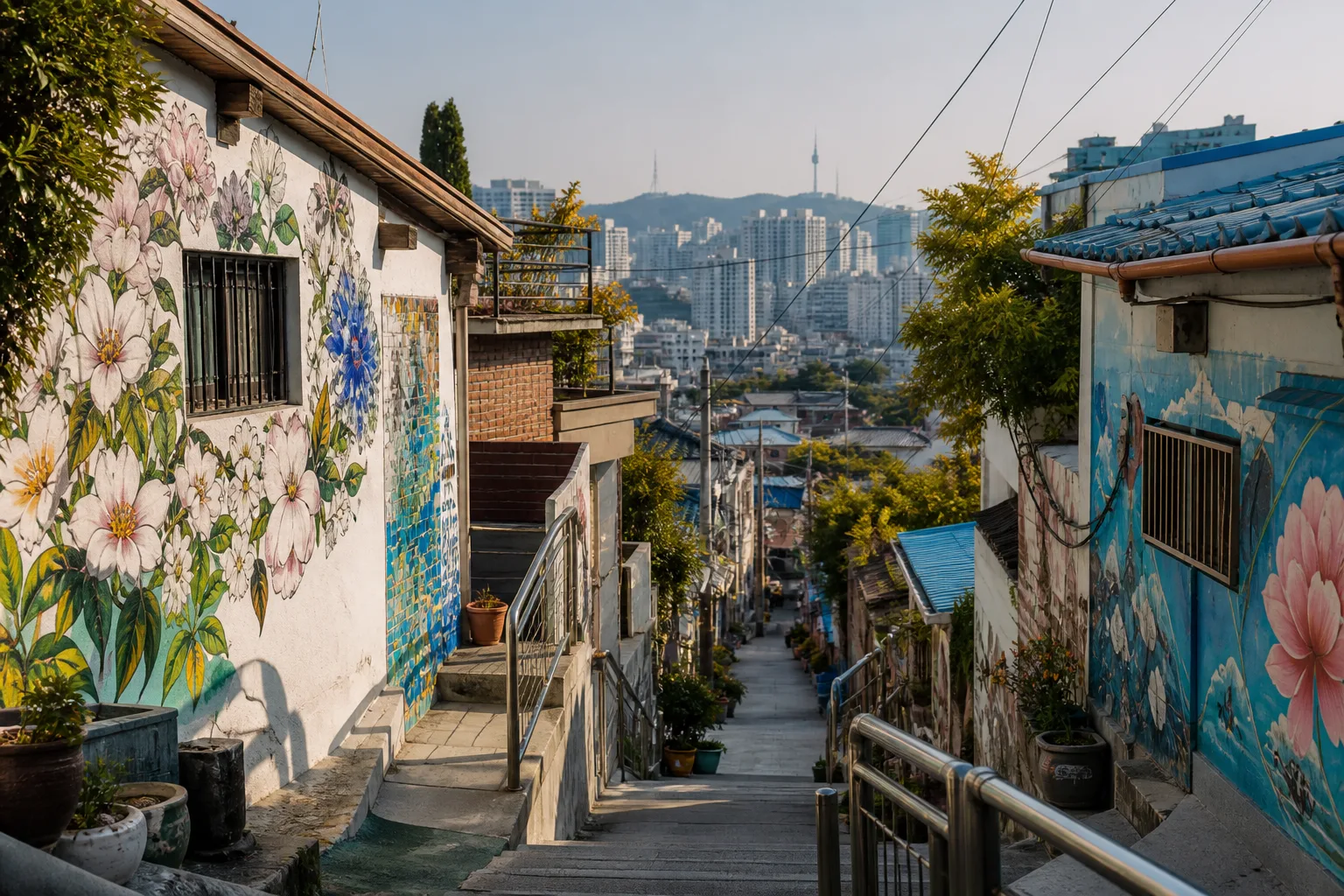
If you have ever seen bright wing murals, stairway art, and hilltop Seoul views on social media and wondered whether the place lives up to the photos, Ihwa Mural Village is probably the neighborhood you were looking at. It is not a ticketed attraction or a polished theme park. It is a real hillside district where public art, local homes, steep alleys, and skyline viewpoints overlap, which is exactly why planning matters if you want good photos without wasting time or irritating residents.
What Makes Ihwa Mural Village Worth Visiting?
Ihwa Mural Village is worth visiting because it turns a simple neighborhood walk into a layered Seoul experience: street art, old stairways, city wall scenery, and a lived-in residential setting all in one compact area. The village is especially useful for first-time visitors who want a scenic stop that feels local rather than curated.
Most people come for the murals, but the better reason to go is the combination of visual variety and easy proximity to other northern Seoul sights. You can move from an art-filled alley to a skyline overlook in a short time, then continue to Naksan Park, Hyehwa, or nearby cultural districts without needing a long transfer.
The official Seoul travel guide lists Ihwa Mural Village at 70-11 Ihwajang-gil, Jongno-gu, with subway access from Line 4 Hyehwa Station Exit 2 and a walk of about 765 meters. That puts it in the part of the city that works well for a half-day on foot, especially if you want to combine art, city views, and cafes.
If you are building a first-timer route, this stop fits naturally into a north-central Seoul day. It is also a good add-on after palace sightseeing, museum hopping, or a Daehak-ro lunch break. For a larger trip structure, it can sit comfortably inside The Ultimate 10-Day South Korea Itinerary for First-Timers without feeling like a detour.
The story behind the murals
The village became famous through a public art revitalization project that transformed what had been an ordinary neighborhood into one of Seoul's most photographed walking routes. The result is not uniform, and that is part of the appeal. Some walls are playful and bright, some are subtle, and some of the most memorable scenes are not murals at all but staircases, lookout points, painted railings, and the interplay between art and the city's older housing fabric.
That mix matters because it changes how you should approach the area. If you expect a compact museum-like attraction, you may be surprised by the amount of walking and incline. If you understand that you are visiting a residential hillside that happens to contain public art, the experience makes much more sense. You can slow down, look around corners, and let the neighborhood reveal itself rather than trying to move through it as quickly as possible.
The official Seoul tourism listing describes the area as a mural village below Naksan Fortress, and that relationship with the city wall is one of the biggest reasons the stop remains compelling. The village is not just about colorful walls. It is also about the elevation, the steps, and the shift in perspective as you climb.
What you will actually see on the ground
Expect a mix of small-scale murals, photo-friendly wings and painted faces, stairs with decorative touches, alley viewpoints, and occasional signs that help you orient yourself. Some of the famous images online are spread out farther than new visitors expect, which means you should not treat this as a one-street attraction. The neighborhood rewards wandering.
You will also notice that the visuals change depending on weather and time of day. On a sunny afternoon the colors pop and the city view is much clearer. On an overcast day the village can feel quieter, more textured, and less crowded, which may actually make it easier to take clean photos. Either way, the hillside setting gives you more depth than a flat mural alley would.
The practical takeaway is simple: come for the art, stay for the walk, and use the whole route as the attraction.
Where Ihwa fits in Seoul's broader art scene
Ihwa Mural Village is street art first, but it belongs to the same creative ecosystem that includes galleries, museum districts, design streets, and neighborhood cafes. If you like the idea of pairing informal art with formal exhibitions, a good follow-up is Best Art Museums and Galleries in Seoul and Beyond: A Complete Guide. That comparison is useful because it helps you decide whether you want a free walking stop, a paid indoor art day, or both.
The contrast is important. A gallery gives you curation and climate control. Ihwa gives you spontaneity, physical movement, and the sense that art is woven into a neighborhood instead of separated into a building. In that way, the village offers a very Seoul kind of experience: it is polished enough for visitors but still shaped by ordinary city life.
How to Plan the Walk
Ihwa Mural Village works best when you treat it as a route, not a single point. Start with the idea that you will climb, pause, photograph, and then continue rather than standing in one spot and hoping the whole visit will be obvious. That mindset will save you energy and help you see more of the neighborhood.
The cleanest approach is to enter from the Hyehwa Station side and move upward through the alleys toward the viewpoints. This direction lets you warm up before the steeper sections and makes it easier to decide whether you want to continue to Naksan Park afterward. It also means you are less likely to miss smaller murals tucked into side paths.
Recommended visit rhythm
If you are short on time, plan for 60 to 90 minutes. That is enough for a straightforward loop, a few photos, and a short break. If you like photography, architecture, or slow travel, 2 to 3 hours is more realistic because you will keep stopping for angles, shadows, and street details.
The village is most enjoyable when you do not rush. A good rhythm looks like this:
- Arrive by subway and walk into the neighborhood.
- Spend the first 15 minutes finding your bearings and noting the slope.
- Photograph the best visible murals early before you get tired.
- Save your energy for the stair sections and skyline viewpoints.
- Finish with coffee, a snack, or a walk toward Naksan Park.
That sequence keeps the experience balanced. It also helps if you are visiting in warm weather because the incline can feel more intense than you expect after a full morning of sightseeing elsewhere in Seoul.
Best kind of traveler for this stop
Ihwa Mural Village is best for travelers who like walking neighborhoods, visual texture, and places where the journey is as important as the destination. It is a strong fit for solo travelers, couples, photographers, and anyone building a content-heavy trip around Seoul's more photogenic corners.
It is less ideal for visitors who want a universally accessible route, a flat path, or a highly structured attraction with clear signage and exact endpoints. Families can still enjoy it, but the stair-heavy terrain makes strollers and very young children more challenging. If you know that in advance, you can choose the right footwear and pace.
When the village feels best
Morning is often best for softer light and fewer crowds. Late afternoon also works well because the angles across the city become more dramatic and the neighborhood feels warmer in tone. Midday can still be fine, but strong sun may flatten some colors and make hill walking less pleasant.
If your goal is clean photos, avoid the busiest weekend windows when possible. If your goal is atmosphere, a quieter weekday gives you a better sense of the neighborhood itself rather than the visitor traffic. Either way, the key is to pair your visit with some flexibility. You are not going to see every mural in a perfect linear sequence, and that is part of the charm.
Practical Guide
Hours, admission, and prices
Ihwa Mural Village is an open neighborhood, not a ticketed attraction. The official Seoul travel guide lists the location and access details, but it does not show a fixed entrance fee or reservation system for the village itself. In practical terms, that means you can visit freely and budget mainly for transport, drinks, snacks, and any paid activities you choose nearby.
Because it is a residential area with public art rather than a gated park, there is no reliable single set of operating hours. Daylight is the most sensible visiting window, both for safety and for photos. If you arrive too late, some alley sections may feel less welcoming simply because they are part of a neighborhood rather than a commercial attraction.
So the simplest budget line is this: the village walk itself is free, and your real cost is whatever you spend getting there and enjoying the surrounding area. If you want a coffee stop after the walk, that is where most visitors end up spending money.
How to get there
The official Seoul tourism listing gives the most straightforward transit note: Subway Line 4 to Hyehwa Station, Exit 2, then about 765 meters on foot. That route is simple enough for a first-time visitor if you are comfortable with a short uphill walk.
If you are coming from central Seoul, the area is easy to add after palace sightseeing, Insadong, or a museum stop. The neighborhood is also near the city wall and Naksan Park, so the most efficient trip is usually one where you combine multiple northern Seoul stops instead of visiting Ihwa in isolation.
If you are using taxis or ride-hailing, ask to be dropped near the Hyehwa side or the specific address listed by Seoul's tourism guide at 70-11 Ihwajang-gil, Jongno-gu. That usually leaves you closer to the most practical entry point than guessing at the top of the hill.
Is there anything to book?
For the village itself, no. You do not need a Klook reservation or a museum ticket to walk the alleys. That is useful because it makes the stop flexible and easy to slot into a bigger itinerary.
Where booking can matter is in the rest of your day. If you are already planning paid experiences in Seoul, it can be smarter to book those separately and use Ihwa as the free scenic segment in between. The village pairs especially well with a broader city plan that includes transportation, food, and a second stop later in the day.
If you are mapping your day around photo spots and cafes, a good companion stop is 10 Most Instagrammable Cafes in Seoul (2026 Edition). That pairing works because Ihwa gives you exterior murals and skyline backdrops, while the cafe gives you a break, a drink, and a place to regroup before your next neighborhood.
What to wear and bring
Wear shoes with decent grip. This matters more than style here because the roads and stairways can be uneven, and you will be going uphill and downhill repeatedly. Light clothing is fine in warm months, but you will be happier if you bring something that handles walking and stair climbing easily.
Also bring water, a phone battery that is not already low, and a little patience. The neighborhood is photogenic, but good photos often require waiting for people to clear a frame or repositioning yourself on a narrow stair. A small tripod can help, though you should be thoughtful about other visitors and residents around you.
Sun protection is useful in spring and summer because some of the best viewpoints have little shade. In colder months, the wind can make the hill feel chillier than the rest of central Seoul, so a jacket is a good idea even when the city at ground level feels mild.
Tips & Common Mistakes
Tip 1: Treat it like a neighborhood, not a set
The biggest mistake travelers make is expecting a perfectly packaged Instagram route. Ihwa Mural Village is beautiful precisely because it is not polished into a theme park. That also means you should move with a little more courtesy, keep your voice down, and avoid blocking doorways or staircases while taking photos.
If you remember that people live there, your visit will be better for everyone. You will notice more subtle details, and you will probably leave with better photos because you are not rushing from one viral spot to the next.
Tip 2: Save the steepest climb for when you have energy
If you arrive already tired from a full morning in Seoul, the incline can feel more exhausting than you expect. A smarter plan is to place Ihwa after a lighter stop or before lunch, not after an all-day marathon. If you want to continue to Naksan Park, do it while you still have some energy left.
That sequencing matters especially in summer when heat and humidity add up quickly. Even if the village itself is not huge, the constant changes in elevation make it more physically demanding than many travelers assume from the photos alone.
Tip 3: Look for frames, not just murals
The best images are often not the most obvious ones. Instead of pointing your camera directly at the most famous mural, look for frames created by railings, stairs, power lines, rooftops, or a curve in the alley. Those environmental details give the photo more sense of place.
This is where Ihwa stands out from a typical mural wall. The neighborhood composition matters. The painted surface, the slope, and the surrounding homes all contribute to the image. If you pay attention to that structure, your photos will feel less generic and more specific to Seoul.
Tip 4: Pair it with food or coffee nearby
You will almost certainly want a break after the walk. Nearby cafes and casual food stops are part of the practical appeal of the area, and they make the visit feel less like a checkbox and more like a proper half-day. If you are planning a photo-and-snack route, the cafe stop is not an afterthought; it is part of the pacing.
For visitors who like to build content-rich neighborhood days, Ihwa works well as the visual anchor, with food and coffee filling the gaps between photo spots and transit connections.
Common mistake 1: Coming with the wrong expectation of accessibility
Some visitors assume all famous tourist spots in Seoul are flat and easy to navigate. Ihwa is not. The stairs are the point. If mobility is a concern, it is better to know that up front and choose a more accessible neighborhood instead of forcing this one into a trip where it does not fit.
Common mistake 2: Visiting without enough time for the walk back down
People often budget time for the uphill exploration but forget that the way down still takes effort, especially if they are continuing to another stop. Leaving a little extra time keeps the village from feeling rushed and gives you space for unexpected photos or rest breaks.
Common mistake 3: Ignoring the surrounding district
The village is stronger when you think beyond the murals. The nearby areas around Hyehwa and Naksan have their own character, and the combination makes the trip more worthwhile than the murals alone. The best visits are the ones where travelers use Ihwa as part of a larger map of northern Seoul, not as a standalone novelty.
FAQ
Is Ihwa Mural Village free to visit?
Yes, the village walk itself is free. There is no entrance ticket for the neighborhood, so your main expenses are transportation and anything you buy nearby.
How long should I spend there?
Most travelers should allow 60 to 90 minutes. If you want to photograph carefully, explore side alleys, and continue toward Naksan Park, 2 to 3 hours is more comfortable.
What is the best station to use?
The most practical transit point in the official Seoul guide is Line 4 Hyehwa Station, Exit 2. From there, expect about a 765-meter walk.
Is it worth visiting if I have already seen Bukchon or other photo neighborhoods?
Yes, if you want something different. Bukchon is more about hanok streets and traditional scenery, while Ihwa is more about public art, stairs, and a hillside neighborhood feel. They are not substitutes for each other.
Can I combine it with other attractions in one day?
Absolutely. It works well with Naksan Park, the city wall, Daehak-ro, nearby cafes, and other central Seoul stops. It is easiest to enjoy when you do not treat it as a separate, isolated outing.
Conclusion
Ihwa Mural Village is one of Seoul's best low-cost scenic stops because it combines art, views, and neighborhood character in a way that feels both photogenic and real. The village is not a formal attraction with a ticket desk and timed entry. It is a lived-in hillside district, which means the experience depends on your pace, your route, and how respectfully you move through it.
If you want the simplest version of the visit, take Line 4 to Hyehwa Station, walk in from the official access side, spend an hour or two exploring the murals and stairways, and then continue to a cafe or Naksan Park. If you want the better version, slow down, look for composition, and treat the whole climb as the point.
For first-time visitors building a Seoul itinerary, Ihwa is strongest when paired with other city stops rather than treated as a standalone must-see. That makes it a practical, flexible addition to a broader trip and a reliable choice when you want one neighborhood to deliver scenery, movement, and photos in the same walk.
If you are planning the rest of your route, use Ihwa as the visual break between bigger sightseeing blocks, then slot in food, coffee, and a second neighborhood so the day feels balanced instead of overpacked.