Day Trips from Chengdu: Emei Mountain, Dujiangyan & Jiuzhaigou Access

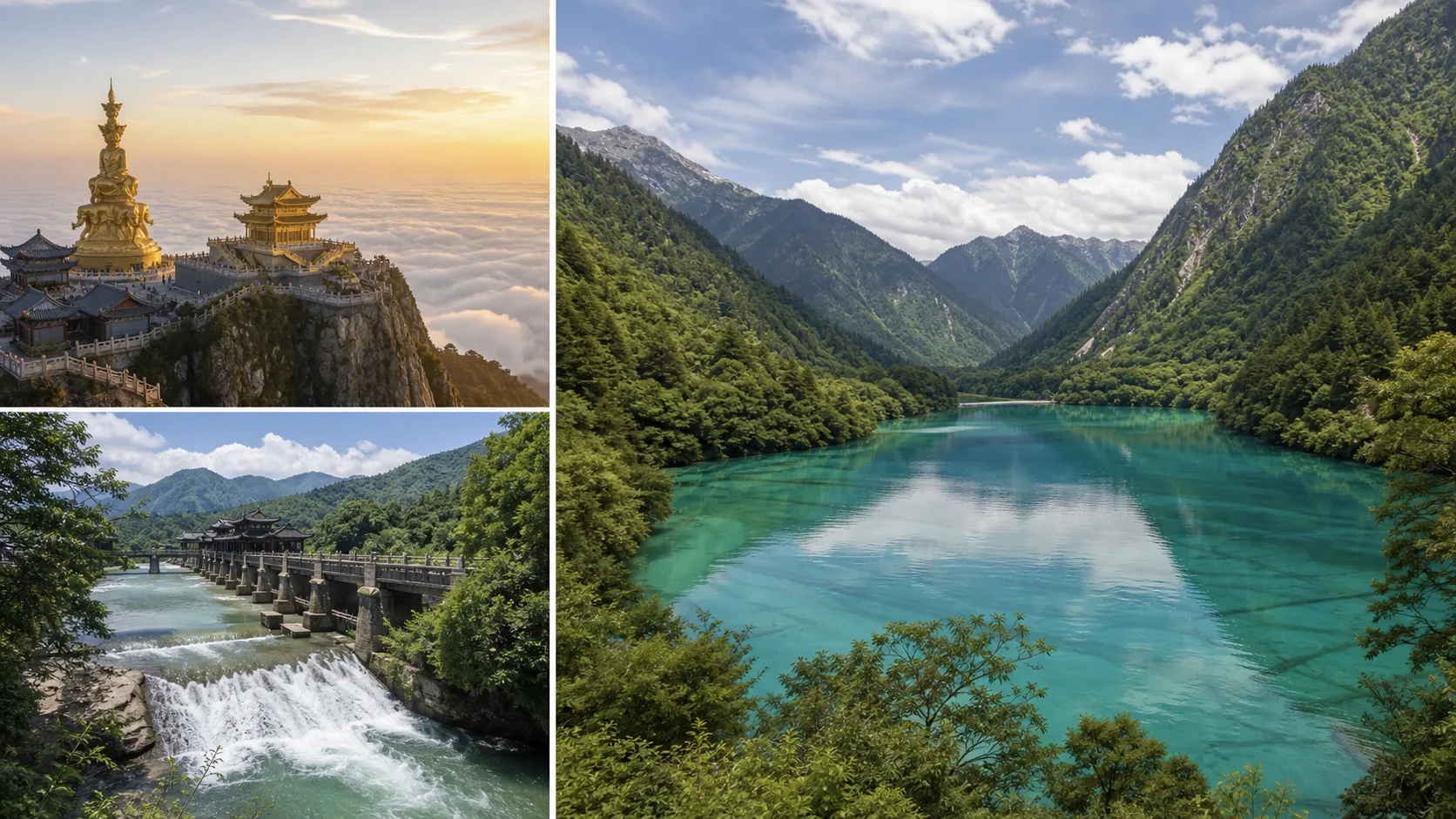
Chengdu is one of the best bases in Southwest China, but it is also a place where travelers overestimate how much they can fit into one day. Emei Mountain, Dujiangyan, and Jiuzhaigou all sit within the broader Sichuan travel orbit, yet they behave very differently on the ground. If you plan them like equal day trips, you will almost always waste time or rush the experience.
What this article helps you decide
The short version is simple: Dujiangyan is the easiest true day trip from Chengdu, Emei Mountain is a stretch day trip that is much better with an overnight, and Jiuzhaigou is not a normal day trip at all. Jiuzhaigou needs long-distance transport, a reservation strategy, and a realistic time budget before you go.
If you want the broader trip context first, start with Chengdu Travel Guide: Giant Pandas, Hotpot & the Best of Sichuan, then use China Travel Planning: Visa, WeChat Pay, High-Speed Rail & Practical Guide for transport basics, and save China's Natural Wonders: Zhangjiajie, Li River & UNESCO Nature Sites if you want to compare Sichuan's scenery with other national-level landscapes.
The practical question is not just “Can I get there?” It is “Will I still enjoy the place after I get there?” Once you answer that honestly, the right itinerary becomes obvious. Dujiangyan rewards a relaxed half-day or full day. Emei rewards an early start or a full overnight. Jiuzhaigou rewards patience, advance booking, and a separate chunk of the trip.
Quick comparison
| Destination | Best for | Best transport | Realistic planning note |
|---|---|---|---|
| Dujiangyan | First-time Chengdu visitors, easy culture/nature combo | Train or car | Best actual day trip from Chengdu |
| Emei Mountain | Temple, mountain, and pilgrimage scenery | High-speed rail plus local transfer | One day is possible, but it is tight |
| Jiuzhaigou | Big scenery, lakes, long-form nature trip | High-speed rail plus shuttle, or flight plus transfer | Treat it as a separate trip, not an add-on |
Emei Mountain from Chengdu
Emei Mountain is one of Sichuan's signature landscapes because it combines mountain scenery, Buddhist heritage, and a sense of scale that is hard to compress into a quick visit. People often add it to a Chengdu itinerary because it is famous and because the route looks manageable on a map. The reality is that the mountain itself is manageable only if you decide what kind of Emei experience you actually want.
What makes Emei different
The key issue is that Emei is not a single compact attraction. You are choosing between low-mountain temple stops, a mid-mountain sightseeing flow, and a higher-altitude scenic experience that can take significant transit time once you arrive. If you also want to walk, ride, rest, eat, and enjoy the views instead of just checking boxes, the day fills fast.
That is why many first-time visitors feel pressure to “do it all” and end up spending more time in queues, transfers, and cable-car lines than on the mountain itself. A rushed Emei day trip can still work, but only if your expectation is to see one clear slice of the mountain rather than the entire system.
Best way to reach Emei Mountain
For most travelers, high-speed rail is the cleanest option because it reduces uncertainty. From Chengdu, the rail leg is the part you want to control tightly; once you arrive, the rest of the journey depends on your exact plan inside the mountain area. A private car can be convenient for families or small groups, but traffic and parking can erase some of the advantage if you leave at a bad time.
The most practical approach is usually:
- Leave Chengdu very early.
- Use the fastest rail connection you can get.
- Decide in advance whether you are doing the low-mountain temple route, the cable-car route, or an overnight mountain stay.
- Build in a return buffer, because mountain weather and transit delays are common.
If you are trying to combine Emei with another stop in the same day, be strict with the clock. Emei can absorb an entire day by itself even before you factor in food breaks and photography stops. The more spontaneous the plan, the more likely it becomes an exhausting transport day instead of a rewarding visit.
One-day Emei itinerary
If you only have one day, keep the scope narrow. Choose one route or one main zone and do it properly. For example, a temple-focused visit lets you absorb the religious and historical atmosphere without racing upward through the mountain system. A scenic-focused visit can prioritize cable access and views while minimizing repeated transfers.
The best one-day Emei itinerary is one that makes a clear tradeoff:
- Less coverage, more enjoyment.
- Fewer stops, better pacing.
- Earlier departure, calmer return.
That tradeoff matters because a “complete” Emei plan often looks efficient on paper but becomes fragile in real life. If weather changes, if a line is longer than expected, or if you stop for lunch longer than planned, the whole day tightens quickly.
When an overnight is better
An overnight is the right call if:
- You care about sunrise, dusk, or slower photography.
- You want to spend real time in the temples or on the trails.
- You are traveling with older family members or younger children.
- You want to combine the mountain with nearby town time without stress.
The overnight also reduces the pressure to run every decision through the lens of “What is the fastest next move?” That is often the biggest quality improvement in a Sichuan trip. You do not just get more time; you get better attention. Emei is a place that benefits from attention.
Who should skip the day-trip version
If your Chengdu stay is short and you still want pandas, food, and one major historical site, Emei may be too ambitious for a same-day return. It is not impossible, but a short trip should usually prioritize easier logistics first. Many visitors are happier using their limited time on Dujiangyan and Chengdu proper, then giving Emei a separate day or overnight later in the trip.
Dujiangyan from Chengdu
Dujiangyan is the most forgiving option in this article because it delivers a lot of value without forcing a punishing travel day. It is the best choice for travelers who want a meaningful outing, some historical context, and a trip that still feels like a holiday rather than a logistics exercise.
Why Dujiangyan works so well
Dujiangyan sits in a sweet spot: close enough for an easy day trip, substantial enough to feel worthwhile, and varied enough to satisfy different travel styles. You can treat it as a history stop, a light nature stop, or a cultural sightseeing day, depending on your pace. That flexibility is exactly why it works so well from Chengdu.
It is also the kind of destination that rewards pairing. You can focus on the engineering and heritage core, then extend the day with nearby scenery or a meal without feeling like you are losing momentum. For travelers who want one well-balanced outing instead of a mountain marathon, Dujiangyan is the strongest candidate.
Access from Chengdu
This is the easiest section of the article to simplify: go early, keep the route direct, and do not overcomplicate the plan. High-speed rail and car transfers both work, but rail usually gives you the least friction if you are comfortable with station-based travel. If you are traveling as a family or with bags, a pre-booked transfer can be smoother because it removes the need to navigate multiple handoffs.
Dujiangyan has also become more user-friendly for international visitors. In January 2026, the Ministry of Culture and Tourism highlighted the scenic area's upgraded booking and service flow, including multilingual ticketing interfaces, broader currency support, and improved convenience for foreign visitors. That matters because access is not only about physical distance; it is also about whether the booking process is predictable.
What to prioritize on a Dujiangyan day trip
Do not approach Dujiangyan as if it were just “one more scenic area.” It works best when you understand the site as a landmark of water management and a living cultural landscape. The first visit should usually prioritize the core heritage area, then add whatever else fits comfortably around it.
If you have time, Dujiangyan can also serve as a calm counterweight to a heavier Chengdu food-and-city schedule. After several days of big meals, busy streets, and crowded attractions, a more open, slower day can feel like a reset.
Best use cases
Dujiangyan is ideal if you are:
- Visiting Chengdu for the first time.
- Trying to keep one travel day low-stress.
- Traveling with older parents or mixed-age family groups.
- Wanting a heritage site that does not require a mountain-level stamina budget.
If your trip is short, Dujiangyan is the trip you should protect. If you are deciding between Dujiangyan and Emei Mountain for the same day, Dujiangyan usually wins unless Emei is the single thing you most want to see.
Jiuzhaigou access from Chengdu
Jiuzhaigou is the most important place in this article to understand correctly: it is a major scenic destination, but it is not a casual day trip from Chengdu. It is a long-distance access problem with a reward at the end. Once you understand that, the whole plan becomes easier to build.
The access reality
The official Jiuzhaigou scenic area site makes the access picture clear. From Chengdu, the road route runs through Dujiangyan, Wenchuan, Maoxian, and Songpan, and the site lists Chengdu bus routes as roughly 440 kilometers and about 9 to 10 hours by road. That alone explains why Jiuzhaigou should be planned as its own trip, not added as an afterthought.
There is good news, though. The official site also shows that the region now has much better rail access. Chengdu East to Huanglongjiuzhai Station can be as fast as 1 hour 39 minutes, and the station-to-scenic-area shuttle system makes the rail option much more attractive than it used to be. For many travelers, that changes Jiuzhaigou from a “maybe someday” destination into a doable, properly structured trip.
Best ways to get there
There are four realistic access patterns:
- High-speed rail plus shuttle.
- Flight to Jiuzhai Huanglong Airport plus transfer.
- Intercity bus from Chengdu or another gateway city.
- Self-drive if you want route flexibility and do not mind long mountain roads.
The rail-plus-shuttle option is the easiest to reason about if you want less uncertainty. The airport option can be efficient in pure distance terms, but it adds the usual flight risks: weather, airport timing, and extra transfers. The bus option is generally the simplest to book if you are already used to long-distance coach travel in China, but it is the least comfortable if you are trying to maximize sightseeing energy.
What the official site says now
For summer 2026, Jiuzhaigou's official ticketing page lists peak-season admission at RMB 190 per person and the sightseeing bus at RMB 90 per person, with peak season running from April 1 to November 15. It also states that all visitors must use real-name reservation and enter with valid ID, and it directs ticket booking through the official WeChat channel.
That matters because Jiuzhaigou is not a place where you can rely on last-minute spontaneity during busy periods. If a travel date matters to you, book ahead. If a date is sold out, the official site itself warns that travelers should choose another date rather than assume they can sort it out at the gate.
Airport, rail, and road in practice
The official arrival page gives a useful reality check:
- Jiuzhai Huanglong Airport is about 88 kilometers from the Jiuzhaigou entrance and around 1.5 hours by road.
- Chengdu bus departures are available from major stations such as Chadianzi and Xinnanmen.
- The Chengdu road route is long enough that the day is consumed mostly by transit.
In practice, the rail route is often the most balanced choice if you want to reduce road fatigue while still controlling your schedule. If you fly, build in extra cushion for weather and transfer time. If you go by road, treat the trip as a scenic journey rather than a quick transfer, because the road itself becomes part of the travel day.
Who should book Jiuzhaigou as a separate trip
Anyone who is coming to Chengdu for five days or less should think carefully before adding Jiuzhaigou. It is easy to fall into the trap of assuming a famous place must be “close enough.” Jiuzhaigou is not close enough. It is one of the most rewarding extensions from Chengdu, but only if you give it enough time to breathe.
If you are building a first-time Sichuan itinerary, the simplest rule is:
- Dujiangyan for a clean day trip.
- Emei Mountain for a fuller day or overnight.
- Jiuzhaigou for a separate scenic block.
That rule keeps the trip enjoyable instead of turning it into a checklist.
Practical Guide
The best practical guide is the one that reduces uncertainty before departure. For these three destinations, uncertainty comes from three different places: Emei's internal scale, Dujiangyan's temptation to overpack the day, and Jiuzhaigou's strict access and reservation rules.
Hours, admission, and prices
For Jiuzhaigou, the official 2026 peak-season details are straightforward:
- Peak season: April 1 to November 15
- Admission: RMB 190
- Sightseeing bus: RMB 90
- Ticketing: real-name reservation with valid ID
The official site also lists the off-season period as November 16 to March 31, with lower admission and bus pricing. If your trip falls in late autumn or winter, check the current page again before you commit to an exact date, because operational details can change with weather and crowd management.
For Dujiangyan and Emei Mountain, the specific ticket mix and internal transport rules matter more than a simple headline price. Both destinations can have multiple components, and the route you choose changes the cost. If you are booking through a platform or package, compare the exact inclusions rather than assuming one ticket equals one complete experience.
How to get there
Use this decision tree:
- Choose Dujiangyan if you want the most reliable one-day outing from Chengdu.
- Choose Emei Mountain if the mountain itself is the main goal and you are prepared for a long day.
- Choose Jiuzhaigou if you are willing to treat the trip as a separate scenic journey, not a side quest.
If you are booking from abroad, high-speed rail is usually the easiest system to understand once you learn the station names and ticketing process. If you are staying flexible inside China, apps and official channels can handle most of the booking work for you. The main rule is to book the long-distance leg first and build the day around it, not the other way around.
Booking strategy
When tickets are scarce or timing matters, book in this order:
- Long-distance transport.
- Scenic-area entry or timed reservation.
- Shuttle, cable, or local transfer if needed.
- Accommodation only after the core route is locked.
That order prevents the most common mistake: committing to a hotel or a side attraction before confirming that the main site is actually accessible at your preferred time.
For Jiuzhaigou in particular, do not rely on a vague “we’ll figure it out” strategy. The official site explicitly warns against low-price ticket scams and fake fast-entry promises. Stick to official reservation channels and keep your ID on hand.
What to pack
Sichuan day trips are not technically difficult, but they are sensitive to comfort. Pack with the access pattern in mind:
- Comfortable walking shoes.
- Layers for mountain weather.
- Water and basic snacks for long transfers.
- A charging cable and power bank.
- ID that matches your reservation details.
If you are heading to Jiuzhaigou, add extra patience. The scenery is famous enough that many travelers arrive with unrealistic emotional expectations. You will enjoy it more if you think of it as a long immersion rather than a series of “must-see” checkpoints.
Tips & Common Mistakes
Most day-trip mistakes around Chengdu come from optimism rather than bad planning. Travelers know the names of the destinations, but they underestimate the time each one actually consumes.
The biggest mistake: treating all three as equal
They are not equal. Dujiangyan is the easiest, Emei Mountain is more demanding, and Jiuzhaigou is a destination trip. If you build your itinerary as if all three belong to the same category, you will overbook your time and undercut the experience.
The second mistake: ignoring the return leg
People tend to plan arrival very carefully and then leave the return open-ended. That usually works badly in Sichuan. When you are tired, mountain transit feels longer, station transfers feel more annoying, and dinner plans vanish. Always know how you are getting back before you leave Chengdu.
The third mistake: overpacking Emei Mountain
Emei can tempt you into trying to see every tier, every viewpoint, and every cultural stop in one pass. Resist that urge. A focused route is usually more memorable than a frantic all-zones route.
The fourth mistake: arriving at Jiuzhaigou without a booking buffer
Jiuzhaigou's official channels are clear about real-name reservation and capacity management. In practical terms, that means you should not assume peak dates will remain available. If your trip is built around a specific day, reserve it early and plan your surrounding Chengdu days around that anchor.
Insider advice
If you only have one “high-value” excursion day from Chengdu, put Dujiangyan first. It gives you the best mix of low friction, decent time efficiency, and a sense that you actually spent the day traveling rather than commuting. Then add Emei if you have another full day or overnight. Leave Jiuzhaigou for the block of the trip that can absorb it properly.
That sequencing is boring in the best possible way: it protects the trip from bad logistics.
FAQ
Is Jiuzhaigou a day trip from Chengdu?
Not in any practical sense for most travelers. You can technically move there in a day if you make the transit the priority, but that defeats the purpose of going. Jiuzhaigou should usually be planned as a separate scenic trip with its own transport and reservation budget.
Which is the easiest day trip from Chengdu?
Dujiangyan. It is the best choice if you want one full outing that still leaves room for a relaxed lunch, a slower pace, and a comfortable return to Chengdu.
Can I do Emei Mountain in one day?
Yes, but only if you leave early and keep the route tight. Many travelers are happier treating Emei as an overnight or a very focused one-day visit rather than trying to see everything at once.
What is the best transport for Jiuzhaigou?
The best option depends on your tolerance for transfers. High-speed rail plus shuttle is often the most balanced. Flight plus transfer is good if you want to reduce road time, and coach or self-drive works best if you are comfortable with long mountain routes.
Do I need to book Jiuzhaigou in advance?
Yes. The official site requires real-name reservation and publishes capacity controls, especially in peak season. If you want a specific date, book ahead instead of trying to solve it at the last minute.
Conclusion
The right Chengdu day trip depends on how much time you actually have and how much travel friction you are willing to absorb. Dujiangyan is the cleanest day trip. Emei Mountain is the most rewarding if you can give it more time. Jiuzhaigou is the biggest scenic prize, but only if you respect its distance and plan it as a separate journey.
If your trip is short, start with the simplest win. If you have more days, build outward from there. The best Sichuan itinerary is not the one with the most names on it. It is the one that matches the realities of transport, timing, and energy.