Pingyao Ancient City: Walls, Gates & Candlelit Night Photography

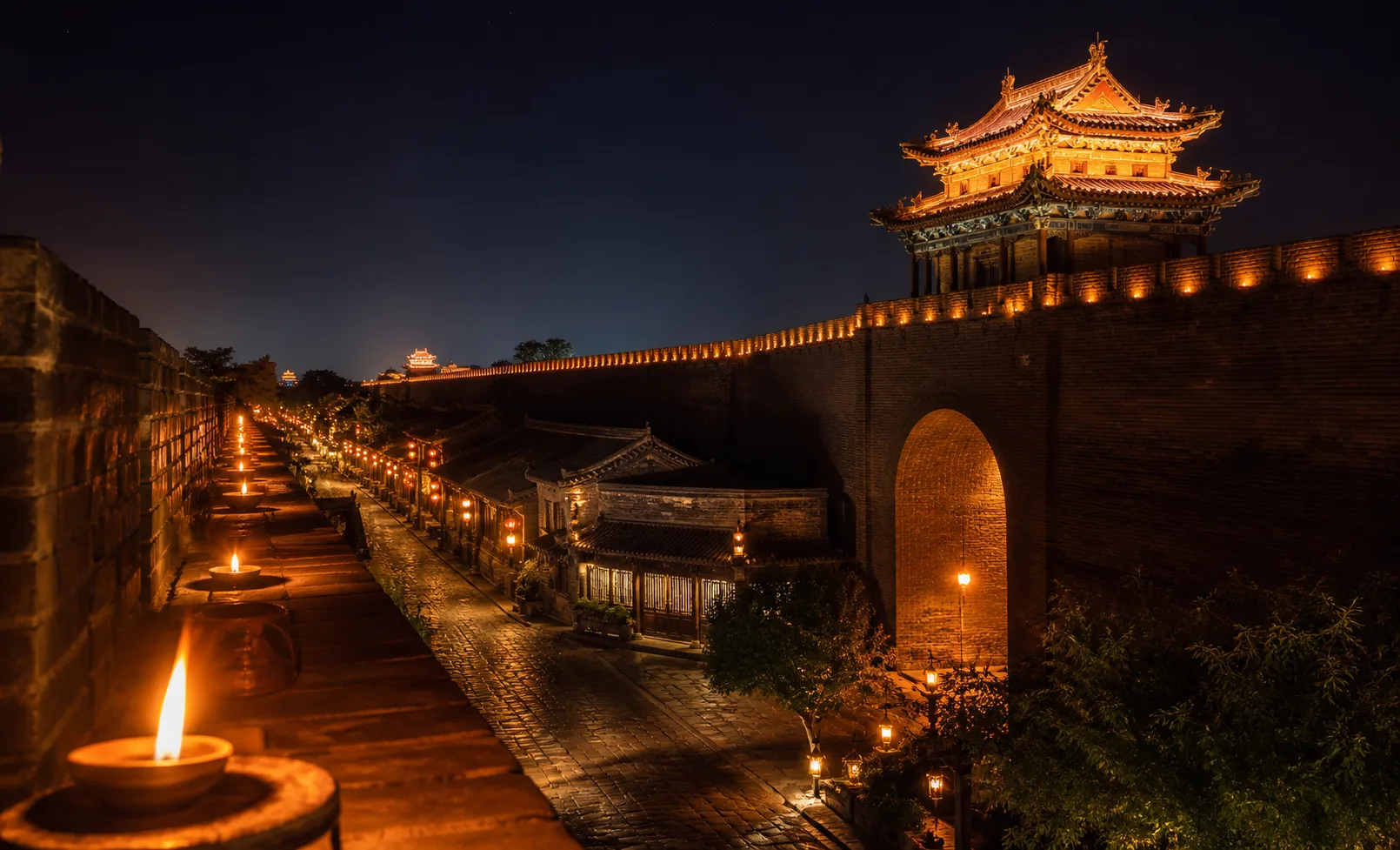
Pingyao is one of the rare places in China where the old city still feels like a complete world after dark. The walls, gates, alleyways, courtyards, and lantern-lit storefronts work together to create a scene that is equal parts documentary, history lesson, and atmosphere. If you want a city break that rewards slow walking and careful composition, Pingyao is hard to beat.
Why Pingyao Ancient City Works for Night Photography
Pingyao is especially good for night photography because the city is compact, enclosed, and historically layered. The old walls define the skyline, the gates create strong leading lines, and the streets inside the city keep enough human activity to make the scene feel alive. Instead of chasing a single landmark, you can build a whole evening around moving between viewpoints and waiting for the light to change.
The best night photos here usually come from a few ingredients working together: a dark sky, warm practical lights, stone or brick architecture, and people moving through the frame. That combination lets you capture not just a monument, but a lived-in historic city. If you are aiming for candlelit mood rather than bright tourism imagery, Pingyao gives you a lot to work with.
A living walled city, not an empty museum
One of the biggest strengths of Pingyao is that it is still a functioning town. That matters for photography because the streets do not feel staged in the way some reconstructed heritage parks do. Laundry lines, bicycles, food stalls, late-night diners, shopkeepers closing up, and travelers drifting between attractions all add detail. At night, those everyday textures become part of the story.
This also changes how you should shoot the city. A perfect empty frame is not always the goal. Often the more interesting shot is the one where a person in a dark coat crosses under a lantern, or where a shop window glows softly while the street around it falls into shadow. Pingyao rewards patience more than speed.
Walls, gates, and lantern light
The city wall is the most obvious anchor for a night itinerary, but the gates are just as important visually. Each gate frames movement differently. Some gates feel defensive and heavy, while others open into wider roads where you can capture the relationship between old stone and modern traffic. At night, that contrast becomes even more striking.
The wall itself gives you scale. Street level photos show intimacy, but the wall gives you perspective. A short climb onto the ramparts can turn a lantern-lined alley into a small part of a much larger composition. If you want your Pingyao photos to feel cinematic, the wall is where you start.
What “candlelit” really means here
The title might suggest literal candlelight, but in practice the mood is usually a blend of lanterns, warm bulbs, tea house lighting, courtyard lamps, and the soft glow from shops and guesthouses. That matters because the appeal is not just darkness. It is warmth against stone, wood, and brick.
Think of the light as layered rather than uniform. Lanterns outline pathways. Windows reveal interior life. Signboards add punctuation. Even a weak source of light can become powerful when it is the only bright element in a frame. If you shoot with that in mind, Pingyao becomes much more than a “night city” subject; it becomes a study in contrast.
A quick route philosophy
For a first visit, do not try to photograph every sight in one evening. Instead, pick one wall section, one gate, one street, and one indoor or courtyard scene. That keeps you from rushing. It also gives you enough variety to build a coherent set of images: establishing shot, detail shot, human activity shot, and a final atmospheric frame.
If you only remember one thing, remember this: Pingyao is better photographed as a sequence than as a checklist.
Best Places to Shoot the Walls, Gates, and Candlelit Streets
The easiest way to approach Pingyao is to think in layers. Start with the perimeter, move through the gates, then work into the streets and courtyards. That structure helps you keep your evening organized while still leaving room for surprise.
Start with the wall as your wide shot
If you want a classic overview, begin near a section of wall that lets you see both the ramparts and the city below. The wall is strongest visually when you can separate it from the rest of the city and let the line of the fortification cut across your frame. At dusk, that line becomes even more readable.
For wide shots, shoot before full darkness. The blue-hour window gives you enough ambient light to keep the wall legible while the lamps begin to glow. Once the sky turns deep blue or black, the city lights become more dramatic, but you may lose texture in the masonry unless you expose carefully.
If you are carrying a tripod, this is the time to use it. A stable base lets you hold the shadows without pushing ISO so high that the brick texture turns noisy. If you are handheld, brace yourself against a railing or wall edge and take several frames in a row. The difference between a usable and unusable low-light shot can be very small.
Use the gates as framing devices
The gates are more than landmarks; they are compositional tools. A gate can frame the street beyond it, compress pedestrians into silhouettes, or create a symmetrical tunnel effect if you position yourself carefully. Because the city is enclosed, gates also work as psychological transitions. They tell the viewer that they are moving from one world to another.
If you are shooting through a gate, pay attention to brightness balance. The exposure often wants to protect the bright area outside, which can leave the interior too dark. In many cases it is better to expose for the midtones inside the gate and let the outside soften slightly. That keeps the atmosphere of the night scene intact.
Some of the best gate shots are not grand architectural portraits. They are simple, almost quiet images: one lantern, one cyclist, one couple walking through the opening. Those frames often feel more authentic than the obvious postcard shot.
Look for street-level glow near the main axes
Once you move inside the walls, the most photographically useful streets are usually the ones with a consistent rhythm of doors, signs, lamps, and foot traffic. You do not need a famous attraction in every frame. You need repeatable structure. Repeating shapes help the eye travel through the darkness.
Pay attention to the places where the street bends slightly, widens, or narrows. Those are natural places to wait because they create depth. The light in Pingyao can be uneven, so a corner with a single lamp may be more useful than a brighter but flatter stretch of road. Look for places where one side of the street is illuminated and the other side falls away into shadow.
If you are working with a phone, use Night mode selectively. It can help in very dark corners, but it can also make the scene look artificial if the software over-brightens everything. Let some black remain in the frame. In night photography, darkness is part of the design.
Don’t ignore courtyards and interiors
Pingyao is not only a street city. Its courtyards, inns, restaurants, and old merchant houses can produce some of the strongest candlelit images of the evening. A courtyard with warm light bouncing off wood and brick gives you a more intimate frame than the wall ever will. If the exterior is about scale, the interior is about texture.
When you shoot in enclosed spaces, watch for reflections in glass or polished surfaces. Those reflections can add depth, but they can also muddy the scene if you are not careful. Shift your angle a little and see whether the light becomes cleaner. Small adjustments matter more at night.
If you are staying overnight in the old town, your accommodation may become one of your best photo locations. A quiet corridor, an inner courtyard, or a doorway lit by a single lamp can be more memorable than a crowded street corner. Treat the whole city as your set.
Build a sequence instead of chasing one hero shot
The strongest Pingyao night set is usually a story:
- A wide wall or skyline shot at blue hour.
- A gate or archway shot as the sky darkens.
- A street-level frame with people and lanterns.
- A courtyard or merchant-house detail shot.
- A final reflective image, such as a quiet lane or doorway.
That sequence gives your gallery rhythm. It also helps you avoid the common mistake of returning with ten similar pictures of the same wall segment. Variety matters more than volume.
Practical Guide
Pingyao is straightforward once you understand how the old city works: the streets are walkable, the heritage sights are ticketed in different ways, and the best experience comes from giving yourself enough time to explore after the day visitors leave.
Hours, admission, and prices
As of the latest public references available for planning, the old city itself is still walkable as a historic urban area, while many of the major sights inside the walls use paid entry or a bundled ticket system. In practice, that means you should think of Pingyao as a place with a free historic street network and a separate admission structure for the museums, compounds, and wall access points you actually want to visit.
That distinction matters. Many first-time visitors assume the entire old town works like a single paid scenic area. It does not. You can spend time wandering the streets, photographing doors and lanterns, and soaking up the atmosphere without treating every step as a ticketed event. The ticketed sites are usually the wall sections, major former financial houses, old government offices, temples, and selected museums.
Because prices and opening schedules can change by season, site, or management update, do not lock your itinerary around a single published number from a random third-party listing. Check the latest ticket desk information on arrival if you need the exact bundle rate for the day. For photography, the more important planning question is not only the price but whether the sites you care about are open during the hour of best light.
For travelers who like to compare related experiences, the broader context in Best Photography Spots in China: Ancient Towns to Modern Skylines is useful if you are deciding how Pingyao fits into a larger photo trip.
How to get there
The most practical approach is usually rail. Pingyao is connected to Shanxi’s rail network, and many travelers arrive via a larger hub such as Taiyuan before transferring onward. High-speed rail is often the cleanest option if you are coming from a major city, because it keeps the trip predictable and avoids the complications of long-distance road travel in the evening.
If you are already in Shanxi, the transfer is simpler still. Build in enough time to arrive before sunset if your goal is night photography. Arriving in the dark is possible, but you will lose the relaxed scouting period that makes the first evening so productive. The more familiar you are with the lanes and gates before the light drops, the better your shots will be later.
If your wider China trip still feels complicated, the practical checklist in China Travel Planning: Visa, WeChat Pay, High-Speed Rail & Practical Guide is the right place to sort out the basics before you book the Pingyao leg.
Booking strategy for photographers
You do not need a complex booking strategy to enjoy Pingyao, but a few choices help.
If you want the calmest atmosphere, stay inside the old town so you can walk back out after dinner and shoot again when the crowds thin. That saves time and makes the night work feel less rushed. If you are traveling on a tighter budget, stay just outside the walls and enter on foot after sunset.
If you want a structured sightseeing day before the night shoot, buy the main ticket or bundle early enough to cover the attractions you plan to enter. Then reserve the late afternoon and evening for wandering. You do not need to race between sites. In fact, the best photography usually comes from slowing down enough to wait for gaps in foot traffic and for the light to settle.
If you are arranging other China attractions on the same trip, book the rail and any long-distance transfers before you fine-tune the photo schedule. Pingyao is best when it is not treated like a rushed half-day stop.
Suggested evening schedule
Here is a practical rhythm for a first night:
3:30 p.m. to 5:30 p.m. Arrive, check in, and walk one section of the old town in daylight.
5:30 p.m. to 6:30 p.m. Shoot blue-hour wall views and your first gate compositions.
6:30 p.m. to 8:00 p.m. Move into the streets and courtyards as lights come on.
8:00 p.m. to 9:30 p.m. Focus on details: shopfronts, signboards, lanterns, reflections, and people.
9:30 p.m. onward. Return to the quietest lanes for your most atmospheric frames.
That schedule is deliberately simple. It lets you respond to the city instead of forcing the city to fit an itinerary. If the weather is cloudy, even better. Thin cloud can spread the ambient glow and make the street lighting feel softer.
Tips & Common Mistakes
Pingyao is easy to enjoy and slightly harder to photograph well. The mistakes tend to be small, but they add up quickly.
Do not over-light the scene
The most common error is trying to make the city look brighter than it feels. If every shadow is flattened, you lose the mood that makes Pingyao special. Preserve some darkness around your subject. Let the viewer sense the night rather than erase it.
If you are using a phone, lower exposure slightly after Night mode processes the image. If you are using a camera, expose for the important highlight and accept that some background detail will disappear. A night photograph does not need to show everything.
Avoid making every frame symmetrical
Pingyao has many naturally symmetrical subjects, especially gates and wall sections. Symmetry is useful, but too much of it can make the gallery feel repetitive. Mix in off-center compositions, diagonal lines, and partial frames. A doorway shot with a person on one side of the frame often feels more human than a perfectly centered arch.
Carry enough battery and memory
Low-light shooting burns power faster than daytime photography, especially if you are reviewing images constantly or using a phone’s processing-heavy night modes. Bring a power bank, a spare battery if you have one, and enough storage for more frames than you think you need. Night photography often improves only after the first dozen “warm-up” shots.
Plan around crowds, not against them
Crowds are not a problem to eliminate completely. They are part of the scene. The trick is to time your images so that the crowd density matches the shot you want. Early evening usually gives you more movement and energy. Later at night, you get more stillness. Shoot both. They tell different stories.
Watch for reflective surfaces
Windows, wet pavement, polished wood, and glass displays can all either help or hurt your image. Reflections can be beautiful when they double the lantern light, but they can also create confusion if they interfere with your subject. Move a step left or right before you give up on a composition. Small shifts often solve the problem.
Respect the places people live and work
Because Pingyao is a living town, not just a museum, be considerate when you set up or linger. Do not block a doorway, a shop entrance, or a narrow lane. If you are using a tripod, keep it compact and efficient. Good night photography should feel invisible to the people around it.
Use the weather, don’t fight it
Clear evenings are ideal for crisp architecture, but light haze or light drizzle can produce a more cinematic glow. If the pavement is damp, lanterns and signs will reflect more clearly. That can make the scene richer, not worse. A perfectly clean sky is not the only good outcome.
Keep your walking route simple
The old town can tempt you into endless wandering. That is fine if you are exploring, but a photographer benefits from a repeatable route. If you are lost, the quality of your images often drops because you spend your attention on navigation. Choose a small loop, learn it well, and refine your shots on the second pass.
FAQ
Is Pingyao worth visiting if I am not a serious photographer?
Yes. The same qualities that make it good for photography also make it good for general travel: a compact old town, strong historic character, and an evening atmosphere that feels different from the daytime tourist rhythm. Even if you only take phone photos, the walk itself is the point.
Can I see the ancient city walls without spending the whole day there?
Yes, but the experience is better if you give yourself at least one afternoon and evening. A rushed wall visit can feel generic. Once you stay through blue hour and darkness, the city’s atmosphere becomes much clearer and more memorable.
Do I need a tripod for night photography in Pingyao?
Not strictly, but it helps a lot. A tripod is most useful for wall panoramas, long-exposure street scenes, and low-ISO shots in courtyards. If you are traveling light, a phone and a steady hand can still work, especially near brighter streets and gate lights.
Is the old city itself open like a normal street district?
Essentially yes. The old town is a real urban area, not just a single enclosed attraction. That said, many specific heritage sites inside the walls have their own admission rules and hours. Plan the old streets and the paid sights as related but separate parts of the visit.
What is the best time of year for candlelit night photography?
Autumn and spring are usually the most comfortable because temperatures are milder and you are more willing to stay out after dark. Winter can be atmospheric too, but the cold can shorten your patience and make camera handling less comfortable. Summer gives you longer evenings but can feel busier and more humid.
How many nights should I stay?
One night is enough for a taste, two nights is better for photography, and three nights is ideal if you want to combine scouting, shooting, and relaxed sightseeing. The second evening is often the one that produces the best frames because you already know which lanes are worth revisiting.
Conclusion
Pingyao is one of the best places in China for a slow, atmospheric night walk because the city gives you structure without destroying spontaneity. The walls create the frame, the gates create transitions, and the streets supply the human scale. Add lanterns, warm interior light, and a little patience, and you have a place that is far more rewarding after dark than it first appears.
If you are planning a photography-led trip, think in layers: arrive before sunset, learn the perimeter, spend time in the lanes, and come back out when the city quiets down. Do that, and Pingyao stops being just a historic destination. It becomes a complete night scene.