Where to stay in Osaka: Namba, Umeda, or Shinsaibashi — a neighborhood decision guide

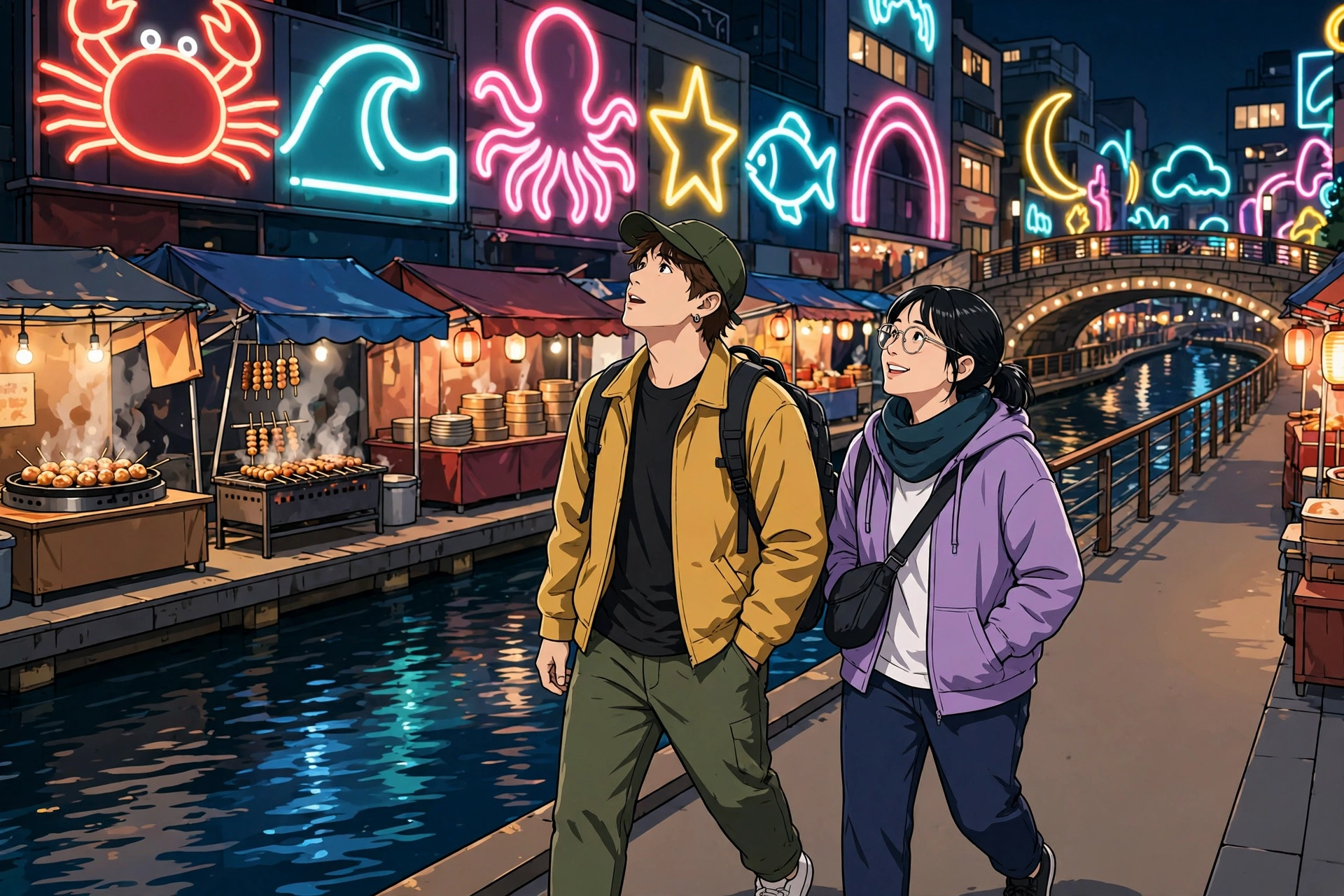
Osaka gives first-time visitors a rare gift: there is no wrong neighborhood, only a neighborhood that fits a different kind of trip. The city runs on a compact grid of three hubs — Namba in the south, Umeda in the north, and Shinsaibashi wedged between them — and each one answers a different question about how your trip will actually run. Are your days built around dawn departures to Kyoto and Nara, or around Dotonbori at 1 a.m.? Do you want to roll off the airport express and walk to your hotel, or trade one transfer for faster day-trip routing?
Most neighborhood advice online lists attractions near each station and stops there. That misses the point. Attractions are cheap to reach from anywhere on the Midosuji Line; what actually changes your trip is transport logic — where your day trips leave from, how late you stay out, and how you get in from Kansai Airport on day one. Get the base right and the whole itinerary gets easier. Get it wrong and you spend the week re-crossing the city you already crossed.
Namba vs Umeda vs Shinsaibashi in one table
Namba is Osaka's entertainment core, best for nightlife and cheap eats. Umeda is the business hub with the strongest rail connections for Kyoto and Kobe day trips. Shinsaibashi sits between them, trading a quieter feel for shopping convenience. Choose by when you sleep, not what you sightsee.
| Namba | Umeda | Shinsaibashi | |
|---|---|---|---|
| Core identity | Entertainment and food district — Dotonbori, Kuromon Market, neon and izakaya | Business and transit hub — Osaka Station, department stores, office towers | Shopping and style corridor between the other two |
| Best for | Night owls, food-first travelers, budget-conscious groups | Day-trippers, business travelers, anyone leaving early most mornings | Shoppers, couples, travelers who want Namba's energy with a calmer sleep |
| KIX access | Direct: Nankai Rapi:t express reaches Namba in about 35–38 minutes with no transfers | One transfer or a direct airport limousine bus (around 50–60 minutes) | Nankai to Namba then one subway stop or a 10–15 minute walk |
| Day-trip routing | Best for Nara (Kintetsu direct) and USJ; workable for Kyoto with a transfer | Best for Kyoto, Kobe, and Himeji — JR and Hankyu/Hanshin lines all converge here; closest regular station to Shin-Osaka for the Shinkansen | Mirrors Namba's routing via the Midosuji Line, plus easy access to central business lines |
| Nightlife | Dotonbori, Shinsaibashi-adjacent bars, late izakaya; the latest scene in Osaka | Kitashinchi (upscale), Umeda's standing bars; quieter after midnight | Bars and clubs spill over from Dotonbori; the most walk-home-friendly option |
| Accommodation profile | Business hotels, hostels, capsules, midrange chain hotels; generally the cheapest of the three | Business hotels and upscale chains; pricier on average, professional and quiet | Boutique hotels, design hostels, serviced apartments; good value for location |
| Watch out for | Tourist-trap pricing on Dotonbori's main strip; noisy streets late at night | Hotels near the station complex can feel sterile; the station itself is a maze the first day | Fewer direct airport options; some blocks skew pricey for what you get |
A note on overlap: Shinsaibashi and Namba are effectively one continuous district — the Shinsaibashi-suji shopping arcade runs straight into Dotonbori, and the walk from Namba Station to Shinsaibashi Station is about 10–15 minutes on foot. Many "Shinsaibashi hotels" are a 12-minute walk from Namba's nightlife and a 2-minute subway ride from Umeda. If your heart says Namba but your budget or noise tolerance says otherwise, Shinsaibashi is often the answer.
How your day-trip plans pick your base
The honest way to choose is to work backwards from your hardest travel days. A base that saves you one transfer each morning pays for itself five times over in a week. Here is how each neighborhood handles the classic Kansai day trips.
Kyoto and Arashiyama
Umeda wins this one clearly. The JR Special Rapid from Osaka Station reaches Kyoto in about 30 minutes, and the Hankyu limited express from Umeda to Kyoto-Kawaramachi takes roughly 45 minutes — two independent routes, which means a missed train or a line delay costs you minutes, not a plan. Hankyu's Kyoto-Kawaramachi terminus also drops you in central Kyoto, closer to Gion and the eastern temples than JR Kyoto Station is for some itineraries.
From Namba, Kyoto is a two-leg trip: subway up to Umeda (or a Hankyu connection via the Namba-area transfer), adding 15–25 minutes each way. That is 30–50 minutes of extra transit per day — enough to matter if you are doing Kyoto two or three times. From Shinsaibashi, add one subway stop to Namba's math; it is marginally better but not meaningfully different.
If your trip is Kyoto-heavy — two or more day trips, or an early Arashiyama start to beat the bamboo grove crowds — Umeda is the rational base.
Nara
This one flips. The Kintetsu Nara Line runs directly from Osaka-Namba to Kintetsu-Nara in about 40 minutes with no transfers — the single easiest Nara access in the city. Kintetsu's limited express is comfortable and cheap, and the Nara terminus sits a short walk from Nara Park and the deer.
From Umeda, Nara requires a JR or subway transfer first (typically Osaka Station to the Osaka Loop or a Kintetsu connection), turning it into a 50–60 minute trip with one change. Not terrible, but noticeably worse. If Nara is a priority — a full day at Todai-ji and the deer park, not a half-day squeeze — Namba's direct line is a real advantage. Time your visit around the park's busiest hours.
Kobe
Umeda again. The JR Special Rapid from Osaka Station to Sannomiya takes about 25–30 minutes, and Hankyu and Hanshin both run Umeda–Kobe services in under 30 minutes. Three parallel lines means you are never waiting long, and the return at night is painless.
From Namba, Kobe is a two-step trip: Hanshin Namba Line to Amagasaki or a subway ride up to Umeda first, then west. Budget 45–55 minutes door to door. The harbor, the beef lunch strategy, and the Arima onsen add-on are all easier when the station math is simple.
Universal Studios Japan
Namba holds a narrow edge. USJ sits on the JR Yumesaki Line via Nishikujo; from Namba, the Hanshin Namba Line to Nishikujo plus one stop takes about 20–25 minutes total. From Umeda/Osaka Station, it is the Osaka Loop to Nishikujo plus one stop — roughly the same time, sometimes a few minutes faster depending on connections.
The practical difference is departure timing, not minutes. USJ rewards early arrival — timed entry tickets and popular rides favor the first hour — and Namba's route runs frequently from early morning. Either base works; check express pass strategy before you lock in a day, because it matters more than station choice here.
Himeji and beyond
Himeji Castle is a straight shot on the JR Special Rapid from Osaka Station — about an hour, no transfers, and the castle is a 15-minute walk from Himeji Station. Umeda is the only sensible base for it. From Namba you add a 20-minute transfer penalty each way, which pushes a Himeji day from comfortable to rushed.
The rule that covers all five: if your week has more day trips than late nights, base near Umeda. If it has more late nights than day trips, base near Namba. Count your early departures and your 1 a.m. returns before you book anything.
Nightlife and late-night transport trade-offs
Osaka is Japan's most nocturnal major city outside Tokyo, and the neighborhood you sleep in determines whether the night ends well or ends expensively. The metro system typically shuts down between midnight and about 12:30 a.m. depending on the line — there is no all-night subway, and the gap between the last train and the first train is the most expensive stretch of your trip if you mismanage it.
Namba: the night you don't have to leave
Dotonbori is the obvious draw — the canal, the neon, the takoyaki lines at midnight — but the real nightlife value of Namba is that the entertainment and the accommodation are the same place. Izakaya alleys, standing bars, karaoke, and late-night ramen sit within a 15-minute walk of most Namba hotels. When the night ends, you walk home. That is worth more than it sounds: a taxi across the city at 2 a.m. in Japan is not cheap, and the late-night surcharge (typically about 20 percent from 10 p.m. to 5 a.m.) applies to every ride.
Namba's food scene after dark is also the best of the three neighborhoods for variety per square meter. Kuromon Market's daytime stalls give way to Dotonbori's evening chaos, and the back streets hold the kind of six-seat izakaya that don't appear in guidebooks. For the food-first traveler, Dotonbori's takoyaki, okonomiyaki, and late-night pacing are what make the district work.
The trade-off is noise. Main-drag Namba hotels hear Dotonbori until late, and weekend crowds thin out but never vanish. Ask for a room on a high floor away from the canal side, or pick a hotel one or two streets back. If you are a light sleeper, this is Shinsaibashi's whole pitch.
Umeda: earlier nights, better mornings
Umeda's nightlife is real but different in character. Kitashinchi, just south of Osaka Station, is Osaka's upscale drinking district — small bars, wine, good whiskey, prices to match. The standing-bar scene around the station's east side is livelier and cheaper, and the big department-store basements (depachika) are the move for an early-evening food crawl before dinner.
What Umeda does not offer is a 1 a.m. street scene. The district winds down earlier, and after the last trains, the area around the station gets quiet fast. That is either a feature or a dealbreaker. If your pattern is dinner, drinks, and bed by midnight — the classic business-trip rhythm — Umeda's quiet is an asset, and your morning starts at the city's best-connected station.
Shinsaibashi: the compromise that works
Shinsaibashi gets Namba's spillover without Namba's intensity. The bars and clubs along the arcade's southern end stay busy late, Dotonbori is a 10-minute walk, and the residential side streets are genuinely quiet. For couples and groups where one person wants the late night and the other wants sleep, this is the neighborhood that ends the argument.
The last-train problem, solved three ways
Whichever base you choose, the midnight question is the same. Three strategies cover it:
- Know your last train. Check the last departure on your specific line the first night — Google Maps and Japan Transit Planner show them clearly. The Midosuji Line's last trains from Umeda to Namba run around 12:20 a.m.; plan backwards from that.
- Stay out until the first train. This is the classic Japanese move: if you miss the last train, keep going. Karaoke rooms, 24-hour manga cafes, and late izakaya exist precisely for this. It is cheaper than a long taxi and, frankly, more fun.
- Budget the taxi. A Namba-to-Umeda taxi at 2 a.m. runs a few thousand yen with the surcharge — acceptable once or twice a trip, painful as a nightly habit. If you are staying in Umeda but living your nights in Dotonbori, reconsider the base, not the budget.
Station access: KIX arrival and daily routing
Day one sets the tone. Kansai International Airport sits on an artificial island about 50 km south of the city, and the airport-to-hotel transfer is the first real decision of the trip. Get it wrong and you start with an hour of confusion; get it right and you are at your hotel before you have finished your airport coffee.
Landing at KIX: Nankai vs JR vs limousine bus
Nankai to Namba is the cleanest arrival in Osaka. The Rapi:t limited express — the dark-blue train with the rounded nose — runs from KIX to Namba in about 35–38 minutes, reserved seats, space for luggage, and no transfers. The standard Airport Express takes about 45 minutes and costs less. Either way, you step off at Nankai Namba and most Namba/Shinsaibashi hotels are a walk or one subway stop away. If your base is Namba, this is a 40-minute door-to-door transfer. Nothing else in the city comes close.
JR Haruka to Tennoji and Osaka serves the Umeda base. The Haruka limited express runs from KIX through Tennoji to Osaka Station in roughly 50 minutes, with good luggage space and reserved seating. It costs more than the Nankai option, but if you are staying in Umeda, the arrival at Osaka Station puts you inside the city's main transit hub — and your hotel is likely a short walk or one subway stop from there. There is also a discount ticket set (the ICOCA & Haruka package) worth checking if you plan to use an IC card anyway.
The limousine bus runs from KIX directly to the Umeda area (Herbis Osaka and nearby stops) in about 50–60 minutes depending on traffic. It is the only option that delivers you to Umeda with zero transfers and zero station navigation, which matters more than it sounds after a long flight. The trade-off is traffic: a bad evening on the highway can add 20 minutes.
For the logistics around all of this — IC cards, rail passes, and which discount tickets are actually worth it — check the current discount rules before you buy.
Daily routing: the transfer tax
Beyond day one, the question is how many transfers your average day costs. Umeda's Osaka Station is the convergence point for the JR Tokaido Line (Kyoto, Kobe, Himeji), the Hankyu network, Hanshin, and the Midosuji subway — most major moves start here with zero or one transfer. Namba is the convergence point for the Nankai network (KIX, Wakayama, Koyasan), Kintetsu (Nara, Ise), Hanshin (Kobe, with a change), and three subway lines. Shinsaibashi rides Namba's coattails via the Midosuji Line plus its own Nagahori Tsurumi-ryokuchi Line.
In practice: count the transfers on your three most frequent routes. If two of them start cleaner from Umeda, the "vibe" argument for Namba loses. Transport logic beats atmosphere when you are doing it twice a day for a week.
One more routing note: the Shinkansen does not leave from Osaka Station. It leaves from Shin-Osaka, one JR stop (about 4 minutes) north of Osaka Station. Umeda is the closest of the three neighborhoods — a trivial hop. From Namba, add 20–25 minutes via subway. If your trip ends with a Shinkansen to Tokyo or Hiroshima, Umeda's proximity is the difference between a relaxed departure and a stressful one.
The luggage problem
Osaka's stations are big, crowded, and not always elevator-friendly at the exits you need. If you are changing hotels mid-trip — say, three nights in Namba then two in Kyoto — Takkyubin (courier) services move a suitcase between hotels with next-day delivery, which turns a multi-base trip from a hauling exercise into a non-issue. For a single base with day trips, pack a small day bag and leave the suitcase at the hotel; every neighborhood above is day-trip-friendly with light luggage.
Who should stay where: four traveler profiles
Profile 1: The night owl
You are here for Dotonbori after dark — the food, the bars, the energy. Your ideal day starts at noon and ends at 2 a.m. Stay in Namba, as close to Dotonbori as your noise tolerance allows. The walk-home factor eliminates the last-train problem entirely, and the neighborhood's late-night food density means dinner at midnight is a plan, not a compromise. If the main strip feels too loud, drop one block back or drift north into Shinsaibashi for the same access with quieter streets.
Budget note: Namba's hostels, capsules, and business hotels are the cheapest of the three neighborhoods on average. Night owls also tend to spend on experiences rather than rooms, which makes the math even better. For keeping the food budget in check between the big nights out, the Japan budget food guide covers conbini strategy, izakaya ordering, and depachika timing.
Profile 2: The day-tripper
Your trip is a Kansai circuit: Kyoto twice, Nara once, Kobe once, maybe Himeji. You are up at 7, out by 8, and you want the fewest transfers between you and the platform. Stay in Umeda, within walking distance of Osaka Station. The 30-minute Kyoto run, the 25-minute Kobe run, and the 4-minute hop to Shin-Osaka for the Shinkansen are the whole argument. You will eat dinner near the station most nights — Kitashinchi for one good splurge, the depachika for the rest — and you will be in bed by eleven because the 7 a.m. train waits for no one.
This profile also benefits most from the rail pass math. Run your day-trip list through the discount-pass rules before buying anything — the Kintetsu and JR regional passes only pay off at specific trip counts, and Umeda's routing makes the JR options most attractive.
Profile 3: The business traveler or fast mover
You are in Osaka for two or three nights, maybe between Tokyo and Kyoto, and every hour counts. Stay in Umeda. The Haruka or limousine bus gets you in cleanly, the Shinkansen is one stop away at Shin-Osaka, and the business-hotel density around the station means reliable wifi, early breakfast, and a front desk that handles checkout in ninety seconds. Umeda's sterility is a feature here — you are not sightseeing, you are executing. Eat well once in Kitashinchi, take the depachika back to the room the other nights, and spend your saved transit time on sleep.
Profile 4: The couple or first-timer who wants it all
You want the food, the shopping, the day trips, and sleep. You do not want to learn a station maze on day one. Stay in Shinsaibashi. The shopping arcade gives you a car-free spine to orient around, Dotonbori is a 10-minute walk for the evenings, Umeda is two subway stops for the mornings, and the hotel stock skews boutique — nicer rooms for the money than equivalent Namba picks. It is the lowest-friction base in the city for travelers who want to do a bit of everything without optimizing any single axis.
Before planning a shopping day, note that the two districts look adjacent on the map but sell very different things, and knowing which is which saves a wasted afternoon.
The decision in one minute
Answer these three questions in order:
- How many 7 a.m. departures does your trip have? Two or more → Umeda.
- How many 1 a.m. returns? Two or more → Namba.
- Did both answers come out low? → Shinsaibashi, and enjoy not having to choose.
Whichever base you pick, the rest of the Kansai plan barely changes — the trains run the same routes from all three, just with different transfer counts. The neighborhood decision is about friction, not access. Minimize the friction on the days you repeat most, and the trip takes care of itself.