Tateyama Kurobe Alpine Route: Crossing, Tickets and Luggage

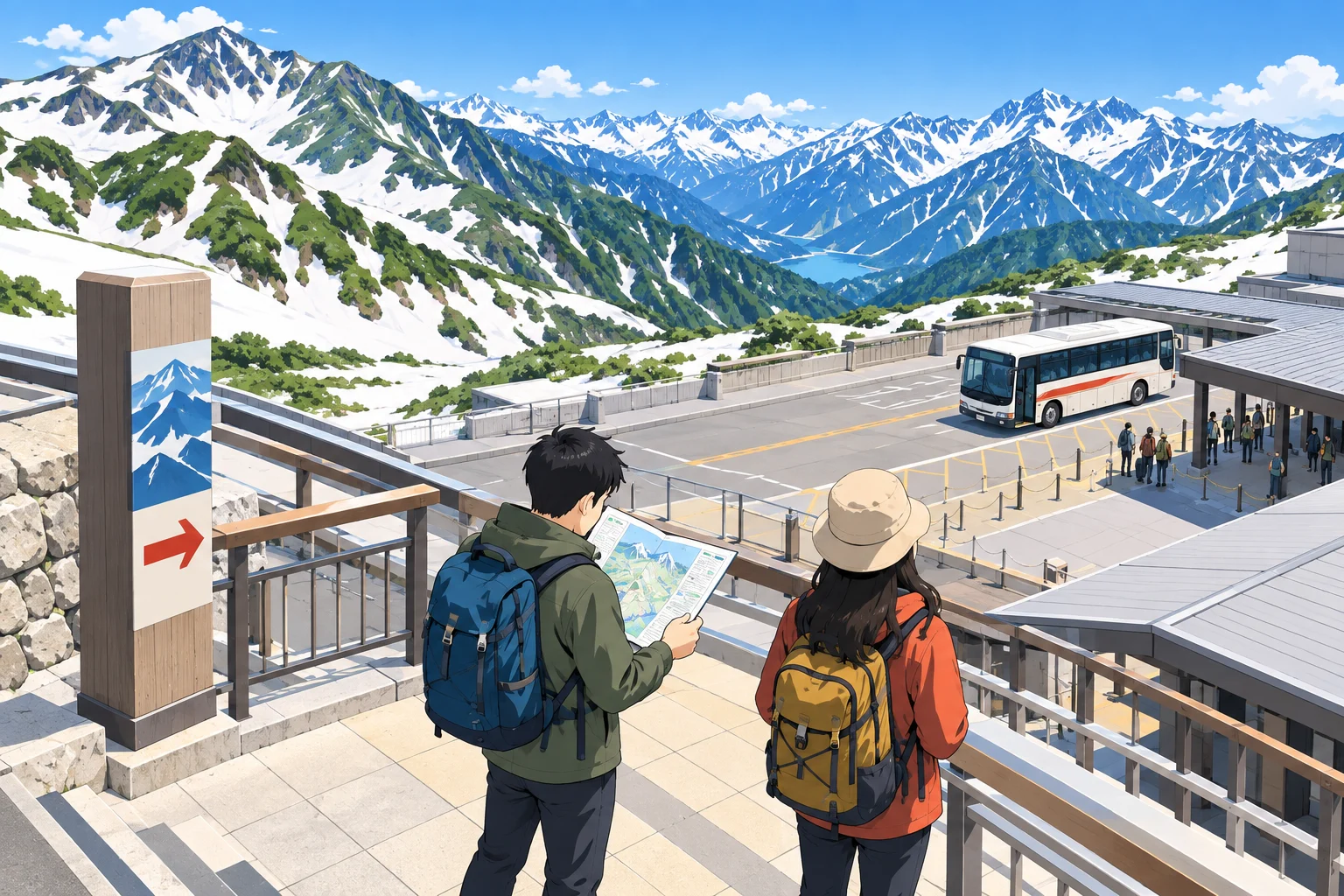
The Tateyama Kurobe Alpine Route looks like a continuous line across the mountains, but it is a chain of different vehicles, stations and timed starting departures. The most important decision is whether you will cross from the Toyama side to the Nagano side or return to the side where you began. That choice determines your ticket, hotel locations, luggage plan and final connection.
This guide is for a Singapore-based traveler arranging an independent Alpine Route visit. It uses the operator's 2026 ticket, timetable and baggage pages. The route is seasonal, and weather or special operations can change services. Treat every time and fee as date-specific: open the current operator pages again before buying a nonrefundable train or hotel elsewhere in Japan.
Choose a Toyama to Ogizawa crossing or a same-side Murodo return
Choose your overnight city before comparing tickets. A crossing ends on the opposite side of the mountains; a return brings you back to your starting side. The right choice depends on your next hotel, luggage handoff and final connection. Decide that route first, then buy its matching ticket.
On the Toyama side, the common approach is via Dentetsu Toyama and Tateyama Station. On the Nagano side, the mountain entrance is Ogizawa, reached by road transport from the Omachi or Nagano direction. The central scenic stop is Murodo. The route operator's access guide notes that private vehicles cannot drive the protected route between Tateyama Station and Ogizawa. This is a connected public-transport journey, not a scenic drive across the pass.
A route diagram can conceal the time needed between segments. Walking to a platform, queuing, taking photographs, using a restroom and waiting for the next service all add up. The operator's same-day ticket page gives indicative durations of seven to eight hours for a Dentetsu Toyama to Ogizawa crossing and seven to eight hours for a Toyama-side Murodo return. These are planning estimates for the listed products, not a promise that every visitor finishes at that time.
If you are traveling with small children, an older relative or a group that wants long photo stops, start early and reduce the number of optional detours. A traveler who wants to linger at Murodo may get more enjoyment from a focused return trip than from racing to the far end. Conversely, someone changing hotels from Toyama to Nagano gains a useful transport connection from crossing, provided the onward bus and luggage handoff are planned.
Before choosing a ticket, write a one-line route: start station, first timed vehicle, Murodo stop, end station, onward connection and overnight city. If you cannot fill in the end station, do not pay for a one-way ticket yet. If you cannot explain how you will reach the starting station before the booked vehicle, do not take the earliest departure simply because it looks efficient on paper.
Understand what a crossing changes
A crossing is attractive because it moves you between regions while sightseeing. Its cost is more than the route fare: you may need a train to Toyama, a bus onward from Ogizawa, a different hotel and a way to move your suitcase. The operator's fare page lets you compare exact station pairs. Use the current date and endpoints, then add the separate city connections. A generic “Alpine Route price” quoted in another article may refer to a shorter section or another season.
A same-side return can be simpler for a short holiday. You leave your main suitcase at the hotel or station storage, travel with a daypack and return without arranging cross-mountain delivery. It does require backtracking, and your outbound sightseeing time must leave room for the last return services. Choose it because the day's shape fits, not because the word “round trip” sounds complete.
Match the route to the main attraction
For many visitors, Murodo is the highlight: alpine views and seasonal experiences are the reason for going. If Murodo is the only indispensable stop, calculate the time available there first. The operator's 2026 timetable page publishes direction-specific schedules. Check the timetable for the actual day and season, then work backward from your last viable return or onward connection. A photo stop is not useful if it makes the final bus impossible.
Do not confuse a headline event with year-round access. The snow-wall experience has a limited seasonal programme, while other scenery changes across spring, summer and autumn. The 2026 transport notice says even peak-hour boarding may not occur on the exact service a visitor wants and highlights date-sensitive event and transfer details. Use the current event page rather than assuming a photo from April describes an October visit.
Reserve the Tateyama cable car or Ogizawa electric bus entry time
The first mountain vehicle is the time-critical reservation. The operator's FAQ says the Tateyama Cable Car from Tateyama Station and the Kanden Tunnel Electric Bus from Ogizawa require a designated boarding time. Later transfers are not all individual seat reservations. That distinction helps you put the firm appointment at the correct end of the day.
For a Toyama-side start, allow time to travel from your accommodation to Dentetsu Toyama, then to Tateyama Station before the reserved cable car. A ticket from Dentetsu Toyama does not eliminate the need to understand where the mountain entry begins. For a Nagano-side start, identify your bus route to Ogizawa and its arrival margin before selecting the electric-bus departure. A late road connection can ruin a perfectly valid mountain ticket.
The operator's web-ticket sales schedule says the 2026 route operates from 15 April through 30 November, subject to changing products and sales dates. Tickets for particular months go on sale under announcements rather than one permanent calendar rule. Check the live sales page for your intended date; if inventory is not yet released, that is different from sold out.
Advance web booking is sensible when a fixed day or popular departure matters. But a sold-out web listing is not necessarily the end: the same-day ticket guidance describes tickets sold at stations, while warning that boarding times are designated. A traveler with a tight hotel change should not build the whole day on hoped-for walk-up stock. A traveler with a flexible backup day can compare the risk more calmly.
Read the ticket as a transport contract
Confirm the boarding station, direction, covered endpoint, passenger category and date before paying. A one-way Tateyama-to-Ogizawa product does not cover the external bus to Nagano unless the product explicitly says so. A Murodo return is different from a full traverse. If a third-party listing bundles rail, hotels or guiding, compare its actual covered sections with the operator's route and fare pages rather than trusting a short product title.
Some special products have narrower validity or different arrival assumptions. The operator's November 2026 ticket notice describes restricted products as snowfall risk grows. That is a reminder to read the terms for your date, especially late in the season. Never assume a ticket sold in spring and a ticket sold in November offer identical access.
Keep the ticket confirmation available offline or in a form you can retrieve without reliable mobile data. Know where the ticket must be exchanged or presented, and arrive before the designated vehicle. This is practical preparation, not an instruction to print every email; follow the format stated by the current official booking system.
Decide what to do when the preferred time is unavailable
The operator's sold-out guidance says cancellations can return web inventory, and a different starting side may still have places. Changing the entry station, however, changes the whole trip. Do not switch from Toyama to Ogizawa in a booking screen without recalculating the city transfer, overnight hotel, ticket endpoint and baggage delivery.
A later slot may be workable for a short same-side visit but poor for a full crossing. Test it against the last departure from the far end before accepting it. If no usable time remains, choose another date or a shorter route. The purpose of a reservation is to make the day executable, not merely to hold a ticket.
Match luggage forwarding to the supported stations and cutoff times
A crossing creates a suitcase problem that a same-side return usually avoids. The official baggage-forwarding page lists a 2026 service from 15 April to 8 November, shorter than the route's full announced operating season. It lists supported transfer sections and receiving points. Do not infer that a suitcase can be forwarded to any hotel in Japan or to Nagano Station just because the mountain ticket ends near Nagano.
For 2026, the operator lists a Dentetsu Toyama or selected Tateyama-area hotel to Shinano Omachi or Omachi Onsen transfer at ¥4,000 per item, plus shorter sections at ¥2,000. These are dated operator examples, not timeless quotes. The site says payment is cash only. Check the current list of participating hotels and the exact receiving point before choosing accommodation. A hotel “near the Alpine Route” may still sit outside the transfer network.
The same page says advance reservation is not required but asks visitors to reach the reception counter 20–30 minutes before departure. That is not permission to leave a bag at any station at any hour. Receiving windows differ by location and season. A traveler who books an early cable car and reaches the luggage desk after its cutoff has created a conflict that cannot be solved by showing a route ticket.
Write the baggage plan as two handovers: where and when you leave the suitcase, and where and when you collect it. Save the receiving slip. Put medication, travel documents, rain protection, warm clothing and valuables in the daypack you carry across the mountains. A same-day forwarding service should never hold essentials you might need before the pickup counter opens or if transit is disrupted.
Compare the three practical luggage choices
The first choice is to return to the same hotel and leave the suitcase there, usually the simplest. Confirm the hotel's storage policy for the day; do not assume every property stores luggage after checkout. The second is official same-day forwarding across a supported section, useful for a true crossing. The third is a separate general luggage delivery arranged ahead of the trip, but only if the provider confirms dates and locations; the Alpine Route operator's same-day service rules do not automatically apply to it.
Carrying a large suitcase through multiple vehicle changes is technically a different decision from being able to fit it on one train. Stations can be crowded, and weather gear takes space. A separate Shinkansen oversized-baggage reservation rule may apply on the onward train; it does not decide how to move luggage across the mountain route. Resolve the mountain handover and the onward rail luggage rule independently.
If your route ends at Ogizawa but the advertised delivery is to Shinano Omachi or a listed Omachi-area hotel, plan the last section explicitly. Do not describe Ogizawa as a door-to-door hotel delivery destination. Likewise, a ticket for travel beyond the mountains does not transform a station pickup into a hotel drop-off. Read the operator's receiving-location table line by line.
Check final connections, seasonal opening and weather changes
Before paying for the mountain day, inspect the official timetable in your direction. Mark the last practical mountain connection, then the bus or train out of the end station. Do not use a first-morning timetable to assume every service repeats all day. Some seasonal periods have different schedules, and the operator may post special operations notices.
A Toyama-to-Nagano plan has at least two separate schedules: vehicles within the Alpine Route and the road or rail connection beyond Ogizawa. The operator's 2026 ticket notice specifically warns that the last Ogizawa-to-Nagano express bus is at 17:00 for the notice's schedule. That figure should be checked against the current timetable and date, but it shows why the far-end connection matters as much as the starting reservation.
Build slack around transfers. Mountain weather can reduce visibility even when transport operates. Peak crowds can slow boarding, and a long pause at Murodo can compress the final leg. You cannot control these conditions, but you can choose a morning entry, avoid a tightly timed onward train, and know which station you would stop at if you need to shorten the day.
Treat season labels as operating rules
The 2026 opening window is not a guarantee that every attraction, walking path or luggage service runs every day inside it. The baggage service ends earlier than the route. Late-season online ticket products narrow as snow risk rises. Spring features different conditions from summer or autumn. Review the operator's latest announcements for your date and the transport notice before leaving the hotel.
Dress for the mountain, not the city forecast. A clear morning in Toyama does not prove that Murodo is warm or dry. Bring a practical layer and rain protection in the daypack; check the current mountain forecast and live route status. Do not plan an exposed walk solely from a promotional photograph. If conditions deteriorate, shorten the optional sightseeing rather than sacrificing a safe return connection.
A workable decision sequence
First, decide whether the trip continues across the mountains or returns to one side. Second, identify the correct start and end stations and inspect the operator's fare and timetable for that exact pair. Third, book a realistic timed first vehicle with an arrival margin. Fourth, either leave luggage at a same-side base or confirm every detail of a supported forwarding service. Fifth, protect the last external bus or train and check current weather and operating notices just before travel.
The broader Japan nature overview can help decide whether this mountain day belongs in your holiday. Once you choose Tateyama Kurobe, the operator's route, ticket and baggage rules determine whether the day actually works. A good itinerary is not the one with the most scenic stops on a map; it is the one that gets you to the end station with your documents, luggage and next connection intact.