Japan Budget Trip First Day Setup Guide

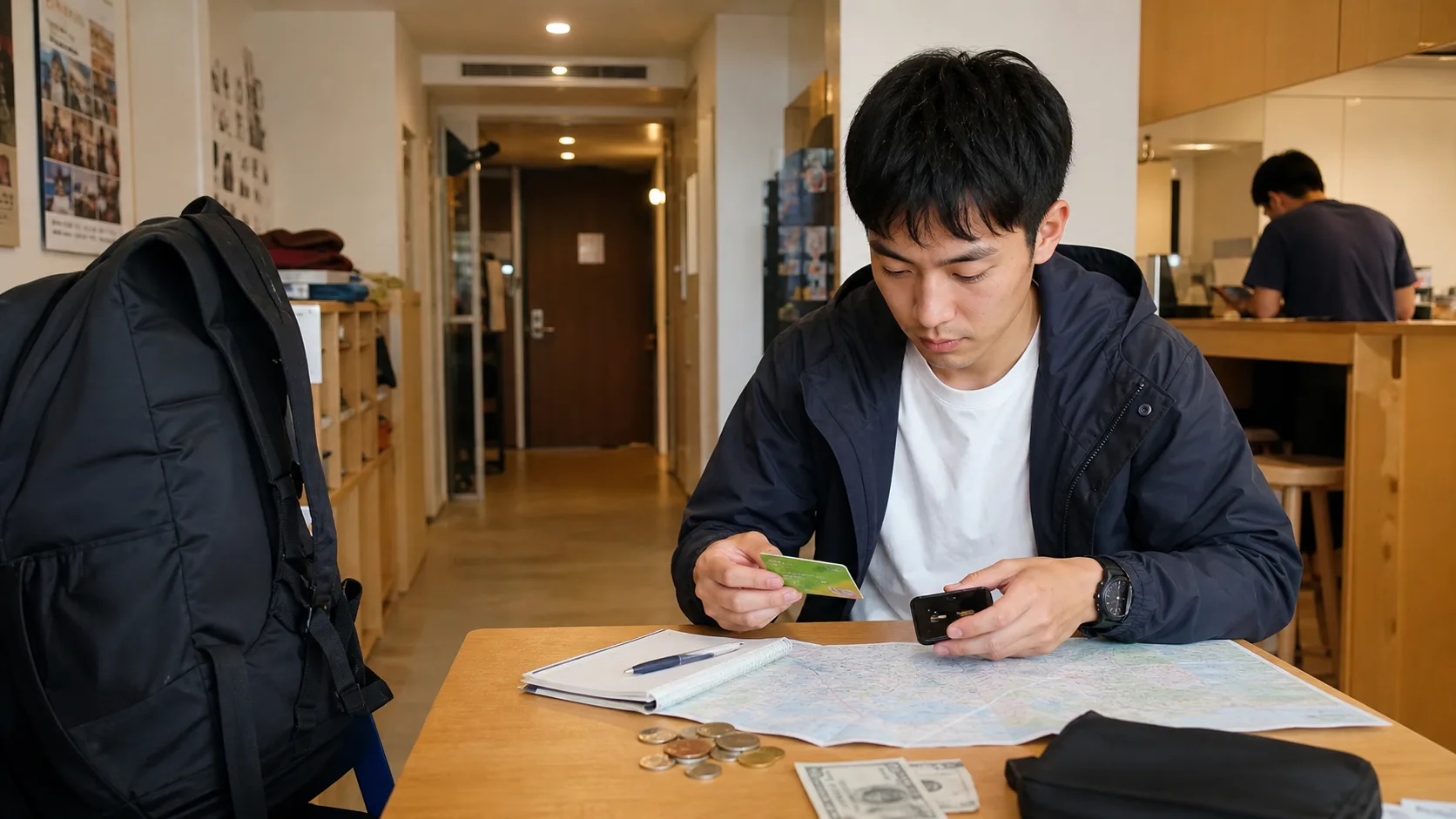
Landing in Japan on a budget is usually not hard. Wasting the first half-day is. If you land tired, overpack your plan, and treat arrival like sightseeing, you will spend more on taxis, snack stops, and convenience purchases than you need to. The smarter approach is to use the first day to lock down the basics: data, transport, cash, check-in, and a simple neighborhood orientation.
1. Fast Answer
For a budget Japan trip, the first day should be boring on purpose. Set up your phone data, get a transit payment method, withdraw a modest amount of cash, ride the cheapest sensible airport transfer to your hotel area, and keep dinner near the hotel. That sequence protects your energy and your wallet.
The fastest way to overspend in Japan is to treat the arrival day like a mini city break. The fastest way to make the rest of the trip smoother is to spend the first few hours getting the logistics right. If you are flying from Singapore, that matters even more because your flight may land after a long-haul sleep cycle, when small decisions feel harder and expensive choices feel easier.
The budget version is not the same as the bare-minimum version. You still need one reliable way to pay for trains and convenience-store purchases, one reliable way to get online, and one reliable route from the airport to your first hotel. After that, you can relax. The rest of the trip gets much cheaper when the first day is controlled.
If you want the simplest version: use a mobile IC card if your phone supports it, or pick up a tourist IC card such as Welcome Suica, ride airport rail when it is the best value, take cash out once, and do not book anything ambitious until the next morning.
2. Context You Need
The best first-day setup for Japan is not sightseeing; it is logistics. Get data, a transit payment method, a small cash buffer, and a low-friction airport-to-hotel route, then spend the evening near your accommodation so you can start day two rested, oriented, and ready to spend less.
Japan is one of the easiest countries in the world to travel in, but the first arrival still has friction. That friction comes from small things that do not matter once you are settled: you may need to top up a transit card, your roaming plan may not activate the moment you land, your hotel may be a short walk from the station, and you may discover that your wallet setup is not as convenient as it is in Singapore.
The useful mental model is this: the first day of a budget Japan trip is a setup day, not a tourism day. In Singapore, you can often land, tap, and move on without thinking much. In Japan, the basics are still simple, but they are split across more decisions. Should you buy an airport rail ticket or take a bus? Should you use a physical IC card or a mobile wallet? Do you withdraw cash now or later? Do you go straight to a city center district, or stay near the airport route you already paid for?
The key system to understand is the IC card. Japan’s transit cards work like stored-value cards for trains, buses, and convenience-store payments. JR East’s tourist card, Welcome Suica, is designed specifically for visitors: there is no deposit, and it is usable for 28 days. A regular Suica requires a 500-yen deposit, which is refundable. That distinction matters for budget travelers because the arrival decision is often about minimizing up-front cost and friction rather than optimizing every future ride.
Cash still matters too. Japan is more cashless than it used to be, but the budget traveler should not assume every small purchase will go smoothly with a foreign card. A realistic first-day setup usually includes one cash withdrawal, one transit solution, and one online data solution. Once those are in place, the country becomes much easier to navigate.
There is also a cultural reason to keep the first day light. Japan rewards punctuality, clean routes, and simple planning. If you arrive exhausted and then stack a museum, a scenic district, and a dinner reservation on top of airport transfer confusion, the trip can start feeling expensive and rushed before you have even checked in. A good budget trip starts with reducing decision fatigue.
3. Step-by-Step Guide
Think of the first day in five moves: connect, pay, move, check in, and reset. If you follow that order, you avoid the most common arrival mistakes.
Step 1: Get online before you leave the airport
Do not wait until you are standing at a train gate to discover that your data plan is not live. If you already have an eSIM, activate it while still on airport Wi-Fi or immediately after landing. If you are using a physical SIM or pocket Wi-Fi, make sure you know where the pickup counter is before you start walking toward transport.
For a Singapore-based traveler, this is the easiest place to lose time because it feels trivial. It is not trivial. Your phone is your map, translator, payment reference, booking app, and backup itinerary. If the data setup fails, everything else becomes slower and more expensive.
Step 2: Choose one payment method for transit
For most budget travelers, there are three sensible options:
| Option | Best for | Budget logic | Downside |
|---|---|---|---|
| Mobile IC card | Newer phones that support Japan transit wallets | Cheapest friction once set up | Not every phone or region works the same way |
| Welcome Suica | Visitors who want a simple physical card | No deposit, easy to understand | 28-day validity, so it is not a forever card |
| Regular Suica or similar IC card | Repeat visitors or longer stays | Refundable deposit and broad usability | Requires a deposit and more setup |
If you are unsure, Welcome Suica is the low-stress option for most first-time visitors. If your phone supports it natively and you already know how to load it, mobile IC can be better because it removes the need to queue for a physical card. If neither is ready, do not stand around trying to solve it perfectly. Buy the simplest workable option and move on.
Step 3: Withdraw a sensible amount of cash
Do not withdraw a giant stack of yen on day one. That is not budget travel; that is carrying anxiety around in your wallet. Withdraw enough for the first day and a half: airport snacks, a convenience-store meal if needed, a local ride if the train timing is awkward, and a small emergency buffer.
The exact amount depends on your style, but the principle is the same. The first-day cash need is usually modest. If your hotel, transport, and main meals are already booked or paid for, you do not need a large withdrawal. On the other hand, you should not assume every small shop will accept a foreign card. One practical withdrawal is better than five guesswork withdrawals.
Step 4: Pick the airport transfer that matches your hotel area
This is where budget travelers save or burn real money. The cheapest option is not always the best if it adds confusion, but the most expensive option is rarely justified just because you are tired.
Use this rule:
| Situation | Best first-day choice |
|---|---|
| Hotel is near a major station and you are arriving in normal daytime hours | Airport rail |
| Hotel is far from the station but served directly by a bus | Airport limousine or airport bus |
| You are arriving late at night, with heavy luggage, or with children | Pre-planned taxi or airport transfer if the split cost is reasonable |
For Narita, the airport’s official access page highlights rail, public bus, and taxi as the main options. That is a useful framework even if your exact airport changes. The budget decision is not “train or taxi?” in the abstract. It is “which route gets me to the hotel area with the fewest paid mistakes?”
If you are heading to central Tokyo from Narita, rail is usually the default budget-friendly choice. If you are going to a hotel that sits much closer to a bus stop than to a major station, a bus can be worth it because you save a transfer and avoid dragging luggage through underground corridors. If you are landing at an awkward hour, the cheapest ticket is irrelevant if the last train has already gone.
Step 5: Check in, then do one useful neighborhood loop
Once you reach the hotel, do not collapse immediately and then order random food blindly. Check in, charge your devices, and then do one short neighborhood loop: find a convenience store, a pharmacy if you need one, the closest station exit, and the nearest coin locker or luggage service if you will need it later.
This tiny loop pays off all trip long. When you know where the nearest station entrance is, what the area looks like after dark, and where to buy water or breakfast, the rest of your trip gets cheaper and calmer.
A practical arrival sequence
- Land and connect to data.
- Confirm your transit card or mobile wallet.
- Withdraw a small cash buffer.
- Ride the airport transfer that best fits your hotel area.
- Check in and drop bags.
- Buy only what you need for the evening.
- Walk the station and convenience-store loop once.
- Stop planning and start sleeping.
That sequence sounds almost too simple, but simplicity is the point. A budget Japan trip is usually won by how little you need to improvise on day one.
4. Costs, Hours, and Logistics
The first-day budget is mostly about small fixed costs, not one giant expense. The key numbers to know are the transit card cost and the airport transfer cost.
Welcome Suica is the simplest tourist card if you want a physical IC card. JR East currently presents it as a no-deposit option that can be used for 28 days. A regular Suica requires a 500-yen deposit, which can be refunded. For visitors who want a low-friction setup, that difference is meaningful. It is one of the few arrival decisions that can save time without adding complexity.
Airport transport costs vary by airport and route, so avoid memorizing a single “Japan airport price.” Narita, Haneda, Kansai, and Chubu all have different train and bus structures. In general:
- rail is the best value when your hotel is near a major station,
- bus is the best value when it drops you closer to the hotel than rail would,
- taxi is a premium choice that makes sense only when time, luggage, or group size justify it.
That means the real logistics question is not “what is the absolute cheapest ride?” but “what is the cheapest ride that does not create a second transfer and an hour of confusion?”
For opening hours and booking caveats, assume the following:
- airport shops and card counters may not match train schedules exactly,
- late arrivals can narrow your transport options quickly,
- convenience stores are the easiest late-night fallback for food and cash withdrawal,
- some attractions and transfer desks close before midnight even when the airport is still open.
That is why you should not build a first-day plan around a fancy dinner reservation or a far-flung neighborhood. The safest budget move is to keep arrival-night logistics inside the same corridor as your hotel and its nearest station.
Payment methods also deserve a quick note. Japan is now much easier to handle with cards and mobile payments than it used to be, but not every small vendor will behave the same way. On day one, assume the following:
- transit is easiest with an IC card,
- convenience stores can solve many small problems,
- some smaller shops still prefer cash,
- your foreign card may work perfectly one moment and fail the next.
The answer is not to carry too much cash. It is to carry enough cash that a card issue does not ruin the evening.
If you are planning a multi-city budget trip, do not overcomplicate the first day with rail passes you have not yet needed. Most first-day setups are better served by a simple airport transfer and a normal IC card than by a long pass purchase decision before you even know your final route pattern.
5. Variations and Edge Cases
The “right” first-day setup changes depending on how and when you land.
If you arrive late at night
Your priority shifts from savings to reliability. A cheap rail fare is not useful if your train is gone or your transfer path is confusing after midnight. Late arrivals are where budget travelers sometimes make the biggest error: they underestimate fatigue and overestimate how long they want to wander with luggage.
In late-night cases, the best move is often a direct route to the hotel district, even if it costs a little more than the cheapest day route. Saving one long walk and one transfer can be worth more than the fare difference.
If you are traveling with family
Family travel changes the math because one awkward transfer becomes several awkward transfers. If you have children, strollers, or multiple suitcases, choose the route that minimizes staircases and platform changes. Sometimes that means a direct bus. Sometimes it means a train with fewer transfers rather than the fastest train.
The useful budget lens for families is not “cheapest ticket.” It is “lowest total friction per person.”
If you are doing Tokyo, Osaka, or a multi-city route
The first-day logic remains the same, but the airport and city setup changes:
- Tokyo arrivals tend to favor IC card setup and station-centered hotel planning.
- Osaka arrivals often make rail-to-hotel logistics straightforward if you stay near a major node.
- Multi-city trips become smoother if you pick one payment and data setup that works everywhere rather than switching tools in each city.
The common mistake is to assume that because Japan is unified, every local decision is identical. It is not. Your first city determines how much hassle you absorb on arrival.
If you are a light packer
You can usually be more aggressive with rail. Light luggage means stairs, platforms, and station transfers are less painful. That gives you more route flexibility and often reduces cost.
If you are carrying a lot of luggage
Heavy baggage makes cheap choices look less cheap. A slightly more expensive direct bus or transfer can be better than a lower-cost route that leaves you hauling bags through crowded station corridors. Also consider luggage forwarding after arrival if you are moving between cities. On a budget, one forwarding fee can still be worthwhile if it saves a bad transfer day.
If you are a repeat visitor
Repeat visitors can optimize more aggressively because they already know the airport, transport network, and hotel neighborhoods. For you, the first day may be the right moment to use mobile IC, a preplanned cash buffer, and a more direct hotel route. The budget improvement comes from confidence, not from squeezing every last yen out of the arrival ride.
If you are arriving in winter or during peak holidays
Weather and crowding matter more than many first-timers expect. Winter can make platform changes and outdoor walks less pleasant. Golden Week, Obon, and New Year periods can make stations and transfer desks busier than usual. During those periods, the cheapest route can also be the slowest. Build a margin into the first-day plan.
6. Mistakes to Avoid
The most common first-day mistakes are predictable, which means they are easy to avoid.
First, do not try to do too much. The arrival day is not the day to stack shopping, a long day trip, and a famous dinner district. The more ambitious the plan, the more likely you are to spend extra on transport and food just to compensate for exhaustion.
Second, do not land without a data plan and then trust you will “figure it out.” You can usually figure it out, but the time you spend doing so is expensive because it delays every other choice.
Third, do not overbuy cash. Japan is comfortable for cash users, but your budget is still better protected when you withdraw a modest amount and reassess later.
Fourth, do not assume every airport route is equally good for every hotel. A cheap train to the wrong station can be worse than a slightly pricier bus that drops you closer to check-in.
Finally, do not skip the neighborhood reset. Knowing where the nearest convenience store and station exit are is a small thing that prevents many small expensive mistakes later.
7. FAQ
Do I need cash on day one in Japan?
Yes, but not a large amount. A small cash buffer is enough for the first day if you already have data and a transit solution. The point is backup, not bulk.
Is Welcome Suica still worth it in 2026?
Yes, if you want a physical tourist card and your phone setup is not ready. JR East currently presents it as a no-deposit visitor card usable for 28 days. That is a strong arrival-day option for short trips.
Should I use rail, bus, or taxi from the airport?
Use the cheapest option that does not create unnecessary hassle. Rail is usually best when your hotel is near a major station. Bus is often better when it drops you closer to the hotel. Taxi is for late arrivals, heavy luggage, or group splits where convenience justifies the cost.
Can I do the whole trip with one mobile payment setup?
Sometimes, yes. If your phone supports Japan transit wallet features properly, mobile IC can cover a lot of ground. But you should still have a backup plan because device compatibility and battery life are real-world variables.
What should I eat on the first night?
Eat near the hotel. A convenience store meal, a simple noodle shop, or a low-cost local chain is better than a long cross-city dinner plan. The budget win is not the exact dish; it is avoiding a second transport run when you are already tired.
What if my hotel is not close to a major station?
Then the airport transfer decision matters more than usual. A bus or a direct transfer can be worth it if it reduces the number of walks and platform changes. Cheap is not always cheap when it adds fatigue and confusion.
Do I need a Japan Rail Pass for the first day?
Usually no. A pass only makes sense when your route actually uses it enough to justify the price. On arrival day, a simple transit card and a single airport transfer are more useful than a big pass decision made before the itinerary is fully real.
8. Next Steps
Once your first-day setup is decided, stop optimizing the arrival day and move on to the next practical choice: where you will sleep, how you will get around the city, and whether your remaining intercity route needs any advance booking. That order matters because the cheapest Japan trip is usually the one that avoids last-minute transport mistakes.
If you are flying from Singapore, the best next move is to finalize your airport transfer, confirm your data setup, and choose a hotel area that matches your arrival time. Then leave the sightseeing for day two. The trip gets better, and cheaper, after the first night.
Related: japan-budget-trip-culture-guide-for-first-time-visitors
Related: japan-budget-trip-itinerary-for-singapore-travelers