Japan Budget Trip Budget Travel Guide for Singapore Travelers

If you are planning a Japan trip from Singapore and want to keep costs under control, the winning strategy is simple: pick one region, lock your transport plan early, and do not overbuy passes you will not fully use. Japan can be affordable, but only if your route matches your budget. The biggest savings usually come from using low-cost flights, staying near major stations, mixing trains with buses, and choosing food and lodging deliberately instead of treating every day like a splurge.
Fast Answer
The cheapest Japan trip is usually not the one with the most famous cities. It is the one with the fewest long-distance moves. For Singapore travelers, a practical budget trip often means flying into one major hub, staying there or nearby for most of the trip, and using local trains, subways, and highway buses instead of bouncing between Tokyo, Kyoto, Osaka, Hiroshima, and Hokkaido in one week.
For a first budget trip, think in terms of three spending layers: flights, accommodation, and transport. If you control those three, everything else becomes manageable. Food can be cheap without feeling miserable, because convenience stores, set meals, noodle shops, bakeries, and supermarket discount counters are all easy to use. Attractions can also be inexpensive if you focus on public parks, temple districts, free viewpoints, markets, and neighborhoods rather than ticket-heavy theme parks every day.
The most common mistake is buying a national rail pass too early just because it sounds efficient. Many short trips are cheaper with point-to-point tickets, a regional pass, or even a mix of buses and local rail. Another mistake is trying to fit too much geography into one trip. Japan rewards slower routing. If your goal is value, treat time as part of the budget.
Context You Need
Japan is expensive only when you travel in the wrong pattern. The country has world-class rail, plenty of efficient budget food, and a huge range of lodging types, from capsule hotels and business hotels to hostels and simple apartments. That means budget travel is not about discomfort. It is about matching your route, season, and booking style to the places you actually want to see.
For Singapore travelers, Japan also feels budget-friendly in a few important ways. Flight times are reasonable, especially to Tokyo, Osaka, Nagoya, Fukuoka, and Sapporo. Many travelers can fit Japan into a relatively short annual leave window without needing a massive long-haul commitment. Japan also works well for short, high-value trips because transport is reliable and English support is improving in major hubs.
If you want to frame the trip correctly, start with the question: are you building a city break, a food trip, a rail trip, or a nature route? Budget planning changes depending on the answer. A Tokyo-and-Osaka trip can work with efficient point-to-point rail. A Hokkaido road-and-onsen trip may demand a different kind of budget entirely. A Kyushu food and hot spring trip can be very affordable if you stay regional. The cheaper your trip, the more important it becomes to choose a region first and a transport pass second, not the other way around.
There is also a visa and entry planning angle that matters for Singapore travelers. According to Japan’s Ministry of Foreign Affairs, Singapore is one of the visa-exempt countries for short-term stay, with the standard period of stay listed as 90 days. That does not mean you can ignore passport validity, return tickets, or entry questions at the border. It does mean one major hurdle is removed, which makes last-minute planning much easier than for destinations that require advance visa applications.
For budget planning, the useful mindset is this: Japan is a place where small decisions add up fast. Being 10 minutes farther from the station, arriving one day later than the peak weekend, or skipping one expensive intercity hop can save enough to pay for a nicer meal or a better room. If you build the trip in that order, Japan becomes one of the most rewarding value destinations in East Asia.
Step-by-Step Guide
The easiest way to plan a budget trip is to build it backward from your main destination list.
1. Pick one core region
Start with one of these budget-friendly shapes:
| Trip shape | Best for | Budget logic |
|---|---|---|
| Tokyo only | First timers, shopping, food, museums | Lowest transport complexity, easy to use local transit |
| Tokyo + day trips | Travelers who want variety without changing hotels often | You keep one base and avoid repeated check-ins |
| Osaka + Kyoto | Food, temples, easy city movement | Short rail hops and strong hotel competition |
| Fukuoka + Kyushu | Slower pace, food, hot springs, fewer crowds | Regional travel is often cheaper than national zigzags |
| Sapporo + Hokkaido | Nature, summer break, winter snow trips | Best when you stay regional instead of crossing the whole country |
For a first trip on a tighter budget, Tokyo only or Osaka + Kyoto are the safest bets. They let you spend less on intercity movement and more on what actually matters to you.
2. Decide whether you need a rail pass
This is the decision that trips up many travelers. A rail pass is not automatically good value. It is only good value if your actual rides exceed the pass cost and if your route uses the right trains.
For example, if your plan is one arrival city, one base, and one or two day trips, a pass may be unnecessary. If your plan is long-distance shinkansen hops across several regions, a pass or regional pass may help. The correct answer depends on the route, not the prestige of the pass.
Use this quick test:
- List every intercity ride you will take.
- Check whether those rides are on JR lines or on private rail/bus operators.
- Compare the sum of point-to-point fares with the pass price.
- Add the hidden costs of pass convenience, like seat reservation flexibility and time saved.
- Buy the pass only if it clearly wins, not because you want to simplify the decision.
For many budget trips, especially shorter ones, point-to-point tickets plus local IC card use are enough.
3. Book flights with a route, not a city obsession
Singapore travelers often get too focused on round trips to one airport. That can be fine, but open-jaw routing can sometimes save money and time. If your trip is Tokyo to Osaka or Fukuoka to Tokyo, compare the cost of a multi-city ticket with the cost of a round trip plus a domestic rail hop.
If your travel dates are fixed, flexibility still matters. Being open to one-day shifts can reduce the total trip cost more than hunting for obscure discount codes. Look at:
- Midweek departures instead of Friday evening or Sunday afternoon.
- Secondary airports when the total trip time still works.
- Different arrival and departure cities if your itinerary supports it.
The cheapest fare is not always the best fare if it forces a bad route. For a budget trip, the right flight is the one that leaves room for affordable ground transport and a sane first night.
4. Build your lodging around stations, not landmarks
Budget lodging in Japan is most useful when it sits on a sensible train line rather than in the most famous postcard district. A room 15 to 20 minutes from the core area can be a much better deal than a room in the center if it still gives you easy station access.
Look for:
- Direct access to a major station or a line with minimal transfers.
- Simple breakfast included only if the price is genuinely good.
- Laundry access for trips longer than four days.
- Luggage storage if you are moving cities.
- Free cancellation until close to the stay date.
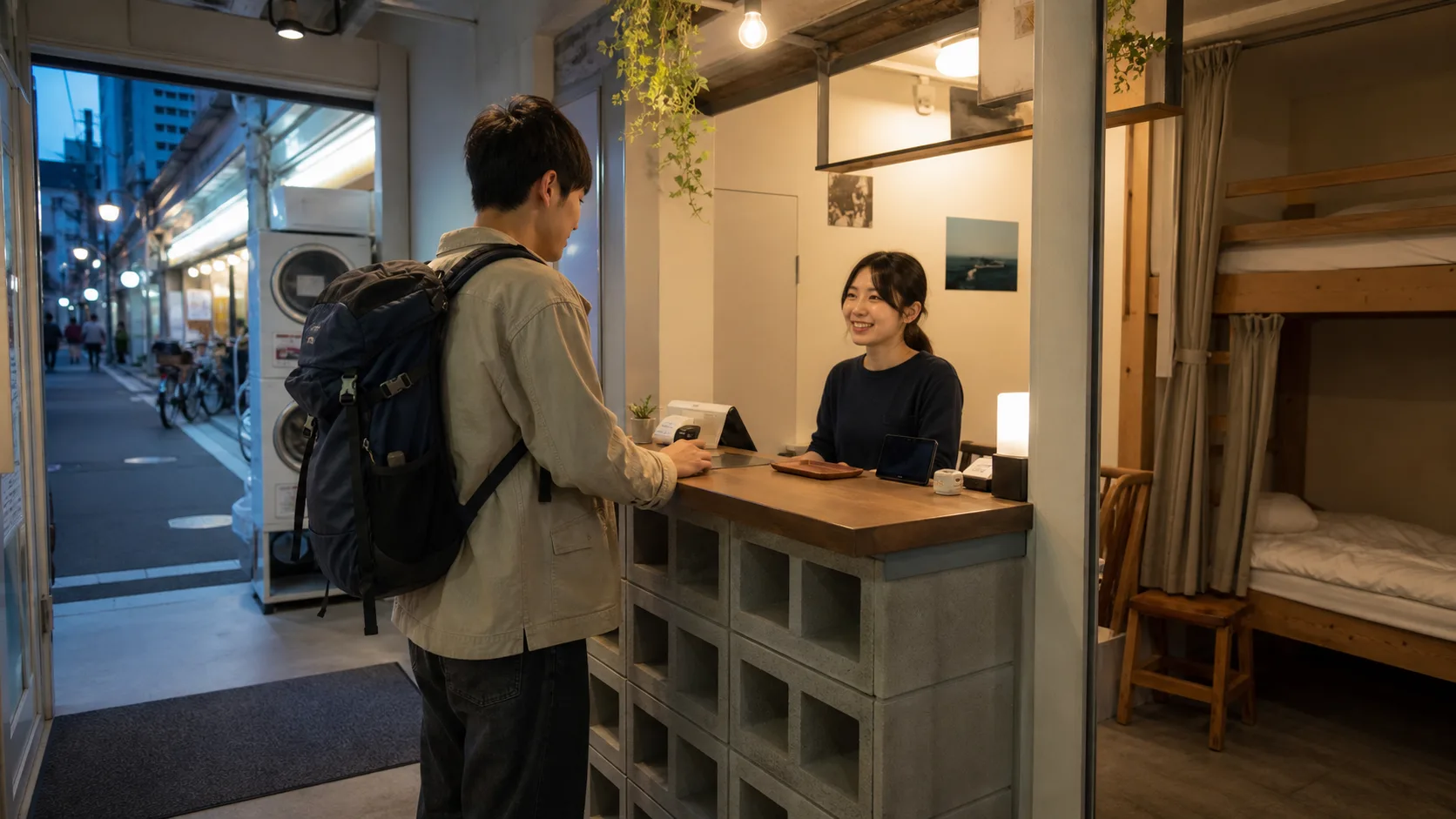
Business hotels are often the sweet spot for budget travelers who want a private bathroom and predictable quality. Hostels are cheaper, but the real comparison is not just price. It is how much sleep, privacy, and convenience you are giving up.
5. Plan your daily transport like a local
The most reliable budget habit in Japan is to use trains and subways for the core of the day, then walk as much as possible between clustered sights. Do not treat every minor move as a taxi ride.
Practical rules:
- Group attractions by neighborhood.
- Use one transit card if possible, so small fares are painless.
- Take buses when they are clearly the best route, especially in smaller cities.
- Avoid random taxi use unless it really saves time or solves a luggage problem.
- Keep one low-energy day in long trips so you are not paying for transport you do not enjoy.
If your route includes shinkansen, remember that speed is a luxury. It can be worth it, but only if it actually improves the trip. A budget itinerary often has one fast intercity leg and then slow, cheap local movement for the rest.
6. Lock food spending before you land
Food is one of the easiest places to overspend or underspend badly. You do not need to eat badly to save money. You just need a system.
Try this mix:
- One convenience-store breakfast or bakery breakfast each day.
- One proper lunch set meal or noodle meal.
- One flexible dinner, which can be a casual restaurant, supermarket meal, or izakaya-style share meal.
This approach keeps the trip enjoyable without turning every meal into a high-spend event. It also prevents the common tourist trap of buying snacks constantly because nothing was planned.
7. Leave a small buffer for impulse spending
Budget trips fail when the plan is too rigid. If you save every yen on transport and hotel but leave no room for a spontaneous museum ticket, shrine donation, local snack haul, or one better dinner, the trip can feel oddly joyless.
A better rule is to set a core daily budget and then add a small buffer. That way you can say yes to something worthwhile without destroying the overall plan.
Costs, Hours, and Logistics
Japan budget planning is easiest when you separate fixed costs from variable costs.
Transport and pass costs
The official JAPAN RAIL PASS currently comes in 7-day, 14-day, and 21-day options, with standard and Green Car tiers. As of the official pricing listed by JR, online purchase prices are 70,000 yen for a 7-day Green Car pass, 50,000 yen for a 7-day Ordinary pass, 110,000 yen for a 14-day Green Car pass, 80,000 yen for a 14-day Ordinary pass, 140,000 yen for a 21-day Green Car pass, and 100,000 yen for a 21-day Ordinary pass.
For budget travelers, that pricing matters because it is not a casual add-on. It is a major line item. If your route does not include multiple expensive JR intercity journeys, point-to-point tickets can be cheaper and simpler. Also note that JR states that NOZOMI and MIZUHO Shinkansen use requires a special ticket for pass holders.
Entry and stay rules
Japan’s Ministry of Foreign Affairs lists Singapore among the visa-exempt countries and regions for short-term stay, with a typical period of stay of 90 days. For most Singapore travelers, that makes trip planning straightforward, but you should still verify your passport validity, onward travel, and any airline-specific document checks before flying.
Typical budget ranges
Exact spending depends on city, season, and how far in advance you book, but these bands are useful for planning:
| Category | Lean budget | Comfortable budget |
|---|---|---|
| Accommodation | Capsule, hostel, simple business hotel | Larger business hotel or small apartment |
| Daily food | Convenience-store breakfast, casual lunch, simple dinner | Lunch sets, one nicer dinner, occasional cafe |
| Local transport | Train/subway with walking | Same, plus the occasional taxi |
| Intercity transport | Bus or point-to-point rail | Faster rail when it saves time |
| Activities | Free parks, temples, neighborhoods | Mix of paid museums, observation decks, and day trips |
If you are trying to build a rough trip budget from Singapore, the cleanest method is to estimate by day rather than by category. A lean city-based trip can stay surprisingly controlled, while a route-heavy trip can jump fast once you add intercity rail.
Hours and seasonality
Japan does not run on one national opening-hours schedule. Urban attractions usually open earlier than nightlife areas, temples often have quieter morning hours, and some museums or smaller shops close on weekdays. Seasonal closures also matter in mountain and snow regions, where weather can affect buses, hiking access, and operating hours.
In practice, that means budget travelers should avoid building a day around a single expensive attraction that might close or sell out. Choose neighborhoods with multiple backup options. If one museum is closed, you can still walk, eat, and visit a free site without wasting the day.
Booking caveats for 2026 planning
If you are booking well ahead, double-check the official transport rules before you pay. Rail passes, seat reservations, and fare conditions can change, and sometimes future price changes are scheduled in advance. That is especially important if your trip sits near a known pricing change or if you are using a pass to justify a multi-city route.
Variations and Edge Cases
Your ideal budget strategy changes depending on who is traveling and when.
If you are traveling as a couple
Couples can often justify a slightly better hotel because private rooms split the cost well. In Japan, two people in a clean business hotel can be a better value than two separate hostel beds once you factor in convenience, sleep quality, and luggage handling. Couple trips also benefit from booking one central base instead of moving too much.
If you are traveling with family
Family trips are where transport and room size start to matter more than headline nightly rates. A very cheap room that is awkward for luggage, naps, or bathroom sharing can create hidden costs in taxis and frustration. For families, a slightly higher room budget may actually lower the trip cost by making the day smoother.
If you are traveling in cherry blossom or autumn peak season
Peak season changes the game. Room rates rise, trains fill faster, and the most famous destinations can feel crowded enough to affect your budget in indirect ways. You may need to stay farther from the core or lock accommodations earlier. On the other hand, you may still save money by choosing less-famous cities, even in peak season.
If you are traveling in winter
Winter can be one of the best value periods if you like colder weather and do not mind planning around daylight and snow. Cities like Tokyo, Osaka, and Fukuoka remain manageable, and certain regions offer excellent off-peak room rates. But if you are heading to snow country, budget for weather disruption and slower movement.
If you only have four to six days
Short trips are where budget discipline matters most. Do not waste them on cross-country travel. Pick one city, maybe one easy day trip, and keep the plan tight. A short, focused trip often delivers better value than a rushed five-city itinerary that feels expensive and exhausting.
If this is your first Japan trip
First-timers usually overspend because they try to buy certainty. They book too many passes, too many transfers, and too many backup plans. In reality, Japan is one of the easiest countries to travel in once you arrive. You can save money by being calm, not by buying a complicated bundle of products before departure.
Mistakes to Avoid
The biggest budget mistakes are usually planning mistakes, not on-the-ground mistakes.
- Buying a rail pass without mapping the route first. The pass may be great, but only for specific itineraries.
- Overpacking the itinerary. Every extra city adds transport, coordination, and fatigue.
- Staying too far from a station to save a little on the room. You often pay the difference back in time and taxis.
- Eating every meal at convenience stores to save money. That can make the trip feel worse than it needs to.
- Ignoring seasonal price spikes. Golden week, school holidays, cherry blossom season, and autumn color season can all raise costs.
- Booking only one hotel option too early. Free cancellation is useful when better deals appear later.
The simple fix is to keep your itinerary narrow and your booking decisions reversible until the route is confirmed.
FAQ
How much money do I need for a budget Japan trip from Singapore?
It depends on length and routing, but a focused city trip can be relatively controlled if you keep lodging near transit and avoid too many intercity moves. The more cities you add, the faster the budget rises.
Is Japan cheap for Singapore travelers?
It can be, especially if you plan around one region and use local transit well. Japan is not the cheapest destination in Asia, but it offers good value when you avoid premium transport and high-end hotels.
Is the JR Pass worth it for a short trip?
Often not. If you are only doing one city and a couple of day trips, point-to-point tickets or a regional pass may be better. The JR Pass makes the most sense only when your long-distance rail use is heavy enough.
Do Singapore passport holders need a visa for Japan?
Japan’s Ministry of Foreign Affairs lists Singapore as visa-exempt for short-term stay, usually up to 90 days. Always verify passport validity and entry requirements before you fly.
What is the cheapest way to travel inside Japan?
Usually a mix of walking, local trains, subways, and occasional buses. For long-distance travel, the cheapest option is not always the fastest one, so compare rail, highway bus, and flight before choosing.
Should I visit Tokyo or Osaka first on a budget trip?
If you want the simplest budget trip, Tokyo is easier to structure because it has dense transit and endless neighborhood options. If you want food and a slightly more compact feel, Osaka with Kyoto day trips can be a very strong value choice.
When is Japan cheapest?
Usually outside major holiday periods and outside peak blossom or autumn foliage windows. Exact pricing varies by city and accommodation type, so look at your dates first rather than assuming one season is always best.
Next Steps
The best next move is to choose a route before you compare transport products. Decide whether your trip is Tokyo-based, Kansai-based, or regional, then price flights, hotels, and local transit around that shape. Once the route is fixed, compare pass options only if they clearly fit your actual movement.
If you keep the itinerary tight, use one base, and book transport after mapping the journey, Japan becomes much easier to do on a budget. That is the version of Japan travel that gives Singapore travelers the most value: fewer unnecessary moves, more deliberate spending, and a trip that still feels full.
Related: japan-budget-trip-public-transport-mistakes-to-avoid
Related: japan-budget-trip-weather-and-clothing-guide
Related: japan-budget-trip-itinerary-for-singapore-travelers