Hongcun Ancient Village Anhui: Dawn Light Photography & Reflecting Pool

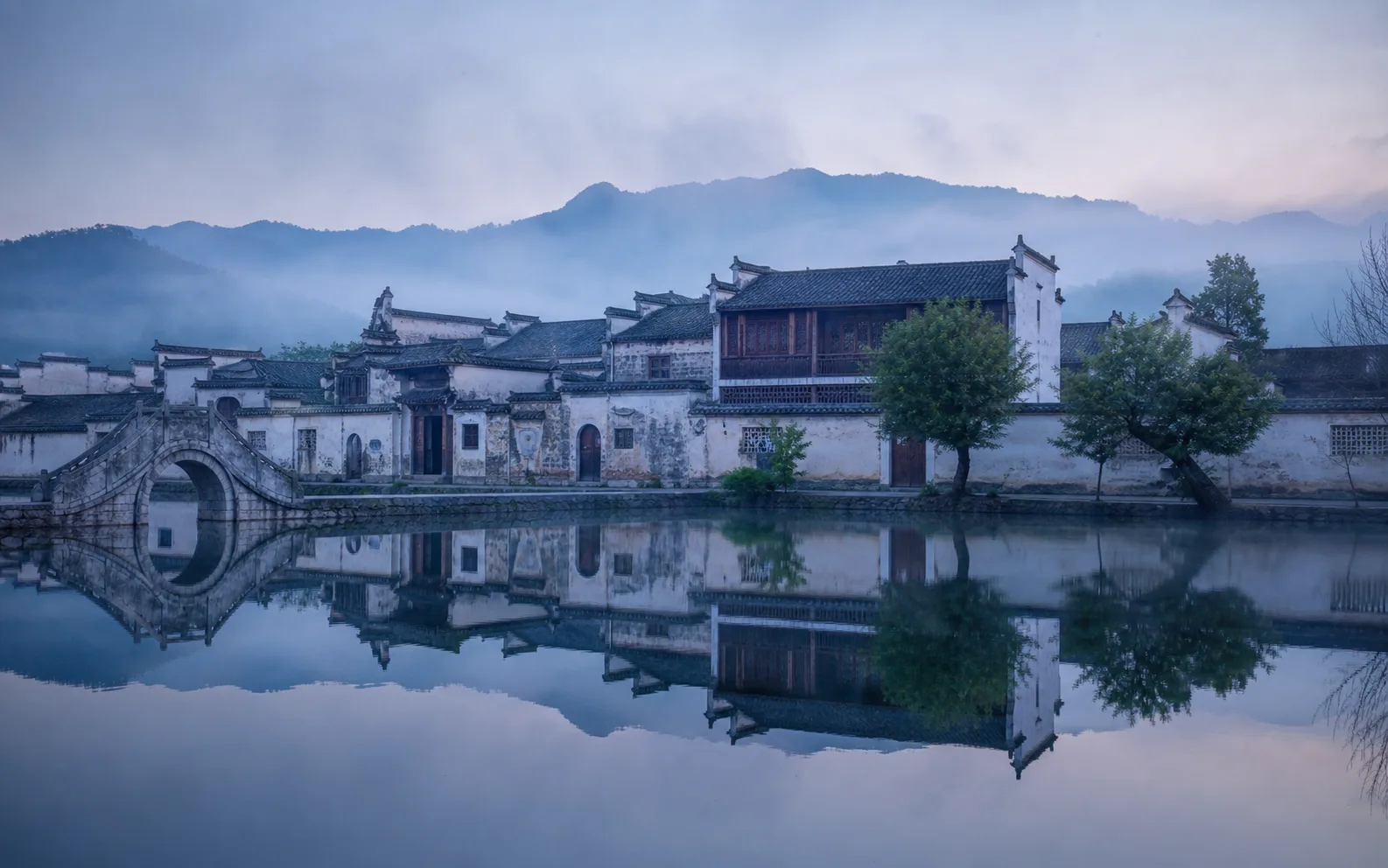
If you want Hongcun to look like the postcards, you need to arrive before the rest of the day-trippers wake up. Dawn is when the village feels slow, the water is still, and the whitewashed walls start catching the first soft light. This guide focuses on the practical side of getting that shot, especially around Moon Pond and the reflecting water in Hongcun's core lanes.
Why Hongcun Works So Well at Dawn
Hongcun is one of the few historic villages where the landscape, the canal system, and the dense cluster of houses all cooperate with a camera. The village is part of the Ancient Villages in Southern Anhui UNESCO World Heritage Site, and its ox-shaped layout is not just a trivia detail. It shapes how light moves through the streets, where reflections appear, and how a photographer can build a scene from layers instead of just a single subject.
Hongcun is best known for Moon Pond and South Lake, but the real advantage for a photographer is that the village is compact enough to cover on foot while still offering a wide range of textures: stone bridges, carved wooden doors, gray tiles, white walls, low morning mist, and water that can act like a mirror if the wind stays down. At dawn, those elements become much easier to separate visually. Bright midday light can flatten them. Early morning gives them shape.
If you are planning a China route that mixes scenery, city time, and logistics, it helps to think of Hongcun as a calm reset between faster-moving destinations. For broader trip planning context, especially if you are still building an itinerary around visas, transport, mobile payments, and rail, see China Travel Planning: Visa, WeChat Pay, High-Speed Rail & Practical Guide.
The main reason photographers come here is simple: Hongcun offers a scene that looks designed for reflection. You can make images that feel architectural, intimate, and almost painted, but you need patience. The best frames are usually not the first ones you see after stepping into the village. They appear after you slow down, wait for the light to rise, and pay attention to the angle of the water.
What to Photograph in Hongcun
Hongcun has several layers of visual interest, and a good dawn session should move through them in sequence rather than rushing straight to the famous view.
Moon Pond and its mirrored edge
Moon Pond is the most obvious starting point. It is the classic reflective pool shot because it sits naturally within the village, so you can include historic houses, walkways, trees, and subtle human movement in a single composition. The best dawn frames usually come from a low, calm perspective. If the water is flat, the reflection can feel almost symmetrical. If there is a slight ripple, the scene becomes more atmospheric and less literal.
The key is to work the edges as much as the center. Many visitors stand where everyone else stands, aim at the obvious reflection, and leave. A better approach is to walk around the pond slowly and test different foregrounds: a stone ledge, a patch of grass, a branch entering from the side, or a narrow slice of walking path that leads the eye into the water. These details matter because they keep the image from looking like a simple documentary shot.
At dawn, the best Moon Pond images are often the ones that leave some negative space. Do not fill the frame just because the scene is famous. The water and the soft wall tones need room to breathe.
South Lake and the broader village reflection
South Lake is not only about the water itself. It is about scale. Compared with Moon Pond, South Lake gives you room to include more of the village silhouette, distant tree lines, and a stronger sense of place. If Moon Pond is the intimate portrait, South Lake is the establishing shot.
This is also where weather matters most. A still dawn can produce a layered, dreamlike view; a breezy morning can turn the water into a broken surface that reads more abstractly. Neither is wrong, but they give you different moods. If you are there on a misty morning, use longer focal lengths to compress the scene. If the air is clear, switch to wider compositions that show the edge of the lake, the village line, and the surrounding greenery together.
South Lake also works well for silhouette planning. When the light rises behind you or to the side, the village can appear as a soft mass against the brightening sky. That is useful when you want a scene that feels quieter and less obvious than a direct postcard reflection.
Narrow lanes, thresholds, and details
Hongcun is not only a landscape location. The lanes are valuable because they give you human-scale geometry. Look for doorways, stone steps, small bridges, hanging signs, and the repeating rhythm of windows and rooflines. These are especially strong in early morning when few people are moving through the alleys.
If you photograph only the water, you miss the village's structure. The lanes tell the story of how the village is lived in, not just viewed from outside. That matters for better images because viewers can sense the difference between a scenic spot and a place with real architectural texture.
Pay attention to transitions. A doorway opening into shadow, a lane turning around a corner, or a small bridge crossing a narrow channel can often create a stronger image than the famous reflection because they suggest movement and discovery.
Ancillary subjects worth keeping
If you have extra time, Chenzhi Hall and other preserved buildings can give you useful secondary material. Their interiors and carved elements help break up a portfolio of mostly outdoor shots. A series with water, lanes, and one or two interior details feels more complete than a set of near-identical pool reflections.
The village as a whole is arranged in a way that rewards patient visual sequencing. You can think of it as four overlapping categories:
- the famous reflective water scenes,
- the lane and bridge compositions,
- the roofline and courtyard geometry,
- the carved details and human-scale textures.
If you cover all four, you leave with a more balanced set of photographs and a better memory of the place itself.
Dawn Light Strategy
The biggest mistake people make in Hongcun is treating dawn as just a prettier version of daytime. It is not. Dawn changes the entire shooting strategy, from when you arrive to where you stand to how long you wait between frames.
Arrive earlier than you think
You do not want to arrive when the sun is already on the roofs. You want to be there when the village is still transitioning from night into morning. That is when the water is most likely to be still and when the surrounding surfaces have not yet lost their tonal subtlety.
Plan to be in position before the first warm light reaches the reflective pools. If your goal is the most recognizable dawn atmosphere, give yourself enough time to walk, adjust, and scout before the light peaks. In practical terms, that means treating sunrise as the midpoint of your session, not the starting line.
Work the blue hour first
The blue hour in Hongcun can be more useful than the sunrise itself. During that period, the highlights are gentle and the village becomes a balance of cool sky tones, gray tiles, and faint lamps or interior light. It is one of the best times to make images that feel calm rather than spectacular.
Then, as the light warms, the mood shifts. The same scene can become more dimensional. Walls brighten, reflections sharpen, and the contrast between man-made structure and natural water becomes clearer. This is why dawn works so well here: it gives you multiple versions of the same subject in a short window.
Use light to separate layers
Hongcun can be visually crowded if you approach it carelessly. The trick is to use light to separate foreground, middle ground, and background. A reflective pool in front, a walkway in the middle, and a white wall or roofline behind can create depth even in a narrow frame.
If the morning is hazy, emphasize the softness. If it is clear, emphasize edges and structure. Do not force the same composition in every condition. Let the weather determine your visual language.
Shoot both symmetry and imbalance
Reflections tempt photographers into symmetry, but perfectly centered images are not always the strongest. A slightly off-center frame, with a tree branch crossing one side or a walkway entering from the corner, often feels more alive. Hongcun is formal enough that a bit of imbalance gives it energy.
Think in pairs:
- one symmetrical shot for the classic composition,
- one asymmetrical shot for mood,
- one wider contextual frame,
- one tight detail frame.
That small discipline prevents your set from becoming repetitive.
Where the Village History Matters
Hongcun is not just photogenic; it is historically legible. The village has a long Huizhou architectural tradition, and the preservation of its layout is part of why it became a UNESCO site with Xidi. That history matters because it explains why the village feels coherent even when you are moving through different streets and vantage points.
The ox-shaped plan is the best-known spatial idea. In practical terms, it helps you understand why the water network and streets feel integrated rather than accidental. The scene is not random. The water channels, ponds, and lanes create a rhythm that makes the village feel like one organism. That is one reason dawn photography works so well here: the light reveals that rhythm before the village becomes crowded and fragmented by movement.
For photographers, this history is more than background. It tells you what to prioritize. Instead of trying to isolate a single famous building, look for the systems that make the whole place feel connected. Water, stone, wood, rooflines, and courtyards are the vocabulary of the village. Use them together.
Hongcun also carries a cinematic reputation because it was used in Crouching Tiger, Hidden Dragon. That fact can be overused in travel writing, but it does point to something real: the village has a layered, almost choreographed spatial feel. Frames here often look composed because the environment itself is composed.
If you are comparing Hongcun to other places in China for scenery photography, it is helpful to remember that the most successful images here are rarely grand landscapes. They are controlled interactions between architecture and water. If you want more ideas for comparable destinations, the broader roundup Best Photography Spots in China: Ancient Towns to Modern Skylines is a useful companion piece.
Practical Guide
Hours, admission, and ticketing
Hongcun is a managed scenic village, so practical access can change with season, local policy, and the exact ticketing setup in effect when you visit. Do not rely on a generic memory of the price or opening window from an old forum post. Check the current scenic-area counter information before you go, especially if you are planning a sunrise visit or a very short stop.
The safest planning assumption is that dawn access and daytime visitor access are not always the same thing. Some photographers assume they can walk in at any hour because the village is a lived-in place, but scenic-area rules and ticketing procedures can still affect where visitors are allowed to enter and when. If early access matters to your shoot, verify the current arrangement in advance.
What you should plan for instead of a specific number is flexibility:
- confirm whether the ticket is for the village only or part of a broader scenic-area package,
- check whether there is a separate early entry procedure,
- carry both cashless payment and a backup payment method,
- avoid arriving with a schedule that only works if the ticket desk opens exactly when you expect it to.
This is one of those places where the logistical detail matters more than the exact numeric price. A great dawn image is worth more than saving a few minutes of planning.
How to get there
The most common gateway is Huangshan City, with onward transport by road into Yi County and then Hongcun. A practical route for many travelers is high-speed rail into Huangshan North, then a transfer by taxi or bus to the village area. That is usually the easiest option if you are coming from Shanghai, Hangzhou, or another rail-connected city.
For local bus travel, buses are available from Huangshan Bus Station, and there are also buses from Tangkou Bus Station near the foot of the Huangshan scenic area. If you are combining Hongcun with Mount Huangshan, Tangkou can be a useful waypoint because it keeps the transfer chain shorter.
If you are taking the bus, build in extra time. Village destinations in Anhui are often simple once you are on the right route, but the handoff between train station, bus terminal, and final drop-off can take longer than a casual traveler expects. Do not schedule your dawn session on the assumption that the last transfer will be perfectly punctual.
Suggested arrival logic for photographers
If your goal is photography rather than a standard sightseeing visit, use this arrival logic:
- Reach Huangshan or Yi County the previous afternoon.
- Stay as close to Hongcun as practical.
- Enter the village before sunrise or be ready to walk in immediately after the earliest access window opens.
- Shoot Moon Pond first, then move to South Lake and the lanes.
- Leave the most famous viewpoints until after you have covered the quieter edges.
That sequence works because the village is smallest at dawn. Once people begin moving through the lanes, the classic reflections become harder to isolate. You want your first hour to be about atmosphere and your second hour to be about variation.
Food, rest, and pacing
Do not underestimate the physical side of dawn photography. You may be walking on stone, standing for long periods, crouching for low angles, and carrying camera gear through narrow passages. Bring water, small snacks, and a plan for where you will rest after the first session.
If you are only visiting for a few hours, avoid turning the trip into a checklist. The village rewards slowness. Build in room for sitting by the water, waiting for people to clear a frame, and revisiting the same view when the light changes. Hongcun is not a place you solve by speed.
Photography Approach by Gear Type
Smartphone
A smartphone can do well here if you work the timing and framing carefully. Use the dawn light and reflections to your advantage, and avoid over-sharpened HDR settings that make the village look artificial. Shoot low and close to the waterline when possible, and let the phone handle the exposure slightly under rather than over-brightening the image.
If your phone has a telephoto lens, use it for compressed reflections and architectural details. The narrow streets and canal edges can look surprisingly refined when you isolate a small portion of the scene.
Mirrorless or DSLR
A mirrorless camera or DSLR gives you the best control over reflection, contrast, and depth. A wide-angle lens is useful for context, but a standard or short telephoto often produces stronger compositions at Hongcun because it lets you isolate texture. A 35mm or 50mm equivalent can be enough for many scenes.
If you use a tripod, be aware of foot traffic and the need to stay out of the way. Hongcun is not a wilderness location. People are moving through the village, and the best photographs are often made by blending into the rhythm rather than trying to control the space.
Filters and exposure choices
A polarizer can help in some conditions, but be careful: too much polarization can kill the very reflections that make Hongcun attractive. If the water is calm and you want mirror-like results, the polarizer may work against you. Use it selectively, not automatically.
For exposure, protect highlights in the water and sky. Dawn scenes can mislead a camera into brightening the whole frame. A slightly darker exposure often preserves the feel of morning better than a washed-out version. If needed, bracket a few frames and choose the one that keeps the tonal range believable.
Tips & Common Mistakes
What most visitors miss
The most common mistake is arriving for the obvious photo and leaving after it. Hongcun is better when you treat it as a sequence of micro-locations. The same morning can produce very different results from Moon Pond, a narrow lane, a bridge crossing, and a courtyard doorway.
Another common miss is ignoring human presence. A lone walker crossing a lane or a local resident moving through the scene can make the village feel alive. Do not always wait for absolute emptiness. A little life often improves the photograph, especially if you are trying to show scale.
Do not overexpose the white walls
Hongcun's white walls are one of its signature visual features, but they can blow out quickly in rising light. If the walls lose texture, the image starts to look flat and generic. Keep the texture visible. The small tonal differences in plaster, roof tiles, and weathered wood are what give the village its character.
Watch your reflections
A reflection is only strong if the framing is disciplined. Check the edges of the waterline, the relationship between the subject and the mirror, and whether the horizon feels level. A tiny tilt can make the scene feel accidental instead of intentional.
Avoid rushing the famous spot
The most important practical advice is also the simplest: spend more time than feels necessary in one place. The first frame is rarely the best frame. Wait for people to move, clouds to shift, or the water to settle. In Hongcun, the difference between a decent shot and a memorable one is often a minute or two of patience.
Build a small shot list
Instead of wandering aimlessly, build a short list:
- one mirrored pond frame,
- one wider contextual village frame,
- one narrow lane frame,
- one bridge or threshold frame,
- one detail of wood, stone, or signage.
If you get those five, you will have a coherent story of the morning rather than a pile of similar images.
A Good First-Visit Itinerary
If this is your first time in Hongcun, and you want to balance photography with simple exploration, use a half-day approach.
Start before dawn near the reflective water. Spend the first light on Moon Pond and adjacent edges where the water is likely to be calm. Move to South Lake after sunrise to capture a broader scene and compare the mood of the two bodies of water. Then shift into the lanes, where the village becomes more intimate and the light begins to sharpen the surfaces.
After that, take a slower walk through the streets and look for mid-morning side light in doorways and alleys. If the village is getting busy, stop chasing the most famous compositions and concentrate on smaller details. At this stage, Hongcun works best when you stop trying to force it to perform and let the place reveal its structure naturally.
If you are combining Hongcun with other destinations in the region, remember that the trip is easier when you simplify the transport chain. A one-night stay nearby usually produces better dawn results than trying to do everything on a same-day return. This is especially true if you are also arranging a broader China route that involves train schedules, cashless payments, and visa timing.
FAQ
Is Hongcun worth visiting if I am not a photographer?
Yes. Even if you do not care about photography, Hongcun is worth visiting for its historic layout, water system, and preserved Huizhou architecture. Dawn just makes it quieter and visually stronger.
How long do I need in Hongcun?
For a serious first visit, plan at least half a day. If you want dawn photography and a slower walk through the lanes, an overnight stay nearby is better. A rushed stop will let you see the famous spots, but not the village's full atmosphere.
Can I get good photos with a phone?
Yes. A phone is enough if you arrive early, keep the water calm in frame, and avoid harsh processing. The village's geometry and reflections do a lot of the work for you.
What is the best season for dawn photos?
The best season depends on the mood you want. Cooler months often give cleaner air and calmer mornings, while wetter or mistier periods can produce softer, more cinematic reflections. The important variable is less the calendar than the combination of still water, thin crowd levels, and usable light.
Should I visit Hongcun or Xidi first?
If your trip is photography-led, start with the village that fits your arrival timing best and leave room for the other if you can. Hongcun is often easier to frame around dawn because of Moon Pond and South Lake, while Xidi offers a different architectural rhythm. If you have time, seeing both gives you a better sense of southern Anhui's heritage landscape.
Final Take
Hongcun is one of those places that rewards preparation more than speed. If you arrive early, understand the water-based composition, and work the village in layers, you can leave with images that feel quiet, rich, and specific to the place rather than generic travel snapshots.
The formula is simple: be there for dawn, start with reflections, move into the lanes, and keep one eye on the changing light and the other on the village's structure. Hongcun is not just a subject to photograph. It is a system of water, walls, and walkways that becomes most legible when the day is still waking up.
For the first-time traveler, the practical lesson is just as important as the photographic one. Plan your transport, confirm the current access details before you go, and give yourself enough time to stay patient. If you do that, Hongcun's reflective pools and dawn light will do the rest.