China Budget Transport: Buses, Slow Trains & Long-Distance Night Trains

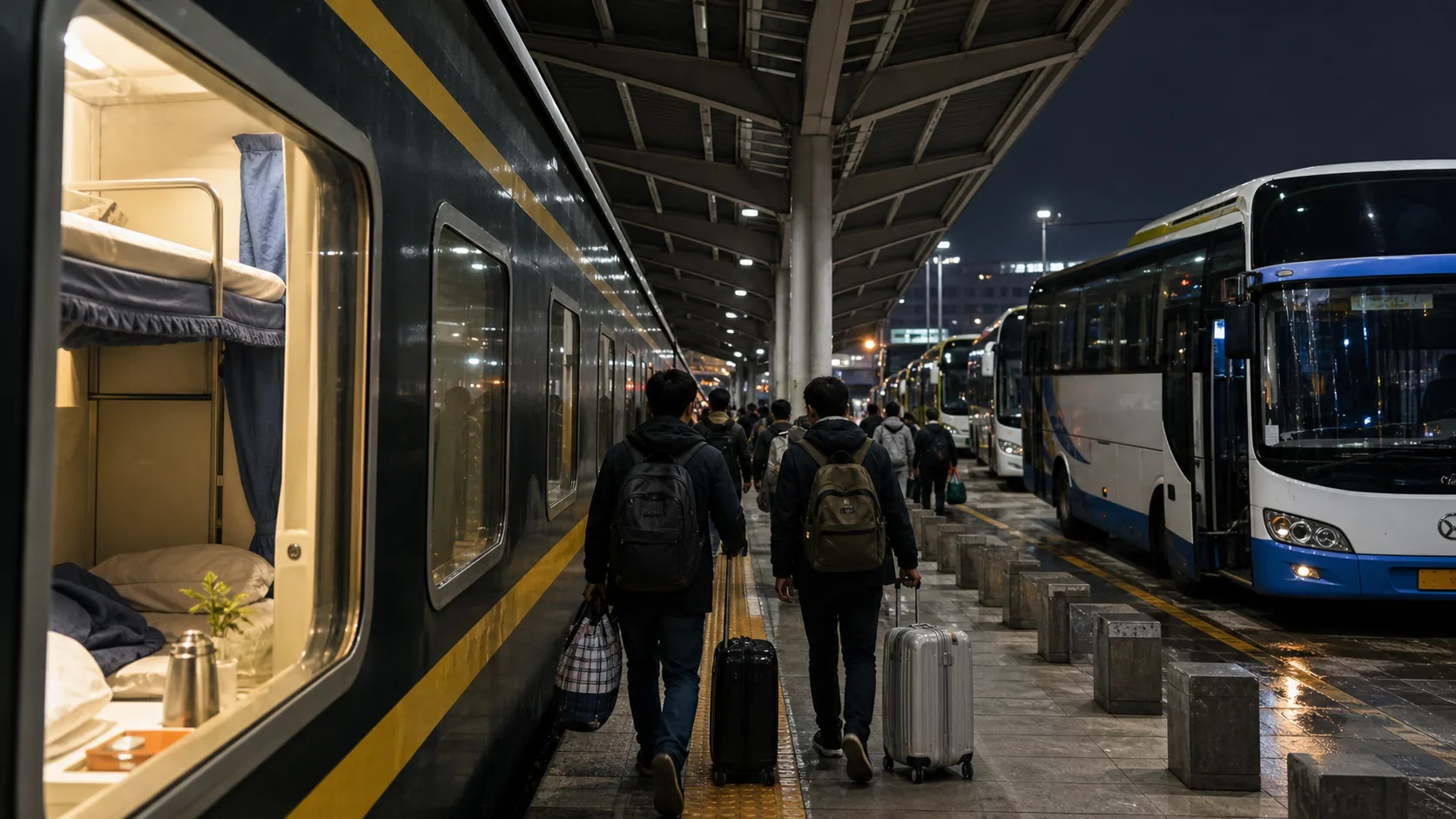
If you are trying to move around China without spending your budget on transport, the real challenge is not finding a cheap ticket. It is choosing the option that saves money without wasting a full day, arriving at the wrong station, or booking something you cannot easily use with a foreign passport. This guide breaks down when buses, slow trains, and long-distance night trains are actually the best choice.
The Budget Transport Landscape in China
China has three practical budget choices for medium and long-distance overland travel: intercity buses, conventional or slow trains, and overnight trains. Each one solves a different problem. Buses are often best for short-to-medium hops where rail is indirect. Slow trains are best when you want the lowest fare and the widest station coverage. Night trains are best when you want to save both a hotel night and a day of sightseeing.
What each option is really good for
Intercity buses usually make sense for routes that are not well served by rail, for smaller cities, or for destinations where the bus station is closer to the final stop than the railway station. Slow trains are ideal if you are traveling on a tight budget, are flexible on travel time, or want a sleeper that turns a long ride into an overnight transfer. Night trains are the sweet spot for many travelers because they combine transportation and lodging in one ticket.
The cheapest option is not always the best value. In China, the question is often whether a slightly higher fare buys you a cleaner station, a faster route, a more predictable schedule, or an easier booking experience. That tradeoff becomes more important if you are moving between major hubs like Beijing, Shanghai, Xi'an, Chengdu, Guangzhou, Kunming, or Xiamen, where train frequency is good and the cheapest bus may not be the fastest way to travel.
Buses: cheap, flexible, but route-dependent
Buses are the most underestimated budget option in China. They are not as glamorous as high-speed rail, and they are not always the first thing foreign travelers think about, but they can be very useful on regional routes. If you are trying to reach a mountain town, a county seat, a border area, a scenic area outside the rail network, or a city where the train station is inconveniently far from the center, a bus can be the simplest and cheapest way to go.
The upside is price and coverage. A bus ticket for a short intercity trip can be very inexpensive, and on many routes there are multiple departures a day. That makes buses useful if you miss a train, if you are traveling during a holiday surge, or if you are connecting from one smaller city to another without a direct rail link. The downside is variability. Buses can be slower in bad weather, more sensitive to traffic, and less comfortable than a train for anything beyond a few hours.
For travelers who want to keep the trip simple, the main advantage of buses is that they often go where rails do not. The main disadvantage is that station quality and booking systems vary a lot by city and province. Some terminals are modern and easy to navigate. Others are confusing, require local-language help, or have limited English signage. If you are traveling with large luggage, a rail option is usually easier unless the bus is clearly the direct route you need.
Slow trains: the classic low-cost backbone
Slow trains are still one of the best budget travel hacks in China. These are the conventional services that stop at more stations, take longer than high-speed trains, and often cost much less. They are especially useful when the route is long enough to make a bus miserable, but not so time-sensitive that you need the fastest possible arrival.
The most important strength of slow trains is that they give you a real choice of fare and comfort. Depending on the route, you may be able to buy hard seat, soft seat, hard sleeper, or soft sleeper. Hard seat is the cheapest, but it is usually only worth considering for very short daytime journeys or for travelers who are extremely budget constrained. Sleeper options are where slow trains become genuinely practical, because they let you rest and wake up in a different city.
Slow trains are also a good fallback when high-speed trains are sold out or disproportionately expensive on a busy day. This happens more often than first-time visitors expect, especially around public holidays, weekends, and school breaks. Even when the journey takes longer, the total trip may still make more sense if a slow train departs at a convenient time and avoids forcing you into an expensive hotel night or a more complicated transfer.
Long-distance night trains: the best value for many routes
Night trains are where China’s budget transport system becomes most efficient. A well-chosen overnight train can remove the cost of a hotel, cut wasted daytime hours, and get you into your destination early enough to start sightseeing or a workday immediately. For long routes, that combination often beats a cheap bus plus a hotel night.
There are two big reasons travelers like night trains. First, they reduce the emotional cost of long-distance movement. Instead of sitting all day in transit, you board in the evening, sleep, and wake up closer to your destination. Second, they make multi-city itineraries easier. If you are trying to see several places in one week, overnight trains can preserve your daylight for the actual trip.
Not all sleepers feel the same. Hard sleeper is the budget standard and works well for most travelers. Soft sleeper is more comfortable, usually quieter, and often worth the extra money on very long routes or if you know you need a better night of sleep. If you are sensitive to noise, light, or movement, the cheaper option can still be acceptable, but you should not expect hotel-level rest.
How to Choose the Right Option
The right choice depends on distance, station access, departure time, and how much you value sleep. A short regional route is usually a bus decision. A medium-to-long domestic route with decent rail coverage is often a slow-train or sleeper decision. A route where time matters, or where rail is not competitive, can justify a bus or even a different mode entirely.
Use buses when the rail network is awkward
Buses are best when they reduce complexity rather than just reduce fare. If the bus station is closer to your hotel, if the destination is not well served by rail, or if you are connecting between smaller cities, a bus may save enough time and hassle to justify it. That is especially true in provinces with scenic destinations that sit far from major stations.
You should also think about buses when you are making a same-day transfer and the rail schedule is too rigid. Buses can sometimes be more forgiving if you are changing plans late. But that flexibility comes with a tradeoff: less predictability, more exposure to traffic, and a higher chance that you will need local-language assistance at the terminal.
Use slow trains when price matters more than speed
Slow trains are the best option when you care more about staying on budget than arriving fast. They also make sense when you want to avoid the stress of a sold-out high-speed service or you need a sleeper but do not want to pay for premium comfort. On very long routes, the extra time can be acceptable if the train schedule is convenient and you can sleep through much of the journey.
For example, if you are moving between a city pair that has both high-speed and conventional rail, the slow train may be worth it when the price gap is large. If you are moving between a major hub and a smaller city, the slow train may also offer a station location that is easier to use than the high-speed station on the outskirts.
Use night trains when you want to save a day and a hotel
Night trains are the best value when they replace a hotel stay. The most common mistake travelers make is comparing the ticket price only against a daytime bus or train. A fair comparison includes the accommodation you no longer need and the sightseeing time you preserve. When you include those savings, sleepers become much more attractive.
This is especially true if you are moving between major tourist cities with strong sleeper connections or if you are trying to minimize backtracking. A night train is not just transport. It is an itinerary tool. You can leave one city after dinner, sleep on the way, and arrive early enough to check in to your next hotel, drop your luggage, and start the day.
Think in terms of total trip cost, not fare alone
The cheapest ticket is not always the cheapest trip. A bus that saves 50 RMB but adds four hours and forces a taxi from a remote terminal may be worse than a train that costs a little more but drops you near the center. Likewise, a slower sleeper that lets you skip a hotel can be much better value than a cheap daytime ride plus a room night.
If you are building a bigger China route plan, it helps to step back and compare transport with food, accommodation, and stopover choices. For a broader budgeting framework, see How to Travel China on a Budget: Cheap Transport, Food & Stays. If you need the bigger logistics picture around entry, payment, and rail planning, China Travel Planning: Visa, WeChat Pay, High-Speed Rail & Practical Guide gives useful context.
Practical Guide
China’s budget transport system is easiest to use when you know the booking channels, the service hours, and the paperwork rules before you reach the station. That matters more for rail than for buses, because China Railway uses real-name ticketing and requires the same identity document for booking and travel.
Booking channels and service hours
The official China Railway English website says the 12306 site provides information query and ticket refund services 24 hours a day, while ticket sales and endorsement services run from 5:00 to 1:00 the next day, with Tuesday sales ending at 23:30. That is a useful detail if you are trying to buy or change a ticket at an odd hour, especially while adjusting plans after arrival in China.
The official 12306 FAQ also confirms that foreign passengers can purchase real-name tickets with valid passports, and that tickets can be bought through station counters, automatic ticketing machines, 12306.cn, the 12306 mobile app, and in some areas by hotline booking. It also notes that only valid foreign passports are accepted on the English website. In other words, the system is designed for foreign travelers, but you need to enter the passport information carefully and use the same passport at boarding.
For rail, the general workflow is straightforward:
- Search the route and compare departure times.
- Choose the train type and seat or sleeper class.
- Enter passenger details exactly as they appear on the passport.
- Pay and keep the booking record or itinerary sheet.
- Travel with the same passport used for the booking.
If you are booking for more than one person, 12306 allows registered users with verified or ready-to-be-verified ID information to buy tickets for themselves or others, as long as passenger details are entered accurately. That is useful for families and groups, but it also means one mistyped passport number can create unnecessary friction at the station.
Current rail rules that matter in practice
One of the most important current rules is that 12306 is the official online ticket source. The FAQ explicitly says travelers should purchase train tickets from railway operation channels or their sales agencies, and that the railway department will not handle ticketing problems that occur on other websites. This is why unofficial sellers are a bad idea even when they look convenient.
Another detail that matters is the change and refund system. 12306 explains that endorsement refers to changing the date, train number, or seat or berth, and that changes depend on available capacity. The official FAQ also lays out that ticket changes can be free in certain time windows and that refund fees depend on how close you are to departure. For a budget traveler, this means booking too early without thinking through your schedule can still be risky if your plan is not fixed.
In practice, the safest strategy is to book the long legs only when your route is stable, and to leave some slack in your itinerary. That is especially important for sleeper routes, because overnight services are attractive precisely because they reduce hotel costs, but they also create more pressure if you miss the departure.
Approximate price expectations
Exact fares change by distance, class, and season, so there is no single China-wide price chart that stays accurate for long. Still, budget travelers can use rough expectations:
- Short intercity buses often land in the low tens of RMB for very short routes and rise from there with distance.
- Conventional slow trains can be the cheapest rail option, with hard-seat fares often competitive on medium routes.
- Hard sleeper is usually the best balance of comfort and price for overnight travel.
- Soft sleeper costs more, but it can be a smart buy when the route is very long or when you want a better chance at real sleep.
What matters most is not the absolute ticket price but the price per useful hour. A 12-hour bus that saves 40 RMB is not a good deal if it ruins your next day. A slightly more expensive sleeper that gets you to your next city rested can be much better value than a full day of transit plus a hotel room.
How to get to the station or terminal
The “how to get there” question is often overlooked. In large Chinese cities, railway stations are usually easy to reach by metro, taxi, or ride-hailing app, but some high-speed stations sit on the outskirts. Bus terminals are even more variable. Some are central; others are far from the neighborhoods visitors actually stay in.
Before booking, check two things: the station name and the distance from your hotel. The wrong station can wipe out the savings of a cheap fare. This is especially common in cities with multiple railway stations, where a budget option might depart from one station and arrive at another that is not near your next stop.
What to bring
For rail, bring the passport used for booking, a charged phone, and a screenshot or saved copy of the booking details. For overnight trips, add earplugs, a power bank, water, and a small bag of snacks. For buses, bring the same essentials plus a little more patience, since boarding procedures can be less standardized than rail.
If you are traveling in winter or on a long overnight route, a light jacket is useful because train temperatures and sleeping conditions can vary. If you are on a hard sleeper, a small eye mask and a neck pillow can help more than they would on a plane, because the ride is longer and the sleeping environment is more exposed.
Tips & Common Mistakes
Most first-time travelers make the same mistakes with budget transport in China. The good news is that they are easy to avoid once you know what to look for.
Mistake 1: Comparing only the ticket price
The cheapest fare is not always the best deal. A bus that arrives in the middle of nowhere, a train that lands at an inconvenient station, or a sleeper that leaves you exhausted can cost more in the end. Always compare total travel time, station access, and the likely need for a taxi on arrival.
Mistake 2: Assuming all trains are the same
In China, “train” can mean a very fast high-speed service or a slower conventional service with sleepers and lower fares. If you only search by destination, you can accidentally miss the budget-friendly rail options. For long routes, it is worth comparing both rail types before you decide.
Mistake 3: Booking the wrong station
Large Chinese cities often have multiple train stations, and the cheapest ticket may not use the most convenient one. Double-check both departure and arrival stations before paying. This matters even more if you are linking a train to a hotel check-in, airport transfer, or same-day sightseeing plan.
Mistake 4: Leaving too little time for boarding
Budget transport can be cheap because it is efficient, not because it is casual. Rail stations can be large, and bus terminals can be confusing. Arrive early enough to find your platform, locate the right exit, and handle any passport or ticket checks without stress.
Mistake 5: Trusting unofficial sellers
The official 12306 FAQ makes it clear that the railway department will not handle ticketing issues that happen on other websites. That is the key reason to avoid random resale platforms for rail tickets unless you fully understand the risk. If you need rail, use the official channel first.
Mistake 6: Forgetting that overnights are also logistics
Night trains save time, but they are not frictionless. You still need snacks, sleep gear, and a plan for your arrival time. If you land too early for hotel check-in, budget a cafe stop, a station locker, or a short walk so you do not waste the morning.
Mistake 7: Ignoring comfort on longer rides
Budget travel does not mean sleeping badly by default. If the route is long enough to matter, the difference between hard seat and hard sleeper, or between hard sleeper and soft sleeper, can decide whether you arrive ready to explore or need half a day to recover. Spend where it actually improves the trip.
FAQ
Are buses always cheaper than trains in China?
Not always. For short regional routes, buses can be cheaper. But on many long-distance routes, slow trains are extremely competitive, and sleeper options can be better value once you account for the hotel night you save. The cheapest fare and the best overall value are not the same thing.
Can foreign travelers use China’s rail booking system?
Yes. The official 12306 FAQ says foreign passengers can purchase real-name tickets with valid passports, and the English website accepts valid foreign passports that can be used according to the relevant rules. The key is to enter the passport information accurately and travel with that same document.
Is a night train worth it for a first trip to China?
Usually yes, if the route is long enough. Night trains are especially useful when they replace a hotel night and preserve daytime sightseeing hours. If you are not used to sleeper travel, start with a route that is long but not absurdly long, and consider soft sleeper if the price difference is manageable.
What is the safest budget option for long-distance travel?
For most travelers, a conventional train with a sleeper is the safest mix of price, predictability, and comfort. Buses are fine on the right route, but trains usually offer a better balance once the journey becomes long enough to affect your energy and schedule.
When should I choose a bus instead of rail?
Choose a bus when the rail route is indirect, when the destination is not well served by train, or when the bus terminal is clearly closer to where you need to be. Buses can also be useful for smaller cities and scenic areas where rail coverage is limited.
Conclusion
China’s budget transport system works best when you treat it as a planning problem rather than a pure price search. Buses are useful for routes rail does not cover well. Slow trains are the classic low-cost backbone. Night trains are often the smartest value on long routes because they save a hotel night and keep your itinerary moving.
If you remember only three things, make them these: compare total trip cost instead of fare alone, check the exact station names before paying, and use the official 12306 booking flow for rail. Once you do that, budget travel across China becomes much easier to plan, easier to book, and much less stressful on the day you travel.