Busan Museum of Art and the Cultural District Guide

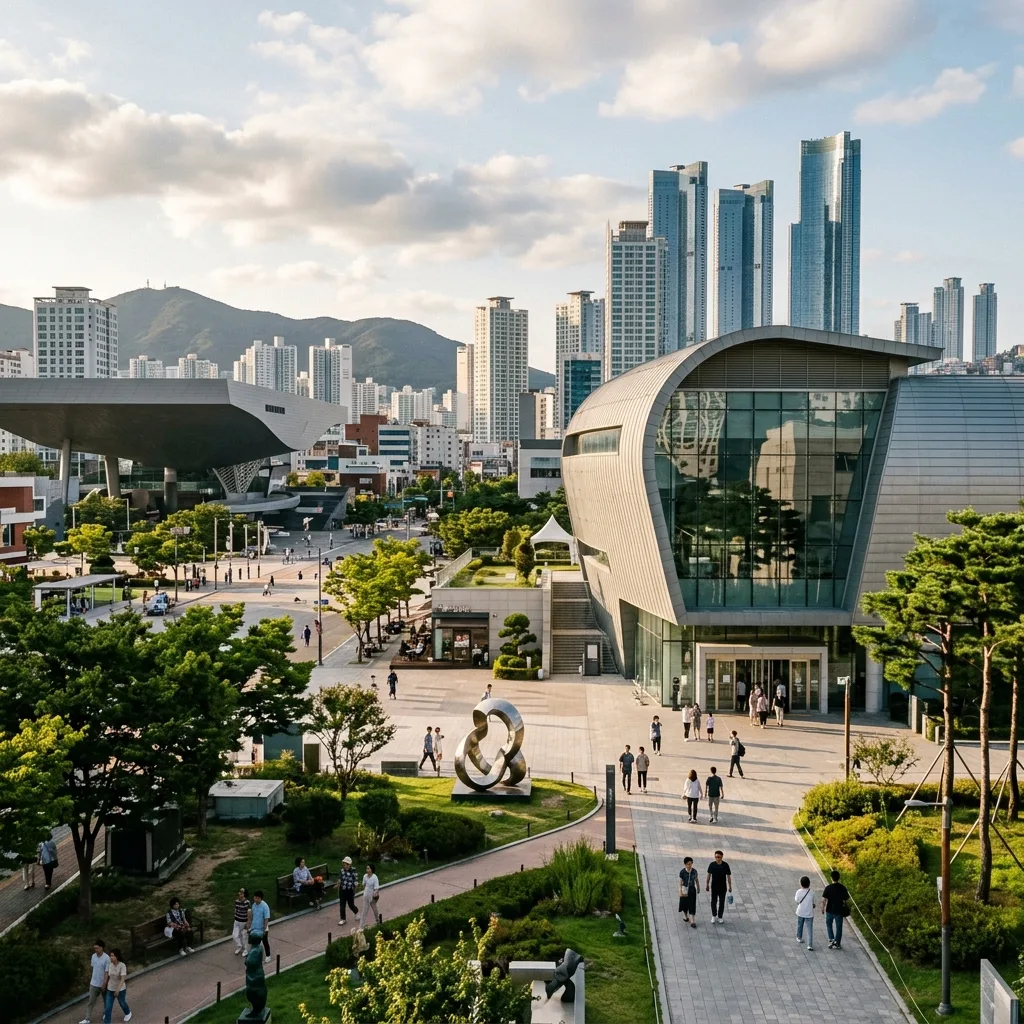
Busan is often celebrated for its sweeping beaches, bustling seafood markets, and vibrant coastal culture. However, beneath the surface of this dynamic port city lies a rapidly growing, world-class contemporary art scene. At the heart of this cultural renaissance is the Busan Museum of Art (BMA), located in the ultra-modern Centum City district. While the museum's main building is currently undergoing a massive renovation project in 2026 to elevate its facilities to international standards, the museum's prized annex—Space Lee Ufan—remains open, offering one of the most profound artistic experiences in South Korea. This guide will navigate you through visiting the open sections of the museum, understanding the legacy of its featured artists, and exploring the broader architectural and cultural wonders that make up Busan's Centum City.
The Centum City area in Haeundae-gu was built on the site of the former Suyeong Airport. Over the past two decades, it has been transformed into a futuristic hub of commerce, cinema, and fine art. The Busan Museum of Art, opened in 1998, has been the anchor of this cultural district. It focuses heavily on contemporary art, highlighting both international figures and the unique regional art movements born in the southern provinces of Korea.
2026 Update: The Main Building Renovation
Before diving into the highlights of the district, it is crucial to address the current operational status of the museum. As of 2026, the main building of the Busan Museum of Art is closed for an extensive, multi-year renovation project. The city of Busan is overhauling the infrastructure to accommodate larger, more complex international exhibitions and to modernize the visitor experience.
While this means the vast permanent collections and large-scale temporary exhibition halls are temporarily inaccessible, the museum is not entirely dormant. The institution has adapted by launching "Loop Lab Busan," an international media art platform that hosts pop-up exhibitions, digital art installations, and cultural forums at various off-site venues across the city. More importantly, the jewel in the museum's crown—the standalone annex known as Space Lee Ufan—remains fully open to the public.
The Highlight: Space Lee Ufan
For art lovers, Space Lee Ufan is reason enough to visit the BMA campus. Opened in 2015, this dedicated annex celebrates the work of Lee Ufan, one of Korea's most important living artists and a leading figure of the Dansaekhwa (Korean monochrome painting) and Mono-ha (School of Things) movements.
Who is Lee Ufan?
Born in rural South Korea in 1936, Lee Ufan moved to Japan in his youth and became a pivotal philosophical and artistic bridge between the two nations. His work is characterized by extreme minimalism, focusing on the relationship between materials, space, and the viewer. He often uses unworked natural materials, such as massive boulders, and places them in deliberate proximity to industrial materials, like steel plates. His paintings usually feature a single, repetitive brushstroke on a vast, empty canvas, exploring the concepts of infinity, emptiness, and the passage of time.
Inside the Annex
Space Lee Ufan in Busan is uniquely significant because the artist himself meticulously designed the building's layout to harmonize with his artworks. It is not just a gallery; it is a holistic spatial installation.
- The Architecture: The building is minimalist, utilizing raw concrete, natural light, and stark geometry. It feels more like a modern temple than a traditional museum.
- The Sculptures (Relatum Series): As you approach the building, you are greeted by his famous Relatum sculptures. The juxtaposition of heavy, silent stones resting against sharp, rusted steel plates invites quiet contemplation.
- The Paintings (From Point, From Line): Inside, the galleries display his iconic painting series. The progression from his early, more densely patterned works to his recent, minimalist single-stroke canvases (Dialogue series) is laid out chronologically.
- The Atmosphere: The space requires silence and patience. It is designed to force the viewer to slow down and become hyper-aware of their own physical presence in relation to the art.
Expanding Your Itinerary: The Centum City Cultural District
Since the main BMA building is closed, you will likely spend about 1 to 1.5 hours exploring Space Lee Ufan. Fortunately, the museum is located in Centum City, an architectural playground filled with other cultural and leisure attractions. You can easily build a full-day itinerary without leaving the neighborhood. If you are planning a broader trip, this area is a must-include in The Ultimate 10-Day South Korea Itinerary.
Busan Cinema Center (Seoul Cinema Center)
Just a short walk from the museum is the breathtaking Busan Cinema Center, the official venue of the renowned Busan International Film Festival (BIFF).
- The Architecture: Designed by the Austrian firm Coop Himmelb(l)au, the building is famous for its massive, cantilevered roof, which holds the Guinness World Record for the longest cantilever roof in the world.
- The LED Canopy: At night, the underside of the roof comes alive with an incredibly complex LED light show, displaying swirling colors and cinematic sequences.
- What to Do: Even outside of festival season (which takes place in October), the center screens independent, classic, and international films in its world-class theaters.
Museum DAH: (Digital Art House)
If you are craving more contemporary, highly visual art after the quiet minimalism of Lee Ufan, head over to Museum DAH:.
- The Concept: This is South Korea's first digital media art museum. The entire interior—including the floors, walls, and ceilings—is covered in high-definition LED screens.
- The Experience: The exhibitions consist of deeply immersive, constantly shifting digital landscapes, often accompanied by synchronized soundtracks. It is a wildly psychedelic, highly Instagrammable experience that provides a sharp, fascinating contrast to traditional fine art.
Shinsegae Centum City
No visit to this district is complete without stepping into Shinsegae Centum City, officially recognized by Guinness World Records as the largest department store in the world. However, calling it a "store" is a massive understatement; it is an indoor city.
- Spa Land: Located on the first floor, Spa Land is a luxurious, massive jjimjilbang (Korean traditional bathhouse). It features hot spring baths sourced from deep underground, multiple themed sauna rooms (like the salt room or the charcoal room), and relaxation lounges. It is the perfect place to unwind after a day of walking.
- Ice Rink and Golf: The complex also houses an indoor ice-skating rink, an indoor golf driving range, and a massive multiplex cinema.
APEC Naru Park and the Suyeong River
If you want to escape the concrete and glass, walk toward the Suyeong River to APEC Naru Park. This long, beautifully landscaped riverside park offers walking and cycling paths. It is an excellent spot to grab a coffee, sit by the water, and look across the river to the towering skyline of Marine City. The park is also dotted with contemporary sculptures leftover from previous Busan Biennale exhibitions.
Practical Guide: Hours, Prices, and Logistics
Space Lee Ufan Operating Hours (2026)
- Tuesday to Sunday: 10:00 AM – 6:00 PM (18:00)
- Last Entry: 5:30 PM (17:30)
- Closed: Every Monday, and January 1st. If Monday is a national holiday, the museum will remain open and close on the following Tuesday instead.
Admission Prices
- Space Lee Ufan Entry: Generally free of charge for the permanent exhibition. If the museum is hosting a special ticketed event within the space, standard adult tickets are usually around 2,000 to 3,000 KRW, making it highly affordable.
- Note: Always check the official website (art.busan.go.kr) before arriving, as the ongoing renovations to the main campus can occasionally impact access routes or cause temporary closures for heavy construction work.
How to Get There
Centum City is incredibly well-connected to the rest of Busan via public transit.
- By Subway: Take Busan Metro Line 2 (the Green Line) to BEXCO Station. Take Exit 5, and the museum campus is just a 2-minute walk away. Alternatively, getting off at Centum City Station puts you closer to Shinsegae and the Cinema Center.
- By Bus: Numerous city buses service the BEXCO/Centum City area, including rapid buses from Busan Station if you are arriving via the KTX high-speed train.
Deep Dive: The Art Landscape of South Korea
If your visit to the Busan Museum of Art sparks a deeper interest in the country's creative landscape, you will find that South Korea is currently experiencing a golden age of contemporary art. The success of Korean cinema, music, and fashion has brought global attention to its visual artists as well.
The Role of Busan in the National Scene
While Seoul remains the undisputed commercial art capital, housing major international galleries like Pace, Lehmann Maupin, and Perrotin, Busan has carved out its own unique identity. Busan's art scene is often described as more experimental, community-driven, and deeply influenced by its coastal environment and history as a port city that took in refugees during the Korean War. The Busan Biennale, held every two years, has gained a reputation for being more avant-garde and politically engaged than its counterparts in the capital. For a comprehensive overview of the national art scene, read our guide to the Best Art Museums and Galleries in Seoul and Beyond.
The Dansaekhwa Movement
When exploring Space Lee Ufan, you are looking at the foundational work of the Dansaekhwa movement. Emerging in the 1970s, this movement (translated as "monochrome painting") was Korea's answer to Western minimalism, though artists strongly reject that comparison. While Western minimalism often focused on industrial precision and removing the artist's hand, Dansaekhwa is deeply spiritual. It focuses on the repetitive, meditative physical labor of the artist—pushing paint through the back of a canvas, endlessly drawing pencil lines until the graphite runs out, or repetitively soaking and drying hanji paper. It is an art form rooted in Taoist and Buddhist philosophies of endurance, nature, and the void.
Tips & Common Mistakes
1. Don't Arrive Expecting a Massive Museum
The most common mistake tourists make in 2026 is arriving at the BMA expecting to spend four hours wandering through massive galleries, only to find the main building fenced off for renovations. Set your expectations appropriately: you are visiting a specialized, standalone annex (Space Lee Ufan). Treat it as a deep, focused dive into a single artist's mind rather than a broad survey of art history.
2. Combine Art with Spa Land
The ultimate Centum City itinerary involves spending the morning engaging your mind at Space Lee Ufan and the Cinema Center, followed by a late lunch in the Shinsegae food court, and finishing the day by engaging your body at Spa Land. Soaking in the hot springs while looking up at the glass atrium of the department store is a uniquely Busan experience.
3. Photography Etiquette
Space Lee Ufan is a space designed for quiet reflection. While taking photos of the outdoor sculptures is fine, photography inside the painting galleries is often restricted or heavily frowned upon. Put your phone away and allow yourself to simply exist in the quiet space the artist created. The lack of digital distraction makes the subtle textures of the paintings far more impactful. For more travel tips across the country, see our Top 10 Must-Visit Cities in South Korea.
FAQ
Q: Is the Busan Museum of Art suitable for young children? A: With the main building closed, the remaining open area (Space Lee Ufan) is very quiet, minimalist, and features fragile installations. It is not an ideal environment for energetic young children. Families would be much better served visiting the nearby Museum DAH:, which is colorful, loud, and highly engaging for kids.
Q: How long will the main building renovations last? A: The city has slated the comprehensive renovation project to continue throughout 2026. The reopening date has not been firmly set, as the project involves major structural overhauls and the installation of state-of-the-art climate control systems for international exhibitions.
Q: Are there English explanations available at Space Lee Ufan? A: Yes, there is basic English signage, and the museum provides English brochures that explain Lee Ufan's philosophy, the Mono-ha movement, and his artistic process.
Q: Can I walk from Haeundae Beach to the Museum? A: You can, but it is a very long walk (around 45 minutes to an hour). It is much faster and easier to hop on the Green Line subway at Haeundae Station and ride it three stops to BEXCO Station.
Culinary Highlights in Centum City
While exploring the contemporary art and futuristic architecture of Centum City, you are also perfectly positioned to dive into Busan's famous culinary scene. The district offers an incredible mix of high-end dining, casual street food concepts, and hyper-local seafood specialties. A day spent feeding the soul at Space Lee Ufan should be followed by a meal that feeds the body.
Shinsegae Centum City Food Court
The basement level of Shinsegae Centum City is not your average mall food court; it is a sprawling, high-quality culinary destination that rivals some of the best markets in Asia.
- What to Eat: You can find everything from premium sushi and freshly baked artisanal breads to traditional Korean street food staples like tteokbokki (spicy rice cakes) and eomuk (fish cakes).
- The Eomuk Experience: Busan is arguably the fish cake capital of Korea. Look for the Samjin Amook bakery inside the department store. It operates like a French bakery, but instead of croissants, you use tongs to select dozens of different types of fried, steamed, and stuffed fish cakes. It is a quintessential Busan snacking experience.
Local Specialties: Milmyeon and Dwaeji Gukbap
If you want to step away from the department store and try the dishes that Busan is most famous for, you do not have to go far.
- Milmyeon (Wheat Noodle Soup): This dish was born out of the Korean War when buckwheat (used for traditional cold noodles) was scarce. Refugees used wheat flour from US aid to create a chewy, refreshing cold noodle soup. It is served in an icy, slightly sweet, and tangy broth, usually topped with a dollop of spicy gochujang paste. There are several excellent milmyeon specialty shops scattered within walking distance of the BMA.
- Dwaeji Gukbap (Pork Soup with Rice): This is the ultimate comfort food in Busan. It is a rich, milky-white broth made by boiling pork bones for hours, served with tender slices of pork and a bowl of rice. You customize the broth at the table with salted shrimp, spicy paste, and fresh garlic chives. It is hearty, deeply satisfying, and perfect if you are visiting the museum during the colder winter months.
Fine Dining and Cafes
If you are celebrating a special occasion or simply want to elevate your dining experience after a day of fine art, the area surrounding the Cinema Center and Marine City offers numerous upscale options.
- Marine City Dining: Just a short taxi ride (or a pleasant walk) from Centum City is Marine City, an ultra-luxurious residential district overlooking the ocean. The ground floors of these skyscrapers are lined with high-end Italian restaurants, premium Korean BBQ joints, and chic cafes with ocean views.
- Specialty Coffee: The cafe culture in Busan is booming. Within Centum City, you will find several sleek, minimalist cafes that roast their own beans and offer precision pour-overs, perfectly complementing the aesthetic you just absorbed at Space Lee Ufan.
The Future of the Busan Museum of Art
The ongoing 2026 renovations are not merely a structural facelift; they signify a major shift in the ambition of the Busan Museum of Art. The local government is aggressively positioning Busan to compete on the global art stage, aiming to draw the caliber of international exhibitions previously reserved exclusively for Seoul or Tokyo.
What to Expect Post-Renovation
When the main building eventually reopens, visitors can expect radically transformed interior spaces. The ceilings are being raised to accommodate massive contemporary installations, and the climate control systems are being entirely replaced to meet the strict insurance requirements of lending institutions like the Louvre or the MoMA. Furthermore, the museum plans to heavily integrate digital and interactive technologies into its permanent collection displays, blurring the line between traditional curation and modern media.
The Rise of Art Busan
This renovation coincides with the rising international prominence of the "Art Busan" art fair, typically held at the nearby BEXCO convention center. In recent years, Art Busan has evolved from a regional event into a major commercial hub, attracting top-tier galleries from Europe, America, and across Asia. The synergy between a newly modernized BMA, the expanding Art Busan fair, and the established Busan Biennale ensures that the city's cultural trajectory is firmly pointed upward. For travelers interested in tracking the evolution of the Korean art scene, Busan is the city to watch over the next decade.
Conclusion
The temporary closure of the Busan Museum of Art's main building is a transition, not a tragedy. The continued operation of Space Lee Ufan ensures that travelers can still experience the profound, meditative power of one of Korea's greatest modern masters. Furthermore, the museum's location in Centum City means that your cultural exploration doesn't stop at the gallery exit. From the architectural marvel of the Cinema Center to the immersive digital worlds of Museum DAH:, and the luxurious relaxation of Spa Land, Centum City offers a multifaceted look at modern Korean culture. Embrace the quiet minimalism of the art, then step out and enjoy the futuristic energy of the city.