Best Neighborhoods for Digital Nomads in Shanghai: Jing'an to Xintiandi

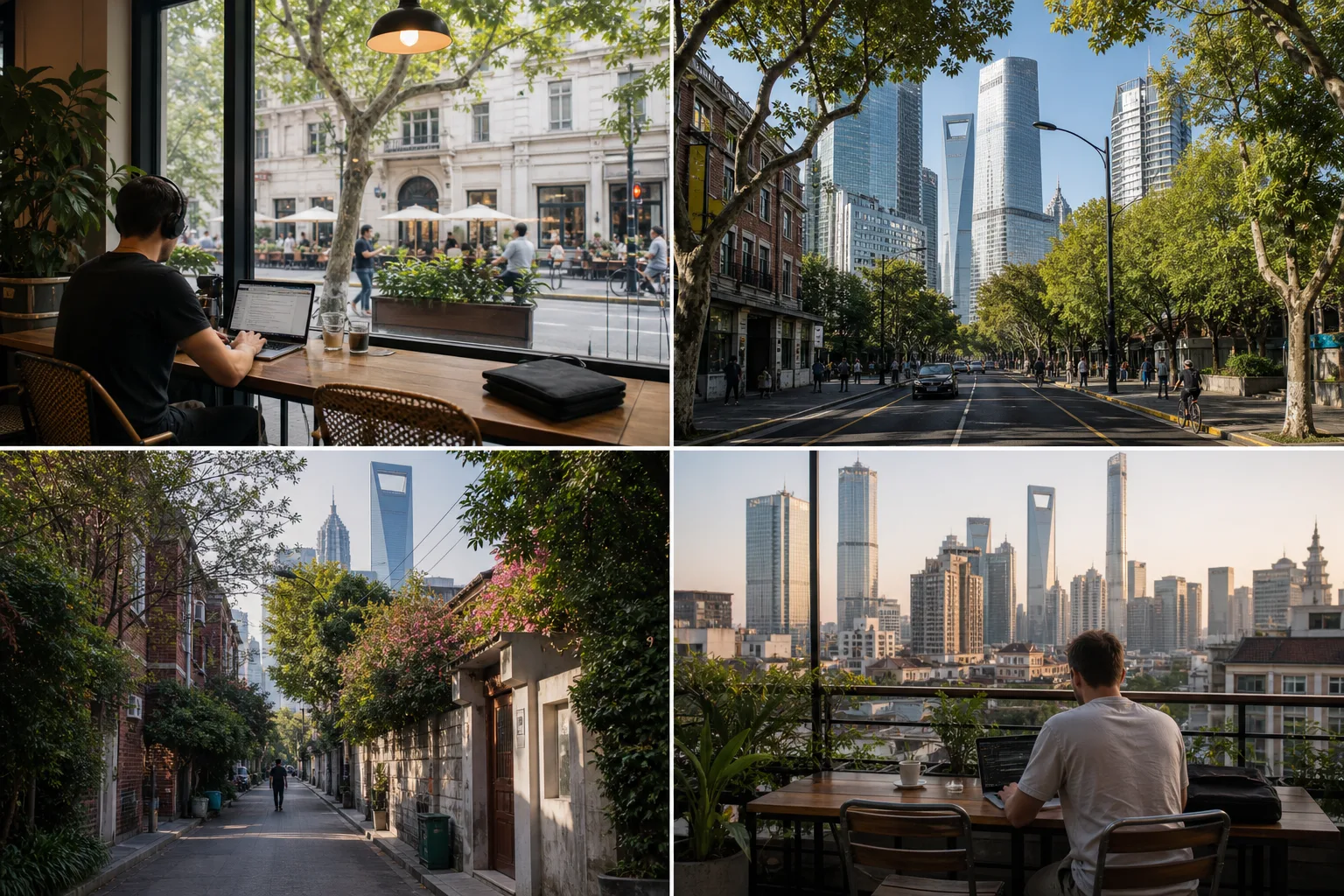
Shanghai is not a city you base yourself in randomly. The difference between a productive month and a frustrating one is often one metro stop, one street width, or one building with better noise insulation. If you are working remotely, the question is not just where the cafes look nicest. It is where your commute, meals, Wi-Fi, and daily rhythm stay predictable enough that you can focus on work instead of logistics.
This guide compares the parts of central Shanghai most digital nomads actually consider: Jing'an, Xintiandi, and the streets that spill into the former French Concession. These are not the cheapest neighborhoods in the city, but they are the ones that make a short or medium stay feel manageable. If you want a broader background on why Shanghai works so well as a base city, start with Living in China as a Digital Nomad: Visa, VPN & Remote Work Guide. If you are still sorting the country-level setup, China Travel Planning: Visa, WeChat Pay, High-Speed Rail & Practical Guide is the companion piece that covers the essentials.
Where to Base Yourself in Central Shanghai
If you only remember one thing from this article, make it this: choose your base for function first and atmosphere second. Jing'an gives you the strongest everyday balance of transit, food, and convenience. Xintiandi gives you the cleanest first impression and the easiest orientation if you are new to the city. The former French Concession gives you the best walking experience and the strongest sense of neighborhood life, especially if you want to settle in rather than just pass through.
Jing'an: the practical default for remote work
Jing'an is the most straightforward recommendation for a digital nomad who wants Shanghai to feel easy from day one. It sits near the center of the city, has strong metro coverage, and offers a dense mix of apartment buildings, office towers, malls, cafes, and service businesses. That combination matters more than dramatic architecture. When you need to buy groceries, take a call, meet someone for lunch, or get across town without overthinking it, Jing'an makes the city feel smaller.
The district's transit advantage is hard to ignore. Jing'an Temple station is a major interchange, and the wider area connects quickly to other parts of central Shanghai. That means you can reach business areas, entertainment blocks, and older residential streets without building your day around long transfers. If you are the kind of remote worker who values frictionless movement over a cinematic neighborhood feel, Jing'an is usually the safest starting point.
Another reason Jing'an works well is that it has enough variety to absorb different lifestyles. You can stay in a serviced apartment, a modern high-rise, or a smaller older building and still keep your day-to-day needs within a short walk. That matters if you are in Shanghai for a few weeks or a few months and do not want to spend your first days learning where every basic errand lives.
Jing'an is not a budget neighborhood, but it is often a better value than more obviously prestigious areas because the practical upside is so high. You are paying for saved time, easy transit, and a city-center routine that stays stable even when your workweek gets busy.
Xintiandi: the polished introduction to Shanghai
Xintiandi is the neighborhood people often picture when they imagine a refined Shanghai stay: pedestrian-friendly, stylish, easy to navigate, and close to a lot of the city’s best-known central attractions. It is one of the most legible places to stay if you are arriving with a suitcase, a laptop, and no desire to spend the first week decoding the city.
For digital nomads, Xintiandi has two advantages. First, it is extremely central. Second, it is simple. The area is orderly, easy to explain to drivers, and surrounded by enough restaurants, hotels, and services that you can get through a workday without leaving the district if you really need to. That kind of convenience can be worth a premium when you are juggling jet lag, client calls, and new systems.
The tradeoff is that Xintiandi feels more curated than lived-in. It is polished and commercial, and some travelers find it too neat for a long stay. If you want an environment that feels like an urban neighborhood instead of an upscale open-air complex, Xintiandi may be better as a reference point than as your actual long-term base. Still, it is excellent for people who want to land somewhere low-risk, learn how Shanghai works, and then decide whether to move a little farther out later.
The metro access is also easy to understand. South Shaanxi Road station gives you strong cross-city connections, and the surrounding blocks keep you within a sensible distance of both the old French Concession and the larger commercial core. That is one reason Xintiandi stays popular with first-time visitors who want centrality without chaos.
The former French Concession: best for walkability and everyday texture
If Jing'an is the practical default, the former French Concession is the romantic alternative that still works in real life. Its shaded streets, lower-rise buildings, and human-scale blocks make it easier to walk, pause, and feel like you are living in a city rather than commuting through one. This is the part of Shanghai many people fall in love with because the pace is slower even when the district itself is busy.
The former French Concession is not one uniform neighborhood. It is a broad central area that includes different blocks, different levels of polish, and different price points. Some streets are lined with boutiques and polished cafes. Others are residential, quieter, and much more ordinary in the best possible way. If you want to wake up, walk for coffee, work for a few hours, and then drift into an evening meal without opening a map, this is where Shanghai rewards you.
The district is also one of the easiest places to understand Shanghai’s mix of old and new. You see lane houses, tree-lined streets, and apartment blocks that feel rooted in daily life rather than designed for visitors. That is why the area remains such a strong choice for people staying longer than a quick city break. It gives you enough urban texture to keep things interesting, but not so much scale that every task becomes a project.
For a broader city walk that shows how these areas connect to the riverfront and to Shanghai's most famous public spaces, the Shanghai Travel Guide: The Bund, French Concession & Hidden Gems is the best companion read.
How to choose between them
Use this simple filter:
- Choose Jing'an if you want the easiest everyday base and the best all-around logistics.
- Choose Xintiandi if you want a polished, central landing zone and do not mind paying for simplicity.
- Choose the former French Concession if you value walkability, tree-lined streets, and a neighborhood feel that still works for remote work.
If you are staying under a month, the cleanest answer is often Jing'an or Xintiandi because they reduce decision fatigue. If you are staying longer, the French Concession usually becomes more attractive because it gives you a better sense of daily life and a stronger relationship to the city. That said, all three areas are close enough that the difference is less about geography than about how you prefer to spend your mornings.
What Life Feels Like in Each Area
Neighborhood choice is not just about rent. It changes your schedule, your walking habits, your food options, and the way your workday starts and ends. In Shanghai, those details matter because the city is big enough to reward deliberate choices and busy enough to punish bad ones.
Jing'an feels efficient
Jing'an is the neighborhood for people who like clarity. There are enough malls, office buildings, apartment towers, and service businesses that life feels organized. You can usually find what you need without going far, and there is enough density that the area stays active throughout the day.
For remote workers, that efficiency translates into fewer disruptions. Need to find a cafe before a meeting? There will be several. Need to switch from work to errands to dinner in one hour? Jing'an makes that easy. Need to get across town without a long transfer chain? You are in a good place. The district is strong because it minimizes the time you spend solving small problems.
Jing'an also tends to suit people who enjoy being near business activity without wanting to live in a business hotel. You get central Shanghai energy, but you can still build a routine. That makes it a good fit for consultants, freelancers, startup operators, and anyone who needs the city to behave like infrastructure instead of a destination.
Xintiandi feels immediately legible
Xintiandi is the easiest district for newcomers to decode. The streets are clean, the routes are clear, the food and retail options are obvious, and the whole area is designed to be navigable on the first day. That reduces the hidden cost of settling in. If you arrive tired, this matters.
The downside is that legibility can feel a little too polished after a while. Some digital nomads love the reassurance of an environment that always seems ready for a dinner meeting. Others eventually want more character, more neighborhood grit, and a little less commercial shine. Xintiandi can be a great first stop, but it is worth asking yourself whether you want to stay there long enough for the novelty to wear off.
The former French Concession feels human-scale
The former French Concession is the best neighborhood family for people who want Shanghai to feel livable instead of merely convenient. The streets are better for walking. The blocks feel more intimate. The mix of old residences, cafes, and everyday shops creates a stronger sense of place.
That does not mean the area is sleepy. Far from it. Some blocks are busy from morning until late evening, especially near commercial streets and café clusters. But the district still feels less dominated by transit corridors and office sprawl than Jing'an, and less curated than Xintiandi. If you want to write, plan, meet, and explore all from the same area, this balance can be ideal.
A useful mental model
Think of the three areas as three different kinds of productivity:
- Jing'an is logistical productivity.
- Xintiandi is psychological productivity.
- The former French Concession is creative productivity.
That is not a strict rule, but it is a helpful way to decide where you will be happiest. If your work is heavy on meetings and quick movement, Jing'an usually wins. If you want a soft landing and minimal uncertainty, Xintiandi is strong. If your best work comes from a calm, walkable environment with plenty of character, the French Concession is the better fit.
Practical Guide
If you are choosing a Shanghai neighborhood as a digital nomad, the practical questions are very predictable: how do you get around, where do you work, what kind of accommodation makes sense, and how much friction will daily life create? The answer is less about one perfect district and more about whether your chosen base keeps the small tasks small.
How to get there and move around
Shanghai’s metro is the backbone of the city, and all three neighborhoods benefit from it. Jing'an Temple station is one of the easiest anchors in the city center, and South Shaanxi Road gives you excellent access to the blocks around Xintiandi and the former French Concession. If you are new to Shanghai, choose accommodation within easy walking distance of a metro station and your whole stay gets simpler.
You do not need to build your daily life around taxis unless you want to. In central Shanghai, the subway is usually the most reliable way to move between districts, especially during peak traffic. That matters for digital nomads because it turns cross-town movement into a normal part of the day instead of a special trip that requires planning.
If you are using ride-hailing, make sure your pickup locations are easy to describe and that you know the Chinese names of the major landmarks near your address. That saves time when you are leaving a restaurant, heading to a meeting, or returning home after dark.
Where to work during the day
For most remote workers, the best setup is a mix of home base, nearby cafe, and occasional coworking space. Shanghai supports that well, especially in Jing'an and the former French Concession. You can usually find a coffee shop for a laptop session, but you should not assume every cafe is equally suitable for long work blocks. Some are great for a one-hour call and terrible for a six-hour writing day.
Coworking spaces make the most sense if you have a lot of meetings, need stronger concentration, or want a cleaner separation between work and personal time. They are especially useful if you are staying long enough to justify a monthly setup and want a reliable backup when cafe seating is unpredictable.
If you prefer cafes, choose ones with enough turnover, enough space between tables, and a clientele that seems comfortable with laptops. The former French Concession is particularly strong for this because the neighborhood has a wide mix of coffee shops at different price points and with different atmospheres. Jing'an offers more volume and convenience. Xintiandi offers polish, but often less variety in feel.
Housing strategy
Housing is the single biggest factor in whether your Shanghai stay feels comfortable. In central districts, you are paying for location, building quality, noise control, and convenience. That is why two apartments that look similar in photos can feel very different in real life.
If you are staying for a short period, a serviced apartment or modern short-term rental can be the least stressful option. The premium may be worth it because it reduces the friction of furnishing, utility setup, and local troubleshooting. If you are staying longer, a standard apartment may make more sense, but only if you are confident about internet quality, building management, and the surrounding block.
Look for a place that has:
- a real desk or table,
- reliable Wi-Fi,
- enough natural light for daytime work,
- a quiet bedroom or sleep area,
- and easy access to groceries and transit.
The neighborhood itself matters, but the unit matters just as much. A beautiful district cannot fix a bad layout or a noisy building. If your work depends on focus, inspect for sound insulation and ask specific questions about the apartment rather than assuming the listing photos tell the full story.
Budgeting without overcomplicating it
Do not overbuild your budget model. For central Shanghai, the main cost buckets are always the same: housing, food, transport, and the small convenience expenses that accumulate when you live in a dense city. Jing'an and the former French Concession are generally higher-cost zones than outer districts because you are paying for centrality and walkability. Xintiandi tends to sit toward the premium end because of its polished location and commercial appeal.
A useful way to budget is to think in relative terms:
- Central and convenient usually costs more than central and plain.
- Walkable and charming usually costs more than efficient and standard.
- Short-term convenience usually costs more than longer-term commitment.
That framework keeps you from fixating on one line item. The real question is whether the neighborhood helps you stay productive. If yes, the extra cost can be rational. If no, you are paying for scenery rather than useful daily life.
Payment, SIMs, and admin
Neighborhood choice cannot solve bad setup. Even in the best part of Shanghai, you still need your basic digital and financial tools working. Set up your payment apps, carry a backup card, and make sure your phone and data plan are ready before you arrive. That advice sounds obvious, but many travelers only discover the friction after they have already booked housing and transport.
This is especially important if you plan to move around the city or take side trips outside Shanghai. The less you have to think about payment and connectivity, the more useful your neighborhood choice becomes. A great district is only great if you can actually operate inside it.
Tips & Common Mistakes
Shanghai is easy to enjoy when your expectations are aligned with how the city actually works. The mistakes digital nomads make here are usually not dramatic. They are small, repeated errors that make every day feel slightly harder than it should.
Mistake 1: Picking a neighborhood for its reputation instead of its routine
Xintiandi looks attractive in photos, so people often choose it too quickly. Jing'an sounds businesslike, so people dismiss it before they understand how useful it is. The French Concession sounds romantic, so people assume every block will be equally calm and charming. None of those assumptions is reliable.
The better question is: what will your Tuesday look like? If the answer involves laptop work, coffee, transit, errands, and dinner, choose the neighborhood that handles all five without friction. That is usually Jing'an or the French Concession, depending on your style.
Mistake 2: Living too far from a metro station
In Shanghai, distance to transit changes how often you leave the house. A place that looks central on the map can still feel awkward if the walk to the station is unpleasant or if the nearby line is inconvenient for your usual routes. For digital nomads, that is a hidden productivity cost because every errand becomes a mental calculation.
Mistake 3: Assuming cafes are a full office replacement
You can absolutely work from cafes in Shanghai, but the best setup is usually a hybrid one. Use cafes for flexibility, not dependence. If you have client calls, deep work, or days when you need total consistency, build your stay around a home base that can absorb those sessions.
Mistake 4: Confusing polished with practical
Some neighborhoods look cleaner and more beautiful than they function. Others are less photogenic but much easier to live in. Xintiandi is a good example of why you should not judge only by aesthetics. It is excellent for orientation and convenience, but long stays often benefit from a district that feels more like a neighborhood and less like a showcase.
Mistake 5: Ignoring the city-level context
Shanghai is not just a cluster of attractive central blocks. It is a huge city with different rhythms by district. If you are planning more than a short visit, you need to think about how your neighborhood fits into the rest of your stay, including airport runs, train trips, and any side travel you want to do. That is where the broader planning guide matters, especially if you are still aligning your stay with practical travel systems and payment setup.
FAQ
Which Shanghai neighborhood is best for a first-time digital nomad?
Jing'an is usually the safest answer because it combines transit, dining, and everyday convenience better than most central areas. If you want a slightly softer landing and do not mind paying more for a polished environment, Xintiandi is a strong alternative.
Is the former French Concession better than Jing'an?
It depends on what you value. The former French Concession is better for walkability, atmosphere, and a more residential feel. Jing'an is better for pure convenience and movement. If you care about how your daily life feels, the French Concession often wins. If you care about how efficiently your life runs, Jing'an usually does.
Is Xintiandi too touristy to live in?
It can be, depending on your tolerance for polished commercial spaces. Xintiandi works very well as a first stop or short-term base, but some remote workers find it a little too curated for a longer stay. If you want more neighborhood texture, look just beyond it into adjacent blocks.
Can I work from cafes in these neighborhoods?
Yes, but treat cafes as part of your setup rather than the entire setup. Shanghai has plenty of good coffee shops, especially in Jing'an and the former French Concession, but not every cafe is equally suited to long work sessions. If your work depends on quiet, stable internet, and long calls, build around a proper home base or coworking space as well.
How long should I stay in one neighborhood?
Long enough to learn whether it fits your routine. A few weeks is usually enough to tell whether the transit, food, and housing arrangement are working. If you are staying longer than that, you will probably know whether you want to keep the same base or move one neighborhood over.
Should I choose a neighborhood for nightlife or for work?
For most digital nomads, work should come first. Nightlife is easy to find in central Shanghai, but your daily experience is shaped more by where you sleep, work, and move during the daytime. Choose the neighborhood that supports your routine, then use the rest of the city for evenings and weekends.
Conclusion
For digital nomads, the best Shanghai neighborhood is the one that removes friction from daily life. Jing'an is the strongest all-around choice. Xintiandi is the easiest polished landing zone. The former French Concession offers the best balance of walkability and atmosphere if you want a place that feels like a real neighborhood rather than a city-center machine.
If you are still deciding, do not overthink the first move. Pick the district that best matches your work style, book a place close to a metro station, and give yourself enough time to learn the block before making bigger judgments. Shanghai rewards people who settle in deliberately.
Once the basic setup is handled, the city becomes easier to read and much more enjoyable to live in. For the wider context around city life, routes, and practical movement, the Shanghai travel guide shows how these neighborhoods connect to the rest of the city. If you want the broader remote-work and arrival checklist, keep the digital-nomad guide and the China logistics guide close while you plan your stay.