Best Korean Food Experiences for Groups and Team Building
Planning a group meal in Korea should do more than feed people. The right experience gives everyone something to do, talk about, and remember afterward. That is why Korean food works so well for team building: it is hands-on when you want it to be, social by design, and flexible enough for casual coworkers, executive offsites, friends, or mixed-age travel groups. This guide breaks down the best formats, how to choose the right one, and how to book a group experience that actually fits your people.
Introduction
The best Korean food experiences for groups and team building are the ones that balance participation, pace, and comfort. A strong choice should be easy to book, simple to explain, inclusive of different dietary needs, and interesting enough that people do not just show up, eat, and leave. In practice, that usually means choosing between a cooking class, a market-to-table tour, a premium Korean meal, a barbecue session, or a private tasting that turns dinner into a shared activity.
For a deeper look at one popular format, see Korean Cooking Classes: Where to Learn to Cook Like a Local. If you are also planning the rest of the trip, The Ultimate 10-Day South Korea Itinerary for First-Timers helps you place a food experience into a larger Seoul, Busan, or regional route. For mixed-age trips and family-inclusive group planning, Family Travel in South Korea: Best Kid-Friendly Destinations and Tips is useful because many of the same logistics matter for children, older travelers, and multigenerational groups.
Best Korean Food Experiences for Groups
The best Korean food experiences for groups are the ones that create interaction without creating pressure. People want to feel included, not tested. That is why the most reliable options are experiences where the activity is clear, the time commitment is predictable, and the food itself can be shared easily.
In broad terms, the strongest group formats are cooking classes, market tours, barbecue dinners, hanjeongsik-style set meals, tasting menus with Korean wine or tea, and private chef experiences. Each one solves a different group problem. Cooking classes turn strangers into teammates. Market tours give a wandering group a shared objective. Barbecue creates built-in conversation. Traditional set meals are ideal when you want atmosphere and structure. Private dining works when you need a more polished setting for clients, leaders, or a celebration.
1. Korean cooking classes
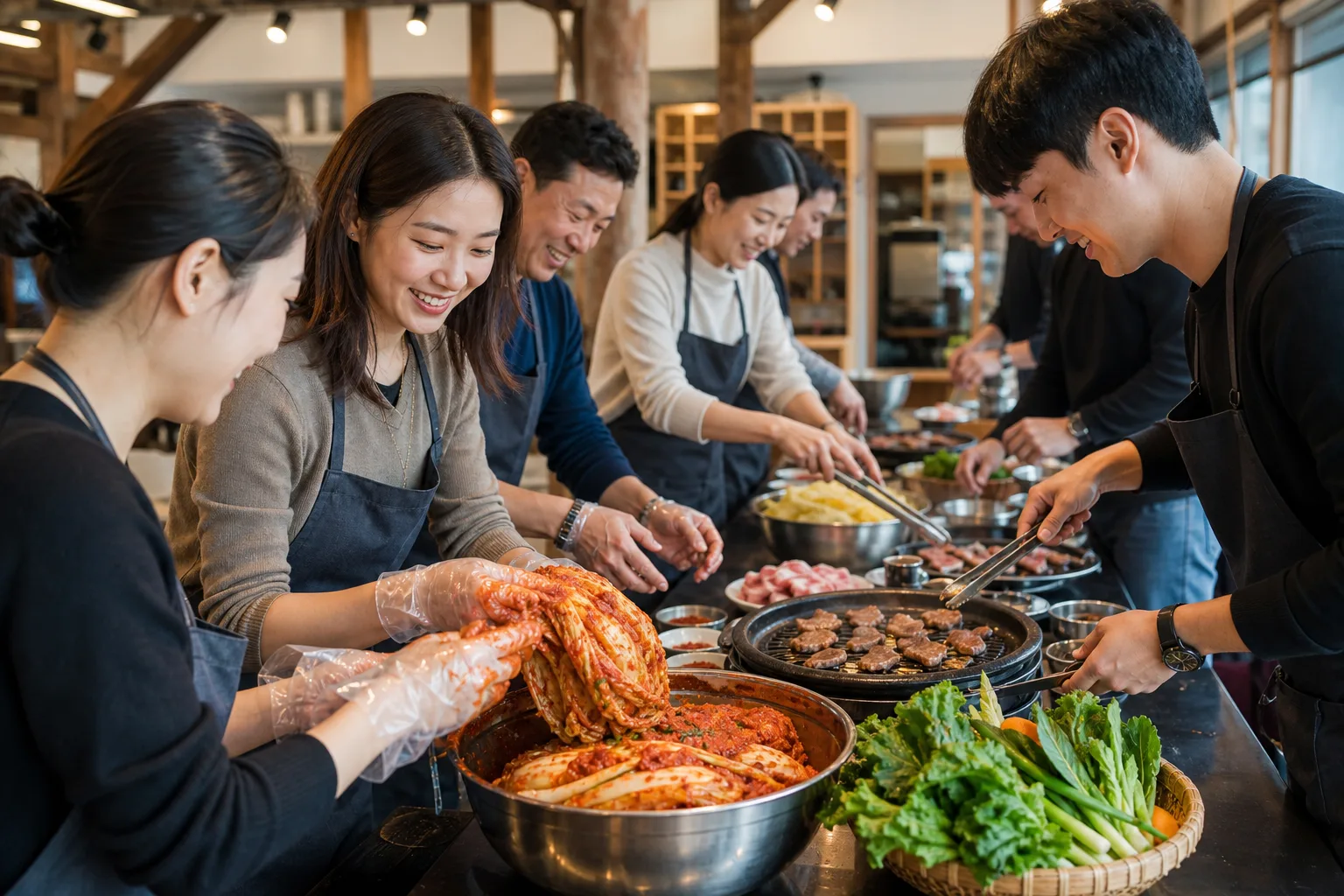
Cooking classes are usually the most direct team-building choice because they require collaboration. Someone chops, someone mixes, someone plates, and everyone gets a result they can eat. That structure makes it easy for a facilitator to keep the group moving, and it also lowers the social friction that comes with a formal dinner where everyone just sits in the same room and waits.
The best classes for groups usually focus on a small number of iconic dishes: kimchi, bibimbap, japchae, tteokbokki, mandu, or Korean pancakes. Those dishes work well because they are recognizable, adaptable, and easy to explain to first-time visitors. A good instructor can also scale the level of challenge up or down depending on your group. For a casual corporate outing, a hands-on kimchi or bibimbap class is enough. For a more engaged team, a class that includes sauce balancing, knife work, and a shared meal afterwards feels more rewarding.
Cooking classes are also one of the easiest ways to make the experience memorable without overspending on spectacle. The point is not luxury. The point is a shared task that creates inside jokes, photo opportunities, and a concrete thing to take home in memory or in a recipe.
2. Market tours with a tasting focus
Market tours are a better fit when your group wants movement, variety, and light education rather than a full kitchen session. They work especially well for teams with mixed interests because the walking portion gives people a break from sitting, and the tasting stops make it easy to keep the pace lively.
In Korea, a market-based experience can include rice cakes, dumplings, fried snacks, street food staples, seasonal fruit, tea, noodles, and regional specialties. For groups, the best version is not a race from stall to stall. It is a guided tasting with enough structure that no one gets lost and enough flexibility that the group can pause, compare notes, and build a shared rhythm.
Market tours are particularly useful for international teams because they teach food vocabulary and local context in a low-stakes environment. Instead of trying to explain every dish at the table later, participants learn what they are looking at while they are still standing in front of it.
3. Korean barbecue dinners
Korean barbecue is one of the most reliable social meals in the country because the format already does the team-building work for you. People share the grill, pass side dishes, debate cooking preferences, and naturally move into conversation. There is no awkward silence problem when everyone is managing the same hot plate.
For groups, the key question is whether the restaurant can handle the size comfortably. Some barbecue places are excellent for small groups of four to six, while others can manage larger tables but may become noisy or cramped. If the event is meant to feel informal and energetic, that is fine. If you need a space where people can hear a leader speak, a barbecue meal should usually be combined with a short briefing before or after dinner.
Barbecue works best when the group is ready to eat meat, drink lightly, and participate in a communal rhythm. It is less ideal when the group has many vegetarians, strict dietary restrictions, or people who prefer a more curated dining structure.
4. Traditional hanjeongsik and home-style set meals
Hanjeongsik, or a traditional Korean set meal, is one of the best options when you want a sense of ceremony without the intensity of a formal tasting menu. The appeal here is order. Dishes arrive in a sequence or as a composed spread, and the group can experience the meal as a shared progression rather than as a single plate.
For team building, this format has a few advantages. It feels thoughtful, it works for groups that want conversation more than activity, and it gives everyone the same dining reference point. If you are hosting partners, senior staff, or guests who appreciate Korean tradition, this is often the safest and most elegant choice.
Home-style set meals can also be a smart middle ground for groups that want authenticity but do not want the complexity of a market tour or the logistics of cooking. The experience is still distinctly Korean, but the pressure to perform is lower.
5. Premium chef’s table or private dining
Private dining is the right answer when the event is as much about relationship-building as it is about food. This could be a client dinner, an executive offsite, a reward dinner for a top-performing team, or a small group celebration where you want fewer distractions and more polish.
The advantage of a private chef’s table is control. You can usually align the pacing, dietary restrictions, language support, wine or tea pairing, and seating arrangement in a way that is impossible in a standard restaurant. That makes it ideal for groups that need the experience to feel smooth rather than adventurous.
The downside is that private dining does less to create shared participation. The group is still bonding, but mostly through conversation and the structure of the meal itself. If your goal is active team building, pair this format with a separate activity earlier in the day.
6. Makgeolli tasting or Korean beverage workshop
A beverage-led experience can be a good fit for smaller adult groups that want something different from a conventional meal. Makgeolli, traditional rice wine, is especially useful because it introduces Korean drinking culture in a way that feels social and educational rather than purely celebratory.
These workshops are best when they include tasting notes, food pairing guidance, and a little background on production or regional variation. They can be combined with snacks, light cooking, or a short dinner afterward. For teams that already know one another, a beverage workshop can be a strong evening activity because it is less formal than fine dining and more memorable than a standard bar crawl.
7. Temple food or vegetarian-focused dining
If your group includes vegetarians, health-conscious travelers, or people who avoid heavy meals, temple food is one of the most thoughtful options in Korea. It is not just a substitute for meatless dining. It is a different cultural lens entirely, emphasizing seasonal ingredients, balance, and restraint.
For team events, temple food works best when the group is open to trying something quieter and more reflective. It is less about loud social energy and more about shared attention. That can be a powerful reset for corporate teams that need a calm environment after a busy workday or conference schedule.
8. Dessert, tea, or cafe-based food experiences
Not every team-building experience needs to be dinner. Dessert cafes, tea tastings, and sweets workshops are useful when you have a half-day slot, an early evening schedule, or a group that does not want a long meal. They also work well as a lighter follow-up after a more active experience like a walking tour or cooking class.
These options are underrated because they are low-friction. You do not need to worry about heavy dietary restrictions, awkward seating turnover, or the pace of a full-course meal. For some groups, especially mixed international teams, a well-designed dessert experience is easier to enjoy than a more formal lunch or dinner.
How to Choose the Right Format
Choosing the right food experience is mostly about matching the format to the group’s purpose. That sounds obvious, but many bad bookings happen because someone picks the most famous option instead of the most functional one.
Match the experience to the goal
If you want collaboration, choose cooking. If you want social bonding, choose barbecue or a communal meal. If you want cultural learning, choose a market tour or traditional set meal. If you want executive polish, choose private dining. If you want a lighter activity, choose tea, dessert, or a beverage workshop.
The more clearly you define the goal, the easier it is to reject mismatched options. A team that needs to get comfortable with each other should not be sent to a menu-heavy fine-dining restaurant where everyone is quiet and formal. A celebratory group should not be forced into a structured class if they really want a meal and time to talk.
Match the experience to the group size
Small groups of four to eight can usually do almost anything well because the logistics stay simple. Mid-size groups of nine to sixteen need more planning because venue layout, timing, and translation matter more. Larger groups need a venue or operator that already knows how to manage turnover, seating, and pacing.
As a rule, the larger the group, the more you should prioritize venues that specialize in groups rather than one-off boutique experiences. A small, charming venue can be perfect for six people and miserable for twenty.
Match the experience to the personalities in the room
Some groups love being active. Others want to sit down and be served. Some will happily wear aprons and chop vegetables. Others will treat that as work. The best planners account for personality as much as budget.
If your group includes extroverts and introverts, choose an experience with built-in conversation but not too much forced performance. Cooking classes work because everyone has a role. Barbecue works because the table itself becomes the interaction. Traditional dinners work because the meal can carry the social energy.
Match the experience to dietary needs
Korean food is broad, but not every format is naturally inclusive. Seafood, pork, beef, eggs, sesame, soy, gluten, and spice all come up often. If your group has serious restrictions, ask before booking rather than after arriving.
For vegetarian or vegan groups, temple food or a carefully planned cooking class is often better than a barbecue dinner. For gluten-sensitive travelers, clarify sauces and broths in advance. For halal or kosher groups, do not assume a standard Korean restaurant can adapt without planning. The more you ask upfront, the less awkward the meal becomes.
Practical Guide
The practical side of Korean food experiences for groups is not glamorous, but it is what makes the difference between a smooth event and a chaotic one. Hours, admission, transport, and booking rules matter more than people expect.
Hours, admission, and prices
Most group food experiences in Korea do not follow the same rhythm as a normal restaurant meal. Cooking classes and market tours often run on fixed time slots. Private dining may only be available by reservation. Barbecue and set-meal restaurants can be more flexible, but popular places still fill up quickly around lunch and dinner.
Pricing also varies a lot by format:
- Cooking classes usually sit in the mid-range because they include instruction, ingredients, and often a meal.
- Market tours are often priced for the guide and tasting stops rather than for a full sit-down meal.
- Barbecue dinners can be relatively affordable per person if the menu is casual, but premium meat or private rooms increase cost.
- Hanjeongsik and traditional meals range from approachable to expensive depending on the venue.
- Private dining and chef’s tables are the highest-cost options because you are paying for exclusivity, labor, and often a more polished setting.
Because pricing and schedules change often, the best habit is to check the live listing or venue page before you confirm anything. For group events, also verify minimum headcount, cancellation rules, whether deposits are required, and whether the price includes tax, service, or drinks.
How to get there
In Seoul and other major Korean cities, the best group food experiences are usually easiest to reach by subway, taxi, or a short walk from a major transit line. For the planner, the right question is not just “How do we get there?” but “How easy will it be for the slowest person in the group?”
Choose centrally located neighborhoods when possible. That reduces the chance that people arrive late, split up, or get tired before the actual event starts. If you are booking for a team staying in a hotel district, a venue near transit often beats a more famous place across town. The time you save on logistics can be more valuable than the slight prestige of a harder-to-reach booking.
For larger groups, write down the exact meeting point, not just the venue name. Korea is easy to navigate once people understand the system, but a simple address, building entrance, or subway exit makes a group arrival much more reliable.
Booking links and reservation strategy
If a venue accepts online booking, make that your first check. For some food experiences, the official site is best because it lists the clearest policies. For others, a major booking platform is easier because it handles payment, language support, and group confirmation in one place.
When you are comparing options, look for:
- Clear group capacity.
- Whether English support is included.
- Whether the event is private or shared with strangers.
- The amount of hands-on participation.
- Whether dietary restrictions can be handled.
- Whether the total price includes all food and drinks.
If your team is traveling during a holiday period or weekend, book earlier than you think you need to. A group that waits too long often gets forced into a weaker venue choice or an awkward time slot.
Best booking practice for corporate teams
For company groups, the smoothest process is usually to identify the date, expected headcount, budget range, and dietary needs before contacting anyone. That sounds basic, but it is the difference between a venue that can confirm quickly and a venue that has to ask follow-up questions for days.
If the group has a senior host, give that person one simple briefing sheet: start time, end time, meeting point, dress expectations, and whether gratuities or drinks are included. The fewer open questions people have, the more relaxed they are when they arrive.
Tips & Common Mistakes
The most common mistake is choosing a famous food experience because it sounds impressive, not because it fits the group. Korean food is versatile enough that this mistake can usually be avoided with a little discipline.
Do not overcomplicate the schedule
People underestimate how tiring travel-based team building can be. If the day already includes a long meeting, airport transfer, or sightseeing block, do not stack a complicated meal on top. A simple barbecue dinner or a straightforward set meal may produce a better result than a three-hour class that everyone is too tired to enjoy.
Do not assume everyone wants to cook
Cooking classes are popular, but they are not universal. Some people love them. Others feel stressed by the idea of performing in front of colleagues. If you do not know the group well, choose a format with optional participation rather than mandatory participation.
Do not ignore the room noise level
If the experience is for relationship building, conversation matters. Some barbecue restaurants and busy tasting venues are so loud that they become fun but exhausting. That is fine for a casual group, but it is a problem if you need actual dialogue.
Do not leave dietary questions until arrival
This is the easiest mistake to avoid and one of the most annoying to fix. Ask about allergies, vegetarian options, spice levels, shellfish, pork, and alcohol in advance. If the organizer has to improvise on the day, the experience becomes less inclusive and more awkward for everyone.
Do not forget follow-through
A good team-building food experience does not end when the meal ends. People remember the class better when someone shares a group photo, the recipe summary, or a short note afterward. If you want the outing to contribute to team culture, close the loop instead of treating it as a one-off event.
FAQ
What is the best Korean food experience for a first-time group visit?
For most first-time groups, the safest choice is either a Korean cooking class or a Korean barbecue dinner. The class creates interaction, while barbecue keeps the experience easy and social. If the group wants more culture and less participation, a traditional set meal is often the better fit.
Which option works best for large groups?
Large groups usually do best with venues or operators that are already built for group logistics. That means set meals, barbecue restaurants with private space, or organized tours. Small boutique classes can work too, but only if the headcount matches the venue capacity and the instructor can manage the pace.
What if the group includes vegetarians?
Temple food, vegetarian-focused tasting menus, and carefully planned cooking classes are the strongest options. Barbecue is usually not the best default unless the venue can truly accommodate non-meat eaters with equal care.
How far in advance should I book?
For a standard visit, book as soon as your schedule is stable. For weekends, holidays, or company events, book earlier than you would for a normal dinner. The more people you have, the more likely you are to run into timing and capacity issues.
Are food experiences better in Seoul than in other cities?
Seoul has the widest range of options, but Busan, Jeonju, Gyeongju, and other cities can offer excellent food experiences too. Seoul is best for variety and logistics. Other cities can be better when you want a more regional or relaxed atmosphere.
Conclusion
The best Korean food experiences for groups and team building are the ones that make people feel comfortable, involved, and well-fed without overloading the schedule. Cooking classes are strongest for collaboration. Market tours are best for movement and discovery. Barbecue is ideal for casual social energy. Traditional set meals and private dining work well when the event needs more polish. Temple food, beverage workshops, and dessert experiences fill useful niches when the group is mixed, smaller, or short on time.
If you are choosing between them, start with the group’s purpose, then narrow by size, dietary needs, and budget. That sequence is more reliable than chasing the most famous venue. When the format matches the people, the meal becomes part of the trip instead of just another reservation.