Best Co-Working Spaces in Shanghai and Beijing

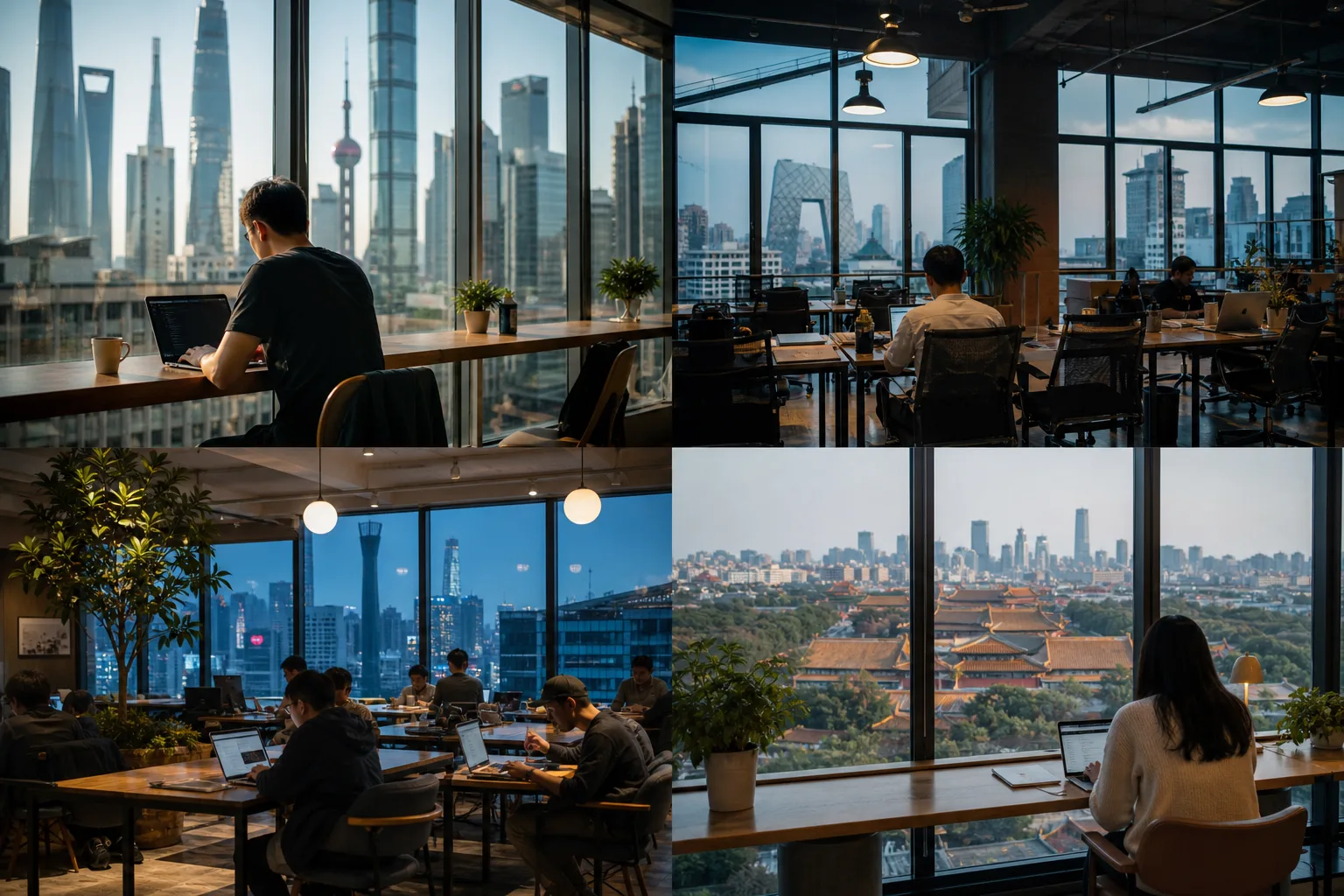
If you are trying to work remotely in China for a few days or a few weeks, the hardest part is rarely finding a desk. The real challenge is choosing a space that is quiet enough for calls, central enough for transit, and flexible enough to fit a travel schedule. If you are still sorting out the legal and connectivity basics, start with Living in China as a Digital Nomad: Visa, VPN & Remote Work Guide before you commit to a long booking.
Introduction
Shanghai and Beijing both have solid coworking options, but they reward different travel styles. Shanghai usually gives you the smoother first impression and better city-center convenience, while Beijing tends to be more value-driven and more office-like. The best choice depends on commute, meetings, and how much structure you want.
If you are choosing between the two cities, the easiest rule is simple: pick the city that cuts the most transit friction out of your day. A coworking desk is only useful if you can reach it, connect easily, and work without wasting energy on logistics. The rest of this guide breaks the decision down by city, use case, and neighborhood.
Best Coworking Spaces in Shanghai
Shanghai is usually the easier city for first-time coworking travelers. The office stock is newer, the international operators are more visible, and the business districts are set up for people who move between hotels, subways, coffee shops, and meeting rooms all day. If your trip already includes sightseeing, Shanghai Travel Guide: The Bund, French Concession & Hidden Gems is the best companion piece because the same neighborhoods that work for tourism often work for short-term work stays too.
Shanghai is the stronger choice if you want polished buildings, easy metro access, and a wider mix of international-style workspaces. In practical terms, the best coworking space is often the one closest to your hotel and on a line you actually want to ride twice a day. For most travelers, central districts such as Jing'an, Huangpu, Xuhui, and parts of Pudong are the sweet spot.
1. WeWork for a polished, international feel
WeWork remains one of the safest default options for travelers who want a predictable setup. The Shanghai locations that matter most are usually in central business districts, and the brand tends to deliver the same basics wherever you go: good reception staff, clear member rules, decent phone booths, meeting rooms, and a layout that is easy to understand even if your Chinese is limited.
That consistency matters when you are only in town for a short stretch. You do not want to spend your first hour figuring out where to sit, how to print, or whether the quiet zone is actually quiet. WeWork usually solves those friction points better than smaller operators. It is rarely the cheapest choice, but it is one of the least stressful.
WeWork also makes sense if you are coordinating with clients overseas. The environment feels familiar to people who have used coworking in Singapore, London, New York, or Seoul. There is enough structure to support calls and enough privacy to avoid the open-office fatigue that can make a workday feel longer than it should.
2. Ucommune for value and local startup energy
Ucommune is often the more practical choice if you care about price and flexibility more than branding. It has deep roots in China and typically gives you more of a local startup atmosphere than the multinational operators. That can be useful if you want to observe how Chinese founders, freelancers, and small teams actually work.
In Shanghai, Ucommune spaces are often best when you need a decent desk, reliable internet, and a central commute without paying premium-international rates. They are frequently a strong middle ground between a bare-bones shared office and a luxury coworking lounge. Expect a more businesslike atmosphere and less of the hotel-lobby polish you get at global brands.
For travelers who plan to stay productive through long work sessions, Ucommune is attractive because the spaces often feel like genuine offices rather than lifestyle clubs. That means more focus, less social noise, and a better chance of finding people who are there to work instead of to network.
3. SOHO 3Q for simple desk-first work
SOHO 3Q is a good fit if you want straightforward workspace without much ceremony. It is a useful option for people who do not need a hospitality-heavy environment and would rather spend their money on location, quiet, and decent seating. In a city like Shanghai, that can be enough.
The brand has long been associated with office-style coworking in China, which makes it especially useful for people who want to feel like they are in a normal business setting. If you are writing, editing, doing spreadsheets, or handling calls across time zones, that simplicity can be more valuable than a fancy lounge or an elaborate coffee bar.
SOHO 3Q is also a decent fallback when you want to be near dense commercial districts. The spaces are usually better for practical work than for client entertainment, but that is exactly what many travelers need.
4. Smaller local spaces for quieter, neighborhood-based work
Beyond the big names, Shanghai has many smaller coworking rooms embedded in mixed-use towers, creative buildings, and office complexes. These are worth considering if you already know the neighborhood where you want to stay and you want something quieter than a flagship brand. Some of these spaces are surprisingly good for long writing days, especially if they serve a local professional crowd rather than a tourist crowd.
The tradeoff is that the user experience can be less standardized. One space may have excellent chairs and a peaceful atmosphere, while another may be noisy, hot, or difficult to book. For a short trip, that uncertainty can be annoying. For a longer stay, though, smaller spaces can be cheaper and more pleasant than the obvious international chains.
If your work day revolves around calls, choose a larger operator. If your work day revolves around writing, research, and deep work, a quieter local space can be a better fit than a better-known brand.
Shanghai neighborhood strategy
The right neighborhood matters more than the logo on the door. Jing'an is a reliable all-around base because it sits close to business districts, metro lines, and plenty of food options. Huangpu works well if you want centrality and easy access to the classic Shanghai cityscape. Xuhui is a good compromise for people who want a more relaxed environment without drifting too far from the center. Pudong is best if your meetings are there, but it can feel less convenient for casual sightseeing.
The other thing to watch is the distance from the nearest metro exit. In Shanghai, a coworking office that looks perfect on a map can still be unpleasant if it requires a long walk through tower podiums, underground malls, and confusing building entrances. Ten minutes on paper can feel like twenty in summer heat.
Best Coworking Spaces in Beijing
Beijing is a different kind of coworking city. It is more administrative, more spread out, and often more value-driven than Shanghai. The best spaces are still good, but the city rewards travelers who plan around transit and neighborhood fit. Beijing is especially strong for people who like quieter, more focused workdays and do not mind a slightly more formal office atmosphere.
If Shanghai feels like a global business showcase, Beijing feels more like a serious working city. That is useful if you are there to get things done. It is less useful if you want a highly polished, lifestyle-first environment. The good news is that Beijing has enough coworking variety to support both styles.
1. WeWork for dependable central locations
In Beijing, WeWork is strongest when you need reliability and straightforward booking. Central locations in business and embassy-heavy districts are especially helpful if you are splitting your day between calls, meetings, and errands. The brand tends to be expensive relative to the local market, but that premium buys you a lower-friction experience.
For travelers, the value is not just the chair or the Wi-Fi. It is also the ability to walk in, get oriented quickly, and spend the day working instead of negotiating access. If you are in Beijing for a short stay, that simplicity can be worth the extra cost.
WeWork is also a good answer for teams. If two or three people are traveling together and need reliable meeting space, the layout and support structure are usually strong enough to avoid the usual coworking headaches.
2. Ucommune for broad coverage and better value
Beijing is home turf for Ucommune, and that shows in the density of its footprint and the way many travelers use it as a practical local option. If you want a space that is easier on the wallet and still feels like a professional work environment, Ucommune is often the first place to check.
The brand works well for solo travelers, startup founders, and remote workers who plan to be in Beijing for more than a couple of days. The local feel can actually be a plus, because it tends to attract people who are there to work rather than to socialize. That usually means fewer distractions and better odds of finding a calm corner.
Another advantage is range. In a city as large as Beijing, having multiple branches can matter more than getting the fanciest possible interior. If your hotel is on one side of the city and your meeting is on the other, branch coverage can save your day.
3. SOHO 3Q for classic office-style productivity
SOHO 3Q is one of the more useful choices for people who want a businesslike desk and do not care about coworking theatrics. In Beijing, that office-first approach works especially well because many visitors are there for work, not for lifestyle content. You can usually settle in, focus, and leave without feeling like you paid for amenities you never used.
This is a good option for writers, analysts, consultants, and anyone who spends more time in documents than in meetings. The environment is generally more formal than a cafe and less performative than a trendy startup hub. That is a feature, not a flaw, if you want to preserve a normal work rhythm while traveling.
SOHO 3Q also appeals to people who prefer a simpler decision process. If you know you need a desk, a stable connection, and a predictable office setting, it is easier to say yes to a straightforward coworking setup than to overthink every extra perk.
4. Zhongguancun-area spaces for tech and startup proximity
If your work intersects with tech, venture capital, or startup meetings, Beijing's northern business districts can be a smart fit. Spaces near Zhongguancun and related office clusters are often more useful for that ecosystem than centrally branded lifestyle coworking locations. You may not get the flashiest interior, but you get proximity to the people and companies you are actually there to see.
That said, these areas are not always the best tourist bases. If you want to balance work and sightseeing, you may prefer a more central district and just commute to meetings when needed. The right call depends on whether your trip is mostly business travel with a little sightseeing or the reverse.
Beijing neighborhood strategy
In Beijing, think in terms of commute logic rather than postcard geography. Chaoyang is a common all-purpose choice because it has a lot of business activity, broad hotel options, and relatively simple access to coworking sites. Dongcheng can be convenient if you need to be near government-adjacent or more central areas. Haidian is the better choice for tech or university-linked work, while Sanlitun works for people who want a more international neighborhood feel.
Unlike Shanghai, where a central position can cover a lot of ground, Beijing often punishes vague planning. Distances are bigger, and a short-looking ride can turn into a real part of your day. Pick a coworking space near the cluster where your meetings or errands are concentrated.
Practical Guide
If you are using coworking as part of a longer China trip, it helps to think about the whole logistics stack, not just the desk. China Travel Planning: Visa, WeChat Pay, High-Speed Rail & Practical Guide is the right companion because payment setup, transit, and connectivity issues affect coworking choices as much as price does.
Hours, prices, and what to expect in 2026
Coworking pricing in Shanghai and Beijing is usually less transparent than travelers expect. Many spaces do not bother with a public, always-up-to-date price sheet because they prefer to sell memberships, short-term passes, or branch-specific packages through WeChat, a sales rep, or a booking form. That is normal in China. It is also why you should treat every publicly visible price as a starting point rather than a promise.
As a practical 2026 planning range, a day pass at a midrange coworking space often lands around CNY 80 to CNY 200. Better-located or more premium spaces can climb to roughly CNY 200 to CNY 350 per day. Short meeting rooms typically price by the hour, and small rooms can start around CNY 100 to CNY 300 per hour before taxes or minimum-use rules. Larger rooms and premium towers cost more.
Hours are similarly variable. Many city coworking spaces operate on a business-day rhythm, often something like 9:00 to 18:00 for staffed access, with extended hours or 24/7 access reserved for dedicated members. If you are only buying a day pass, do not assume you can arrive whenever you want. Confirm the opening window, the lunch break policy, and whether the front desk closes for part of the day.
In practice, the most useful question is not "What is the cheapest price?" but "What does this price actually include?" Some spaces include coffee, tea, printing, lockers, and unlimited meeting room time in certain packages. Others charge separately for every small thing. The cheapest listing can become the most expensive option once you add in meeting rooms and beverages.
How to get there
Almost every useful coworking space in Shanghai and Beijing should be chosen with metro access in mind. A space that is a six-minute walk from the correct station is much better than a prettier one that forces you into a taxi every morning. Trains are usually the easiest way to preserve both time and energy in both cities.
Shanghai is generally the easier city to move through if your office and hotel are on the same metro line or within a short ride of each other. Beijing is more spread out, so a coworking commute can become part of your daily schedule in a way you do not notice until the second or third day. If you are changing cities during the same trip, the travel planning guide above is worth revisiting because high-speed rail is often the cleanest way to move between business hubs without dealing with airport friction.
For payment, bring a setup that works with Chinese apps. Many spaces accept card payments through specific platforms, but it is still smart to arrive with mobile payment sorted. If you are depending on foreign cards alone, you may lose time or get blocked at the front desk. This is one of those small logistics details that saves the day if you handle it before you need it.
Booking links and booking behavior
Most travelers will not book these spaces the same way they would book a hotel. The process is usually one of the following: official website form, WeChat mini-program, phone call, or direct message to a branch manager. Some locations also show up on local discovery platforms or on booking sites for daily workspace reservations. The exact route depends on the operator and branch.
For short trips, booking ahead is a good idea if you need a guaranteed desk, especially in central districts or during conference season. Walk-ins are possible in some places, but they are not something I would depend on if you have calls on the calendar. If your workday has any hard deadlines, lock the desk first and plan the lunch afterward.
If you are booking for multiple days, ask whether the space can hold your seat overnight or whether you need to clear everything out at close. Some travelers assume their desk is secure for the duration of the pass, then discover that the room resets every night. That is a common and annoying mistake.
Which city is better for remote work?
Shanghai is the better fit if you want the easiest first impression, the strongest international service, and the cleanest blend of work and sightseeing. Beijing is better if your trip is more function-driven, if you want value, or if your meetings are concentrated in the northern business districts.
If you are staying fewer than four days, pick the city and coworking space that minimizes transit friction. If you are staying longer, then branch density, local pricing, and neighborhood character become more important. In both cities, the best coworking space is usually not the fanciest one. It is the one that quietly disappears into your day.
Tips & Common Mistakes
The most common coworking mistake in China is treating the space like a Western-style drop-in cafe with desks. It is usually not that casual. You should expect front-desk check-in, a rules-based environment, and a more explicit distinction between visitor access and member access. If you want the flexibility of a lounge, ask before you arrive.
Another mistake is booking based on photos alone. A pretty lounge is not the same thing as a productive office. A gorgeous room with hard chairs, weak air-conditioning, or too much conversation noise can ruin an otherwise good workday. Read the fine print on quiet zones, meeting room access, and air quality if the space mentions it.
Do not ignore the food and coffee situation either. On a long workday, the availability of lunch nearby matters more than decorative seating. A coworking space near a cluster of convenience stores, noodle shops, and coffee counters can save time and money. The best spaces are often surrounded by the most boring but useful infrastructure.
Do not assume English support is automatic. Larger international brands usually handle this well, but smaller local spaces may rely more on translation apps or basic English. That is not a deal-breaker; it just means you should be ready to handle booking questions in advance, not at the front desk while your meeting starts in ten minutes.
Be careful with VPN and connectivity assumptions as well. A coworking desk is not a substitute for a stable remote-work setup. If your job depends on access to certain services, sort that out before you arrive. The digital nomad guide linked above covers the bigger picture, and it is more important than any individual desk recommendation.
Finally, remember that "best" depends on your work mode. If you are on calls all day, prioritize booth availability and sound control. If you are deep in writing or coding, prioritize chair quality and quiet. If you are meeting clients, prioritize location and reception polish. If you are saving money, prioritize branch access and predictable day-pass pricing.
FAQ
Are coworking spaces in Shanghai and Beijing good for short stays?
Yes. In fact, short stays are where coworking spaces make the most sense. You get a stable desk, a predictable environment, and better focus than a cafe, without committing to a full office lease. For travelers who only need a few productive days, that flexibility is the whole point.
Can I just walk in and buy a day pass?
Sometimes, but not always. Walk-ins are more likely at larger brands or central branches with staffed reception. Smaller spaces may require advance booking through a website, WeChat, or a sales contact. If your schedule is tight, do not rely on spontaneity.
Which city is cheaper for coworking?
Beijing is often a little cheaper on the same tier of space, but the difference depends on neighborhood and brand. A central premium branch in either city can cost more than a less central branch in the other. Think in terms of branch class and convenience rather than city averages alone.
Is English support common?
At multinational operators, yes, usually. At smaller local spaces, support can be more limited. You should still be able to manage with translation tools, but if your trip depends on a smooth arrival and quick check-in, stick to the better-known brands.
What should I bring with me?
Bring your passport or ID, a charger, headphones, and a payment method that works in China. If you expect to take calls, bring a backup battery too. A coworking day in either city is much easier when you can keep your phone and laptop running without hunting for outlets.
Conclusion
The best coworking space in Shanghai or Beijing is not necessarily the most famous one. It is the space that matches your schedule, your neighborhood, and your work style. Shanghai usually wins for polish and convenience. Beijing often wins for value and focus. Both cities can be very workable if you choose the right district first and the brand second.
For most travelers, the right formula is simple: stay near a metro line, book ahead when possible, and pick a workspace with the least amount of friction between your hotel, your desk, and your meetings. That approach will matter more than any glossy photo or slogan on the booking page.
If you are building a longer China itinerary, keep your coworking choice aligned with the rest of the trip. Use the China planning guide for payment and transit logistics, and keep the Shanghai city guide handy if you want to turn a work trip into a real visit instead of a hotel-room routine.