Spring Flowers Beyond Cherry Blossoms: Forsythia, Azalea & Canola Fields

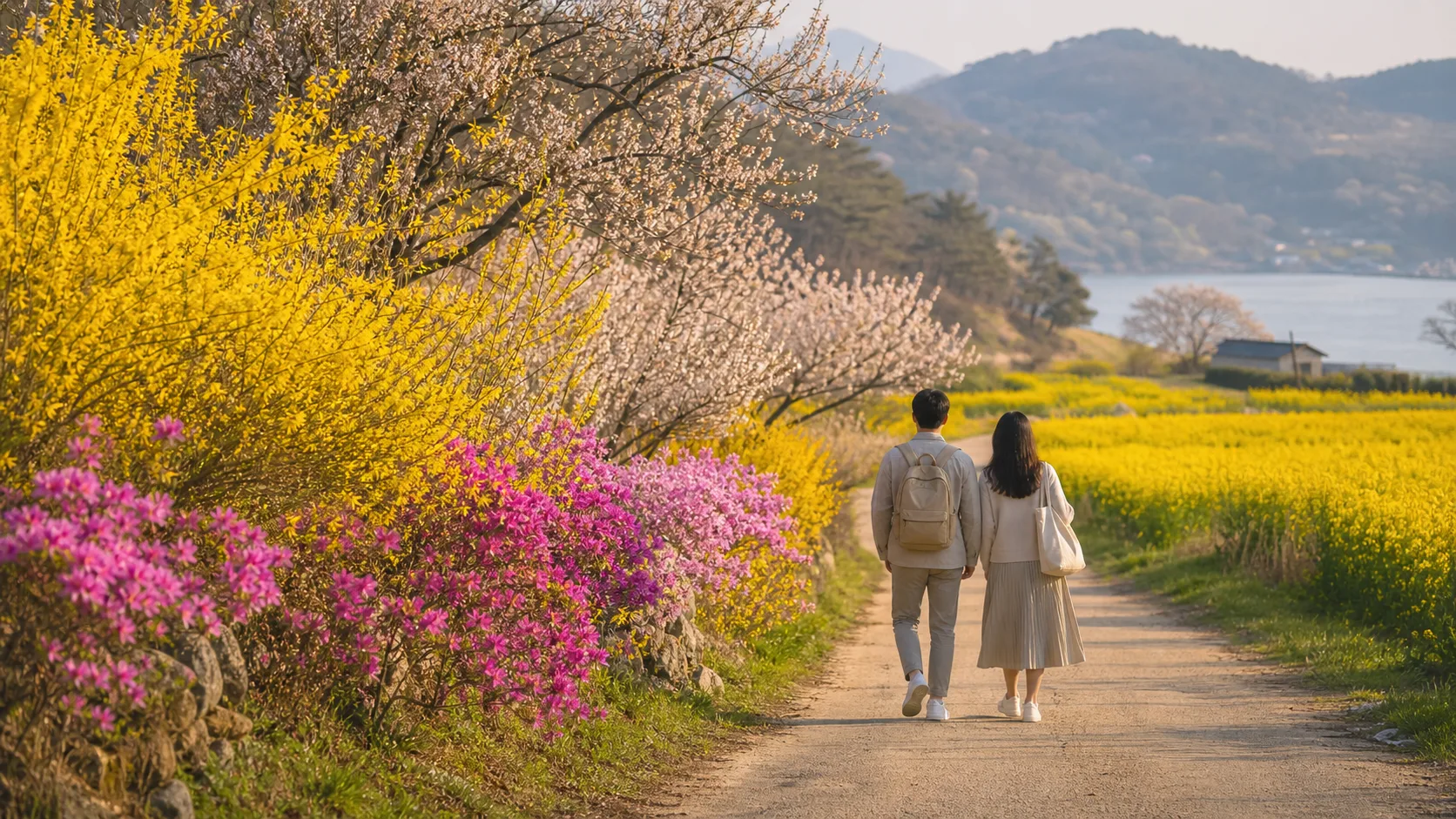
Spring in Korea is often treated like a single event, as if the whole season exists only to support cherry blossom photos. That is a mistake. Cherry blossoms are only one layer of the spring calendar, and in some cases they are not even the best layer for the kind of traveler who wants color, space, and a more forgiving viewing window. Forsythia gives you bright yellow streets and hillsides before peak blossom congestion arrives. Azalea fills mountain paths and temple backdrops with dense pink and magenta. Canola fields give the season a wide-open, coastal, almost cinematic scale that feels different from any urban blossom walk.
If you are planning a spring trip and want the scenery without building your entire schedule around one fragile bloom window, this guide shows how to think about Korea's spring flowers as a sequence rather than a single day. That matters because the best flower trips are not just about what is blooming. They are about where you are, how much time you have, whether you are moving by KTX, bus, or rental car, and how much crowd pressure you can tolerate before the experience stops feeling pleasant.
Why Spring Flowers Matter Beyond Cherry Blossoms
Spring flower travel in Korea works best when you stop asking, "When do the cherry blossoms peak?" and start asking, "What kind of spring scene do I want?" That shift changes the whole trip. Forsythia usually appears first and is often underappreciated because travelers are still waiting for the headline pink bloom. Azalea can feel more local and less staged, especially in mountain parks and temple roads where the flowers interact with the terrain. Canola fields create the most open compositions, especially in Jeju and a few coastal or rural areas where yellow fields stretch toward water, volcanic rock, or hilltops.
At a practical level, these flowers are useful because they extend the spring window. If you miss the first cherry blossom wave, forsythia and azalea can still make the trip feel seasonal. If the weather is warm and the cherry blossom petals have already started dropping, you can shift your time toward higher elevations or more southern regions where the season still lingers. If your dates are fixed, spring flowers beyond cherry blossoms also give you backup plans that are more flexible than a single famous blossom street.
Featured Snippet: The Short Version
Korea's spring flowers do not arrive all at once. Forsythia usually blooms first and gives you bright yellow landscapes in city streets and rural roads. Azalea follows in hills, temples, and mountain parks, while canola fields peak later in the south and on Jeju. If you want the best trip, match flower type to region, elevation, and transport.
Forsythia: The Yellow Signal That Spring Has Started
Forsythia is the easiest spring flower to miss and one of the easiest to enjoy once you know where to look. It does not carry the same branding power as cherry blossoms, which is exactly why it is useful. The flower appears in long rows, roadside clusters, park edges, and neighborhood hillsides. Instead of a single iconic event, it often shows up as a bright yellow signal that the season has turned.
The visual appeal is very different from cherry blossoms. Forsythia reads as strong, graphic color rather than soft romance. It can look almost luminous on a cloudy day, which makes it more forgiving for photography than many travelers expect. Yellow flowers against gray stone walls, pale apartment blocks, or dark temple roofs can create some of the strongest spring compositions in Korea.
Where Forsythia Works Best
Forsythia is especially effective in places where the landscape is already layered. Hillside neighborhoods, fortress paths, university slopes, and low mountain roads all work because the yellow plants outline the terrain instead of hiding it. That gives the flower a very different mood from a manicured garden. You are not looking at one carefully arranged bed. You are seeing spring announced across the landscape.
In Seoul, forsythia is often most pleasant as a surprise rather than a destination. If you are walking a residential route, visiting a park, or moving between transit stops, the flowers may appear in patches rather than in a formal festival setting. That is a strength, not a weakness. It means you can enjoy the season without planning around a crowd-heavy headline attraction.
Outside Seoul, forsythia often becomes more convincing in rural edges and smaller cities where the roads are less compressed. A roadside hill can be more memorable than a famous landmark if the weather is clear and the flowers are dense. This is one reason spring in Korea rewards travelers who are willing to stay flexible instead of forcing every bloom into a neat itinerary block.
When To Go For Forsythia
Forsythia usually appears early in spring, often before the main cherry blossom rush in many regions. That makes it valuable for travelers arriving in March or at the very beginning of April. If your trip starts early and the pink blossoms have not fully opened yet, forsythia can keep the trip from feeling premature.
The best strategy is not to chase forsythia alone. Instead, treat it as the opening act for the season. If you are in Korea in early spring, a day that starts with forsythia and ends with a temple, cafe, or other local stop can feel more balanced than running straight to the most crowded blossom street in the country. Forsythia is also useful in mixed weather because the yellow color still looks energetic under thinner sunlight.
How To Photograph Forsythia Well
The biggest mistake is shooting forsythia as if it were cherry blossom. It is not subtle. It wants contrast. Put it against dark tree trunks, stone steps, or neutral buildings. Use the flower to lead the eye through the frame instead of trying to make it behave like soft pastel petals. A lower camera angle can also help because the plant often works best when it creates a band of color across the edge of a slope or road.
If you are using a phone, look for side light rather than full overhead noon light. Yellow can flatten quickly if the light is too harsh. If you are shooting in the morning, try to catch the flowers when the light hits one side of the bushes and the shadows still define the shape. This makes the color feel deeper and more dimensional.
Azalea: Korea's Most Underrated Pink Season
Azalea is the spring flower that many travelers confuse with cherry blossom at first glance. The confusion is understandable because both are pink, both are seasonal, and both can make a landscape feel romantic. The difference is that azalea often feels denser and more textured. It grows in clusters, on hillsides, and around temple trails, which gives it a stronger sense of place.
That makes azalea ideal for travelers who like spring color but do not want an atmosphere that is too polished or too commercially packaged. You are more likely to find azalea in settings that also contain hiking paths, stone steps, forest edges, and older religious sites. In other words, azalea usually comes with context.
Mountain Settings Are Better Than Flat Parks
Azalea is at its best when the landscape has elevation. A hillside covered in pink blooms is more interesting than a flat garden bed because it gives the viewer a sense of movement and scale. Korea's mountain routes, provincial parks, and temple approaches are especially good for this. The flowers feel woven into the terrain rather than placed on top of it.
This also changes the pace of the visit. You do not just arrive, take one photo, and leave. You walk, climb, stop, look back, and notice how the colors change with altitude. That is why azalea often appeals to travelers who enjoy scenery more than event energy. The experience is slower, more physical, and usually less crowded than the major blossom festivals.
Azalea and Temple Landscapes
Temple settings can be especially strong because azalea softens the geometry of stone, wood, and tiled roofs. Korean temple architecture already has a strong visual rhythm, and the flowers create a seasonal overlay that feels natural rather than forced. If you have ever felt that some spring flower spots are too engineered, temple routes with azalea can feel like a better fit.
This is also where the flower becomes more useful than cherry blossoms for some itineraries. Cherry blossoms often pull crowds because everyone knows the same streets and lakes. Azalea is less likely to produce the same traffic pattern, which means the viewing can feel calmer. For first-time visitors, that is a real advantage. You still get the seasonal mood, but with fewer logistical headaches.
Where To Look For Azalea
Azalea is strongest in two kinds of places: mountainous viewpoints and festival hillsides. Mountain viewpoints give you the most dramatic scenery because the flowers appear in bands across the slope. Festival hillsides are useful if you want a known seasonal event with a defined route and temporary stalls or local food.
If you are traveling in the southern half of the country, azalea can also work as a bridge between other spring stops. You might start in a city, move through a temple or a forest park, and then continue to another scenic region without needing to chase a single crowded bloom location. That makes azalea a good fit for travelers who want to move naturally rather than plan the whole trip around one famous date.
What Makes Azalea Feel Local
Azalea often appears in places that locals already use for hiking, family outings, or weekend exercise. That means the viewing rhythm is less like a tourist queue and more like shared public space. You may see older walkers, school groups, photographers, and people stopping briefly before continuing on with their day. The flower is part of a living landscape, not an isolated attraction.
That local quality matters because it changes how the season feels. Cherry blossoms can make travelers feel like they are inside a festival machine. Azalea, by contrast, can feel like a spring habit. You notice it while moving through normal places, and that makes it easier to combine with a broader trip.
Canola Fields: Wide Yellow Landscapes and Open-Sky Travel
Canola fields are the spring scene people remember when they want something larger than a row of flowers. The yellow is bright, but the scale is what makes the experience feel different. Instead of standing under branches, you are looking across open land toward hills, coastal roads, lava rock, or a distant village. That creates a much more expansive mood than any street-side blossom walk.
In Korea, canola fields are especially appealing because they work so well with the country's geography. On Jeju, the flowers can sit beside volcanic landscape and ocean light. In rural or southern settings, the fields create a clean contrast with darker mountains or traditional architecture. The result is one of the most instantly legible spring images in the country.
Jeju Is the Classic Canola Choice
Jeju is the most reliable mental image for canola fields in Korea because the island's landscape gives the flowers room to breathe. The fields do not feel cramped. They feel set apart from the mainland's dense urban rhythm. That matters for spring travel because it gives you a visual break from city streets and crowded blossom corridors.
The best part of Jeju is that canola can be paired with other landscape elements rather than treated as a standalone attraction. A yellow field with a distant coastal road is already strong. Add volcanic texture, wind, a low hill, or a traditional structure and the scene becomes much more memorable. If you want spring photos that do not look like everybody else's, canola fields are one of the strongest choices in Korea.
Coastal and Rural Context Matters
Canola fields are not simply about color. They are about scale, horizon, and openness. This is why they work well in places where the road itself is part of the scene. A field next to a coastal route feels different from a field hidden behind a parking lot. The photo tells a story about travel, weather, and distance rather than just about flowers.
That makes canola especially useful for road trips and self-drive itineraries. If you are renting a car, the flower stop becomes a natural pause instead of a separate destination. If you are relying on buses, it helps to choose one area and stay there long enough to make the transit worthwhile. Canola fields reward slower movement because the views are broader and the best compositions often depend on how the surrounding land opens up.
Canola Season Versus Cherry Blossom Season
Canola and cherry blossom are sometimes close enough that travelers try to see both at once. That can work, but it is not guaranteed. The overlap depends on region and weather. In the south, the sequence may line up nicely. In other parts of the country, one flower can be fading as the other begins.
That is why canola is better treated as its own goal. If you get both, great. If you do not, the canola field still gives you a different kind of spring scene. In practical terms, that means you should not force your whole spring trip around the hope that yellow and pink will always coincide. Plan for one primary flower and treat the other as a bonus.
How To View Canola Fields Without Rushing
The temptation is to spend ten minutes taking photos and leave. That usually undersells the place. Canola fields are strongest when you take a little time to notice the edges, the wind direction, and the way the field changes from one angle to another. The best shots often come from a slight rise, a roadside curve, or a viewpoint where the yellow sits below a darker horizon.
If you are visiting Jeju or another wide-open spring location, it is worth arriving when the light is still soft. Early morning and late afternoon both work well because the yellow gets richer and the landscape gets more dimensional. Midday can be fine for sightseeing, but the strongest mood usually comes when the sun is lower and the field is not washed out.
How To Build A Spring Flower Route In Korea
The easiest way to plan spring flowers in Korea is to stop thinking in terms of a checklist and start thinking in terms of movement. The right route depends on your transport, your arrival city, and how much time you want to spend in transit between flower stops. A flower route that looks perfect on paper can become tedious if it requires too many transfers for too little payoff.
If You Are Staying in Seoul
If Seoul is your base, forsythia and some azalea viewing are the easiest to fit into your day because they can appear in parks, slopes, and neighborhood routes without requiring a major regional move. This works especially well if you want spring color but also plan to spend time in cafes, museums, palace grounds, or riverside areas.
For Seoul-based travelers, the best strategy is to keep one flower-heavy day and one flexible backup day. That way, if the weather changes or the bloom timing shifts, you can swap the order of your activities without losing the trip. Seoul is strong because it gives you transit convenience, indoor fallback options, and enough urban scenery that a flower walk never has to stand alone.
If You Are Going South
If your route includes Busan, Gyeongju, Jeolla, or Jeju, the spring flower experience becomes more varied. You can combine azalea with hills and temples, canola with coastal roads, and forsythia with smaller towns or roadside landscapes. That makes southern routes especially good for travelers who want more than one flower type in the same trip.
Southern Korea is also useful because it often gives you better spring weather earlier than the north. That means if you are traveling in late March or the first half of April, you may have more viable flower options there than in a colder inland area. The exact combination changes every year, so the key is to keep your route adaptable.
If Jeju Is On Your List
Jeju is the simplest place to build a flower-centric day because the island already rewards slower transport and broader scenery. Canola fields are the obvious spring headline, but the island also works well if you want a mix of coastal driving, scenic stops, and less urban pressure. If you are traveling with a camera or with people who dislike dense crowds, Jeju can be the easiest flower choice in Korea.
The main tradeoff is transport cost and time. Jeju is not a casual add-on if you are already using KTX for the mainland. It deserves its own block of time. That is not a problem if flowers are a priority, but it is a mistake if you are trying to squeeze too much into one short trip.
A Good Rule For Mixed Flower Trips
Choose one "must-see" flower type and one "nice-to-have" backup. For example, you might prioritize canola in Jeju and treat forsythia or azalea as whatever you encounter on the way. Or you might base yourself in Seoul and prioritize azalea in a mountain area while accepting that forsythia will be the easiest spontaneous bonus.
This approach is better than overplanning because spring in Korea is not fully under your control. Weather, temperature, and regional timing all matter. A flexible route gives you a better chance of having a satisfying trip even if the exact bloom schedule shifts by a few days.
Practical Guide
Hours, Admission, and Prices
Most spring flower viewing in Korea takes place in public outdoor spaces, which means the base price is often free. Streets, parks, riversides, temple approaches, and many rural viewing areas do not charge a separate fee just to walk through and look at the flowers. That is one of the reasons Korea is such a strong spring destination: the scenery itself is accessible.
There are exceptions. Managed gardens, special festival grounds, parking areas, and some seasonal exhibits can charge an entry fee, and that fee may vary by year. In practice, it is safest to assume that the flower itself is free but the managed experience around it may not be. If you are visiting a place with a known event page or a local tourism bureau, check the latest admission rules before you travel.
For hours, outdoor flower areas are often accessible throughout the day, but the best viewing time is usually sunrise through late morning or the last hour before sunset. Some festival areas stay active in the evening with lights or food stalls, but the visual quality changes. Daylight gives you clearer color and easier movement. Evening gives you atmosphere and sometimes better temperatures.
The simplest budget rule is this: spring flower travel is usually cheap at the gate and more expensive in transit. You are paying for movement, not just entry. If your route involves regional transfers, a taxi, a bus connection, or an overnight stay, those will matter more than a modest admission fee.
How To Get There
The right transport depends on the flower type and region.
Forsythia can often be enjoyed where you already are. That makes it the easiest flower to fit into a city day or a transitional transit day. If you are in Seoul, many forsythia views can be built into a normal outing rather than a special trip.
Azalea works best if you can reach a mountain park, temple approach, or hillside destination without exhausting your schedule. Some azalea spots are well served by bus or a short taxi ride from a station. Others are worth visiting only if you are already on a longer regional itinerary. The key is not to overestimate how much you want to climb after a full travel day.
Canola fields often reward car access because they are broader and more spread out. In Jeju especially, self-drive gives you the most control over timing and weather. If you are not driving, pick one area with enough density that the transfer is worth the effort. A canola field is most satisfying when you have the time to stop, walk, and actually look at the landscape.
If you are moving between regions, keep the flower window in mind before you commit to an overnight route. KTX is useful for mainland transfers, but the flower stop should be chosen after you know your arrival and departure timing. That is especially true in spring, when moving one day earlier or later can change what is blooming.
Booking Links And Planning Logic
There is no need to book a "flower ticket" for most spring viewing because the flowers are not the product. The logistics are the product. If you are using tours, ferries, rental cars, or intercity transport to reach a canola field or azalea route, book those first. That is the piece that can sell out or become inconvenient.
For travelers who want a low-friction trip, the most important booking decision is usually accommodation near the region you plan to visit, not the flower location itself. A hotel that puts you one transit step closer to sunrise viewing is worth more than a cheap room that forces you into the busiest transfer of the day. Spring flower trips are won by reducing friction, not by chasing the absolute cheapest setup.
Tips & Common Mistakes
The first mistake is treating every spring flower like a cherry blossom substitute. They are not the same. Forsythia has a stronger, more graphic color. Azalea is denser and often more natural in mountain contexts. Canola fields are about scale and horizon. If you use the wrong expectations, you will miss what each flower does best.
The second mistake is arriving too late in the day. This matters for photos and for comfort. Crowds build, light flattens, and transport gets more annoying as the day goes on. If your goal is to enjoy the scenery rather than manage a crowd, start early and leave yourself room to sit down before you are tired.
The third mistake is ignoring elevation and weather. In Korea, spring is not identical across every region. A lower city area can move ahead while a higher or more northern area still lags behind. If one place looks finished, another one may still be in a stronger window. That is why spring flower travel can reward short-range flexibility more than rigid planning.
The fourth mistake is building a route that only works if all the flowers peak on the same day. That is too fragile. Better to choose a primary flower type and a primary region, then use the others as backups or additions. If your trip works only under ideal bloom timing, it is too brittle for real travel conditions.
The fifth mistake is overlooking the rest of the day. A flower viewing stop can be beautiful, but it still needs food, rest, shade, and a realistic transport return. The most pleasant spring trips combine flowers with something else: a temple, a coastline, a market, a cafe, or a short scenic walk. That balance keeps the day from feeling like a seasonal errand.
FAQ
When is the best time to see spring flowers beyond cherry blossoms in Korea?
The season usually starts with forsythia in early spring, moves into azalea in mountain and temple settings, and then reaches canola fields in the south and on Jeju as temperatures warm. The exact timing changes by region and year, so the best answer is to match the flower to your travel window instead of assuming one nationwide peak.
Which flower is easiest for a first-time visitor to enjoy?
Forsythia is the easiest because it often appears in ordinary walking routes and does not require a special festival trip. If you want a bigger destination experience, canola fields are the strongest visual payoff, while azalea is the best choice if you prefer mountain scenery and less crowded landscapes.
Are canola fields and azalea spots expensive to visit?
Usually not at the basic viewing level. Many outdoor flower areas are free or low cost, but managed gardens, parking, and some special festival grounds can charge admission or related fees. The biggest cost is often transport, especially if the location requires a regional transfer or a rental car.
Should I plan a separate trip just for spring flowers?
Only if flowers are the main reason you are traveling. For most visitors, spring flowers work best as part of a larger Korea itinerary that also includes food, city time, and one or two other cultural stops. That keeps the trip resilient if bloom timing shifts.
What if the flower season is already fading when I arrive?
Do not assume the trip is ruined. Move to a different region, a higher elevation, or a different flower type. A city that has finished its main bloom may still have forsythia patches, azalea on slopes, or a nearby rural area where the season is still alive. Spring travel in Korea rewards flexibility more than precision.
Conclusion
Spring in Korea is much richer than the cherry blossom headline suggests. Forsythia gives the season an early yellow start, azalea adds depth and texture in hills and temple settings, and canola fields create the kind of open, spacious spring landscape that many travelers remember long after the trip ends. Once you stop treating cherry blossoms as the only valid spring target, your itinerary gets easier to shape and usually more satisfying.
The best planning move is simple: choose the flower that matches your region and your transport style, then let the rest of the day support that decision. If you are staying in Seoul, use the season as a flexible city add-on. If you are heading south, build around a flower landscape that matches the terrain. If Jeju is part of the route, let canola fields justify the extra time and slower pace.
If you want to compare spring scenery with other seasonal decisions, the full month-by-month calendar is the cleanest next read: Korea Seasonal Travel Guide: Best Time to Visit by Month. If you are still shaping the trip itself, The Ultimate 10-Day South Korea Itinerary for First-Timers helps you place a flower stop inside a realistic route. And if you want a short Seoul-side add-on that pairs well with spring photos and cafe breaks, 10 Most Instagrammable Cafes in Seoul (2026 Edition) is a practical companion for the days when you want a slower pace between flower outings.