Eating halal in Seoul: the Itaewon food guide for Muslim travelers
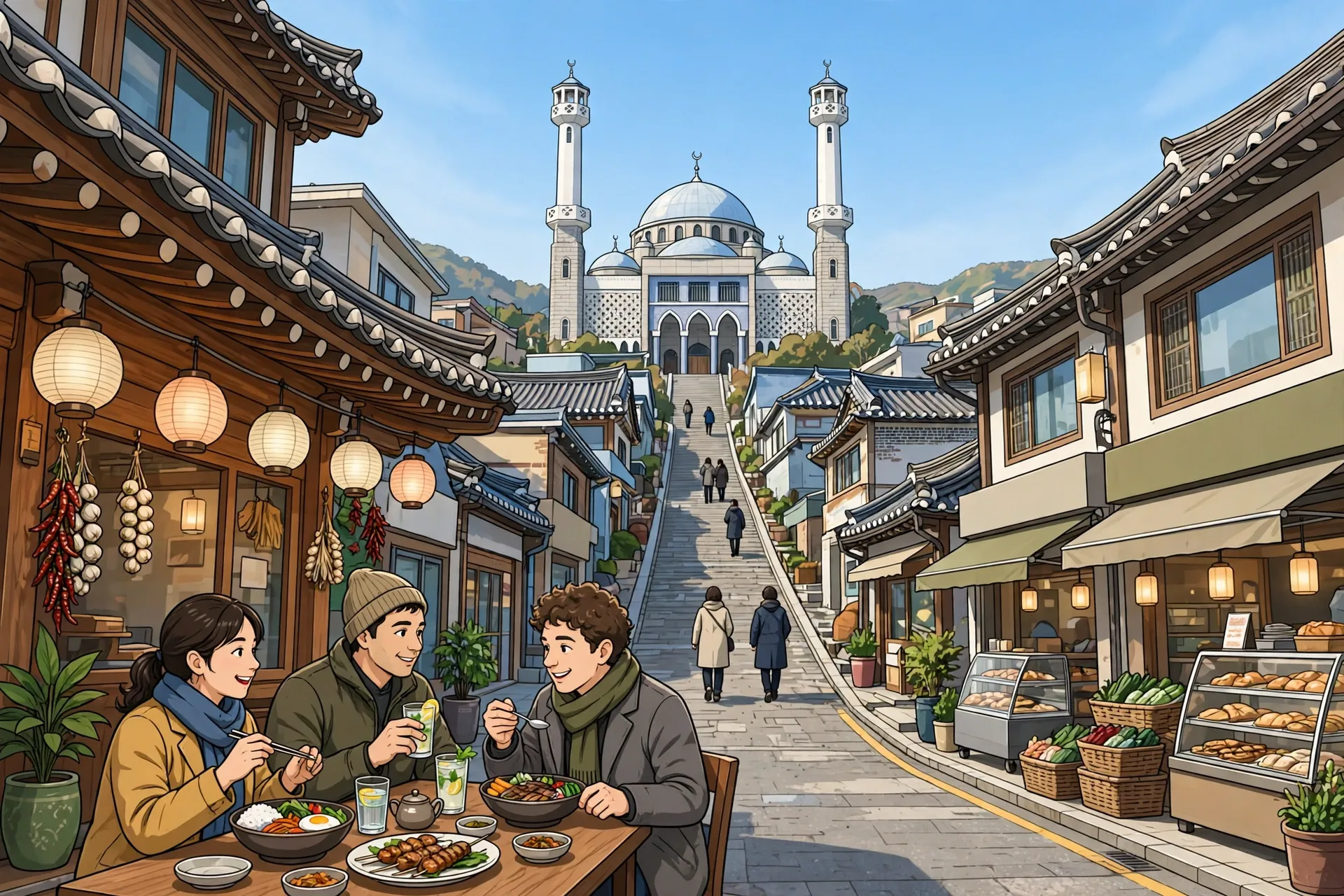
Seoul has halal food, but it is not spread evenly across the city — it clusters in one place. The streets around Seoul Central Mosque in Itaewon hold Seoul's densest cluster of halal restaurants, and the mosque itself is the landmark everything else hangs off: Korea's first mosque, opened on 21 May 1976, at 39 Usadan-ro 10-gil. The question is not whether you can eat halal in Seoul, but which standard of halal you need. Korea divides restaurants into four tiers, from fully certified to pork-free, and the label decides what you can order with confidence. This guide starts at the mosque, explains the four tiers, then walks the mosque street for halal Korean food and the Turkish and other tables beyond it — and ends with how to get there and when Friday crowds make it hard to move.
Start at Seoul Central Mosque: the anchor of Itaewon
Seoul Central Mosque stands at 39 Usadan-ro 10-gil, Itaewon. It is Korea's first mosque, opened on 21 May 1976, and it is the anchor of the whole halal quarter: the restaurants, butchers, bookshop and supermarkets cluster on the streets around it, so once you find the mosque you have found the food.
Visitors are welcome from 10:30 to 17:00. Friday from 12:00 to 15:00 is the busiest time, when worshippers fill the mosque and the streets around it. If you are coming to eat rather than to pray, avoid that window — the lanes are crowded and the restaurants fill up. At other times the mosque street is calm, and the mosque itself is the easiest meeting point in Itaewon: give any taxi driver the address, or walk up from Itaewon Station, and you are at the centre of the quarter.
Read the label: Korea's four halal tiers
The Korea Tourism Organization divides restaurants into four categories, and the tier tells you what you can trust without asking.
Halal Certified means certified by an approved body such as the Korea Muslim Federation, with all food halal. Self-Certified means a Muslim owner states the food is halal, with no formal certification. Muslim Friendly means only some dishes are halal, and alcoholic drinks may also be served — you need to check dish by dish. Pork-Free means no halal menu and no pork used, which is the weakest guarantee of the four.
Pick the tier that matches your standard before you sit down. If you need full certification, eat only at Halal Certified places and check the certificate rather than the sign. If you are comfortable with a Muslim owner's word, Self-Certified opens more tables. Muslim Friendly works only if you ask about each dish, and Pork-Free tells you nothing about the meat, the oil, or the sauces — it only rules out pork.
Halal Korean food on the mosque street
You do not have to skip Korean dishes to eat halal in Seoul. EID Halal Korean Food sits at 15 Usadan-ro 10-gil, on the same lane as the mosque, and it is run by a Korean Muslim family. It serves Korean dishes made halal, including bulgogi, bibimbap, samgyetang (ginseng chicken soup) and fried chicken — the dishes visitors come to Korea to try, cooked to a halal standard.
EID is also one of the nine KMF-certified restaurants in Seoul on Visit Seoul's official Muslim visitor guide. Treat that list as a snapshot, not a guarantee: Visit Seoul's own guide already marks some listed venues as closed, so check current status before travel. Prices and opening hours change too, and this guide does not list them — check them on the day rather than trusting a fixed figure from home.
Turkish, Uzbek and Southeast Asian tables
The mosque street holds more than Korean food. Kervan Turkish Restaurant is at 192 Itaewon-ro, near Itaewon Station Exit 3. It is officially halal-certified and listed by the Korea Tourism Organization, with a Turkish-native chef and stone ovens. The signature order is the mixed grill with baklava.
Beyond the Turkish table, the cluster runs on the same logic as the rest of Itaewon: Visit Seoul's guide lists nine KMF-certified restaurants in Seoul, including Kervan (Itaewon branch), Mr. Kebab and Salam alongside EID. The street outside the mosque also holds halal butchers, an Islamic bookshop and halal supermarkets, so the quarter works as a whole — eat at one table, shop at the next. The same warning applies as everywhere in this guide: the list is a snapshot and some venues it names are already marked closed, so check current status before you travel rather than walking in on a name alone.
Plan your day: getting there and Friday crowds
Take Seoul Subway Line 6 to Itaewon Station and leave by Exit 3, then walk via Itaewon Fire Station and the Bogwang Elementary School junction, about 250 m to the mosque. The walk is short and the mosque is visible as you climb the lane — if you are unsure, follow the halal restaurant signs up the hill.
Time the visit around Friday. Friday from 12:00 to 15:00 is the busiest time at the mosque, and the restaurants around it fill with the Friday crowd. Come before noon or after 15:00 on a Friday, or pick any other day, and the quarter is easy to move through. If you have not sorted cover for the trip yet, check our Korea–Japan–China travel insurance guide before you book. Start at the mosque, eat on its street, and check the tier before you order.