Food Allergies in Korea: Ordering and Using a Translation Card

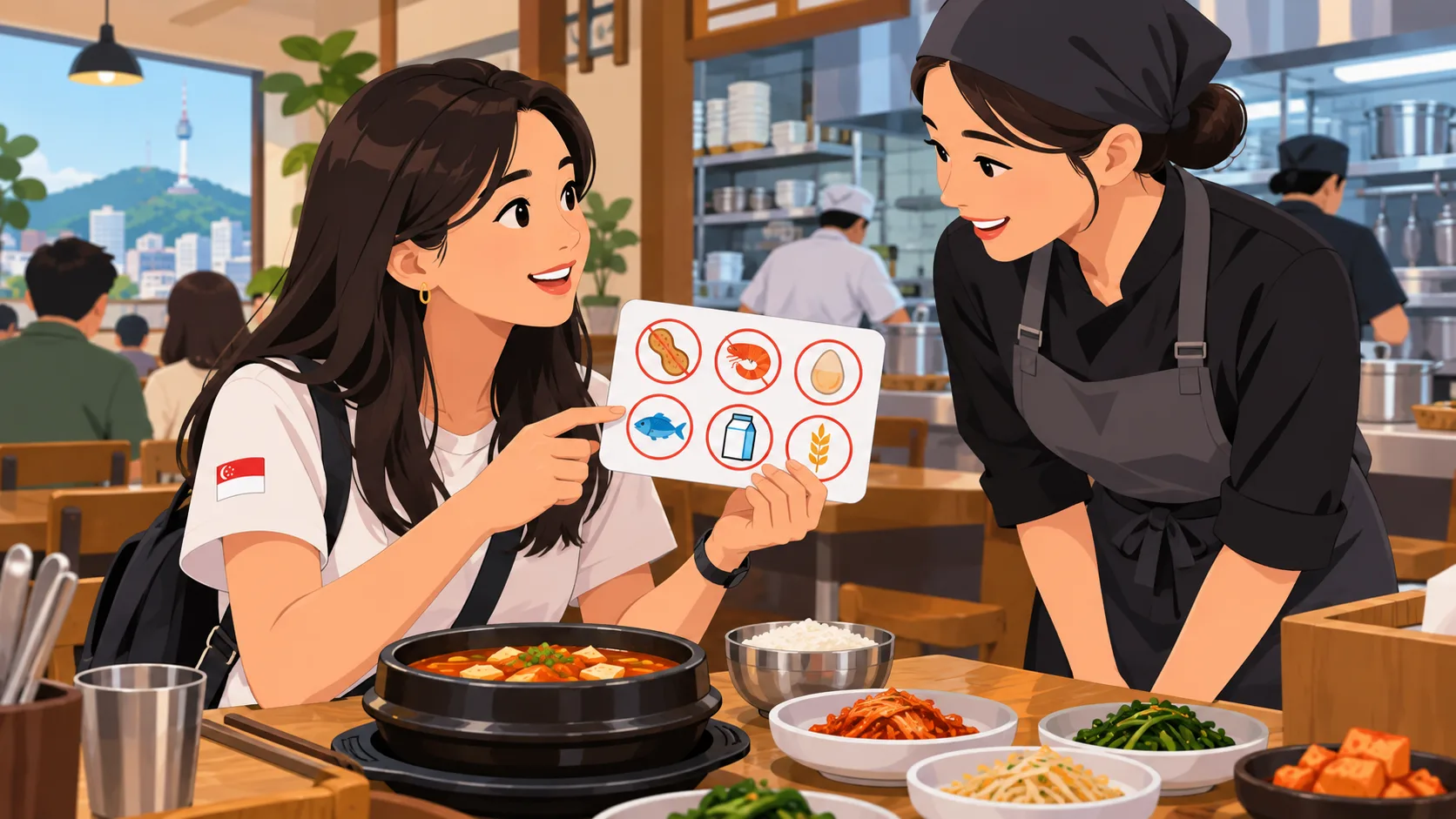
Eating in Korea can be one of the best parts of a trip, but a dish name or photograph cannot tell a person with a food allergy whether a meal is suitable. Broths, sauces, toppings and shared equipment all matter. A translated card helps you ask the right questions; it does not certify a kitchen. This guide gives Singapore travelers a practical decision process for ordering, declining and keeping a backup meal ready.
Prepare a Korean allergy card with ingredient details
Name the exact allergen on a Korean card, explain that it is an allergy, and ask staff to check ingredients and preparation with the kitchen. Have the wording checked by a competent speaker. Show the card before ordering, wait for a specific answer, and leave if verification is impossible.
Use this English master card as a fill-in template, then have a competent Korean speaker translate and check the completed version before departure. The brackets are fields to replace, not words to show a server:
I have a food allergy to [exact allergen or allergens]. Please ask the cook whether [dish name] contains these ingredients or ingredients made from them, including sauces, stock and side dishes. My requirements for shared utensils, oil and preparation surfaces are [your clinician-guided cross-contact requirements]. If the ingredients or preparation cannot be checked, please tell me. I will choose something else. Please take this card to the person preparing the food.
Keep the English original beside the verified Korean translation so you can check that your particular allergens and cross-contact requirements were carried across. This is a request for information, not a kitchen safety certificate. Do not rely on an unverified translation or a generic card for a serious allergy.
The card should be personal. A generic list of common allergens is not enough if your own trigger is a particular nut, seafood, grain, seed or ingredient derived from one of them. List your allergens in English and Korean and include any related ingredients your clinician has told you to avoid. If you react to a particular preparation or need to avoid cross-contact, say so explicitly. Do not copy another traveler's card just because the allergies sound similar. A translated template is a starting point for communication, not a replacement for your medical plan.
Food Allergy Research & Education (FARE) provides chef-card guidance and notes that translations can vary. That warning matters in a restaurant. A literal machine translation of one ingredient may not match the form used on a menu, a packaged-food label or in a kitchen. Before departure, ask a Korean speaker with relevant food vocabulary to check the card, especially the name of each allergen and the sentence about shared preparation. If you cannot obtain a reliable translation, choose dining options where you can communicate with a manager or chef in a language you both understand.
Keep the card easy to show, not buried in a notes app behind a long explanation. A small printed copy and an offline phone copy are useful. Include a line asking the server to take the card to the person preparing the food. If you have multiple allergies, arrange them as a short list rather than a paragraph. Staff need to know what to check, and you need a clear response before ordering. Keep your emergency contact information and medical instructions separately; the chef card's job is to clarify the food request.
State the allergy, not a preference
Saying "I do not eat this" may be interpreted as a taste, religion or dietary choice. That can lead someone to remove a visible topping while leaving an ingredient in a sauce or broth. The card should identify the food as an allergy and ask whether the proposed dish and its preparation can avoid it. Do not assume a polite nod means the kitchen has checked. Ask a follow-up question about the particular ingredient or preparation step that worries you. The useful response is a specific confirmation from someone who knows the recipe.
For example, a diner avoiding a seafood allergen would need to ask about ingredients in soup stock, fermented sauces and side dishes, not just whether a plate contains a visible piece of seafood. A diner avoiding wheat might need to check a sauce as well as noodles. These are examples of questions, not a claim that any named dish is safe or unsafe for every person. Korean recipes vary between kitchens, and the same restaurant can change suppliers. The final decision depends on your own allergy and the actual preparation.
The card should not promise that a meal is safe if the restaurant says a dish is "usually" made without the allergen. Usually is not enough to answer a serious allergy question. Ask who checked the ingredients, whether the product packaging can be read when relevant, and whether the food shares utensils, oil, a grill or a preparation surface with the allergen. If staff do not know, thank them and use your backup plan. Leaving politely is better than treating uncertainty as a social problem you must overcome.
What to prepare before leaving Singapore
Discuss your travel plan and any prescribed medication with your own clinician before the trip. Check that you know your personal emergency action plan and that companions understand how to help. This article does not tell you when or how to use medicine; that decision belongs to your clinician's instructions. FARE's international travel advice recommends translated allergy information and backup food. Prepare both before you need them, while you still have time to correct a translation or change a booking.
Make a short list of restaurants that publish ingredients or can answer questions directly, then contact them at a quiet time if possible. A menu image is only an early filter. Ask whether the team can check your specific allergens and preparation needs on the date of the visit. Keep the response, but repeat the check when you arrive. Staff, recipes and stock can change. If a booking platform offers an allergy field, use it as a note, not as proof that the kitchen has accepted the request.
Carry familiar shelf-stable food that fits your own allergy plan, subject to airline and border rules. A backup snack buys you time to ask questions without hunger forcing a rushed decision. Plan at least one meal option near your hotel where you can communicate clearly. For a long day trip, know what you will do if the first restaurant cannot help. A backup is not a sign that Korean food is inherently unsafe; it is a way to preserve choice when the answer is uncertain.
Ask about sauces broths and shared preparation
The visible ingredients are only the first layer. Ask about the base, dressing, stock, marinade, seasoning paste and side dishes. Then ask whether the kitchen can prepare your order without contact with the allergen through shared pans, utensils, oil or surfaces. A server may know the menu description but not every ingredient or kitchen process; request a check with the cook or manager when a detail matters.
Korea's Ministry of Food and Drug Safety describes allergen labeling for packaged foods, including specified allergen ingredients and warnings about possible mixing during manufacture. That is useful when buying a packaged snack, but it is not a certificate for restaurant dishes. The packaged-food rule and the practices of a small kitchen answer different questions. Read the actual product label every time; do not assume a familiar brand uses the same recipe as in Singapore. If you cannot understand the label or find the relevant ingredient information, choose another product.
The Korea Tourism Organization's vegetarian eating guide explains that ingredients such as meat, egg or seafood may appear in Korean dishes, including broths or fillings, even where a traveler might not expect them. Vegetarian advice is not an allergy-safety system, but it demonstrates why dish names and appearance are weak evidence. Ask about the actual recipe and the actual kitchen. Do not infer from a vegetarian label that a meal is free of milk, soy, wheat, nuts, sesame or another allergen relevant to you.
A two-way conversation at the table
Show the card before ordering and allow time for staff to read it. Ask whether they can take it to the person making the food. If they come back with a detailed answer, clarify any remaining point. If they say only "no problem" without having checked the kitchen, politely ask how they verified it. The goal is not to interrogate staff; it is to decide whether you have enough information to eat. Staff may be busy, and a small restaurant may not have ingredient sheets. Their honest uncertainty is valuable information.
You can help by proposing a simple dish, but do not assume that simplicity removes cross-contact. Plain rice, fruit or grilled food may still be handled in a shared area. Ask about the specific item and preparation. The restaurant might offer to change a dish. Before accepting, confirm that the allergen is not already in a sauce, premixed component or stock, and that the kitchen can handle your cross-contact requirements. Removing a visible ingredient at the last moment is not the same as preparing a suitable meal.
If the server and cook use different languages, avoid a chain of casual guesses. A checked written card, a manager who can translate, or a direct conversation with the cook may work better. Translation apps are useful for identifying menu words, but they can misunderstand an ingredient name or a negative instruction. Have any critical Korean text verified in advance. Do not rely on a phone's camera translation of one line on a menu as the only evidence for a serious allergy decision.
Packaged snacks need their own check
Convenience stores are a useful backup only when a product's current label and your own allergy plan make it suitable. The MFDS label system lists particular allergens, but your trigger might not be among them, and a manufactured product may carry a warning about possible mixing. Read both ingredients and any relevant caution statement. If there is a language barrier, use a verified translation or ask for help; do not use color, packaging style or a product's apparent simplicity as a substitute.
Keep a record of packaged foods you have checked during the trip, but re-read them when you buy another pack. Recipes and factories can change. The same product category may have different ingredients across countries. A snack that is suitable for one person with a food allergy may be unsuitable for another. The point of a backup item is to lower pressure during a restaurant decision, not to create a new assumption that every packaged item in the category is safe.
Social meals and food tours
Korean dining often involves shared side dishes and communal cooking, which can make the social experience lively but the ingredient trail harder to follow. Explain your needs to companions before the meal so they can support a different restaurant choice if necessary. If friends want a barbecue or street-food stop that the kitchen cannot verify for you, agree on another shared activity or an alternate meal. You do not need to accept an uncertain dish to be courteous.
For a food tour or cooking class, contact the operator before payment. Ask who prepares the food, whether ingredients and equipment can be checked, and whether the experience still works if you do not eat a particular course. The KTO asks visitors to specify allergy types when reserving some cooking experiences. A generic "dietary requests accepted" box does not answer your specific preparation question. Keep a written reply, but confirm it with the instructor or kitchen on arrival.
Our Korean dining etiquette guide explains table customs. Here, safety takes priority over etiquette: it is appropriate to ask questions, decline a dish, or leave if information is insufficient. Our vegetarian Korean street-food guide helps identify ingredients that might be hidden in familiar snacks, but a vegetarian choice is not automatically suitable for a person with a food allergy.
Choose a safer alternative when staff cannot confirm
Set a decision rule before you are hungry. Eat only when the kitchen can explain the ingredients and preparation well enough for your personal allergy needs. If the answer is vague, inconsistent or dependent on a guess, do not order that dish. Choose a verified alternative, use your prepared food, or return to a restaurant that has already handled your questions clearly. You are not judging the staff's goodwill; you are acting on the quality of the information.
FARE's dining-out advice stresses communication with restaurant staff and the role of a chef card. A card is useful because it makes the request repeatable; it does not remove the need to listen to the answer. When the kitchen says it cannot prevent cross-contact or cannot identify a component, thank them. An honest "we cannot confirm" is a better outcome than false reassurance. Your backup plan exists for precisely this moment.
For a full-day outing, identify a fallback near a transit stop rather than at the opposite end of town. Check the fallback's hours and whether it can actually handle your request. A hotel with kitchen access may be useful for some travelers, but it still requires suitable ingredients and preparation. Others may rely on familiar packaged food brought under applicable rules. The right backup is the one your own medical and dietary plan permits and that you can access without a stressful detour.
If a reaction is suspected
Follow the emergency plan you developed with your clinician. Do not use a travel article to diagnose symptoms or decide treatment. The Korea Tourism Organization lists 119 for medical emergencies in Korea; its emergency information page also lists 1330 for non-emergency tourist information and interpretation. A suspected severe reaction is an emergency-services situation, not a travel-hotline question. Save the address of your hotel and know how to show your current location to responders.
Travel companions should know where your prescribed medication is, how to contact emergency services, and what your clinician has instructed for your particular case. Tell them before an incident, not while you are trying to explain symptoms across a language barrier. If a person is unwell, do not delay emergency help while searching for a translation of a menu. The card and meal checklist are preventive tools; they are not a substitute for an emergency response plan.
A practical ordering checklist
Before sitting down, decide whether the restaurant can give you enough time and attention to check the meal. Show the verified card and name the exact dish you are considering. Ask about the ingredient itself, derived ingredients, sauces or broths, and shared preparation. Wait for a kitchen-informed answer. If the answer is clear and meets your own requirements, order only the checked item and confirm it again when served. If the answer remains uncertain, decline and use the planned backup.
Do not turn a list of "safe Korean dishes" into a universal rule. Recipes differ. A meal can vary by branch, season and cook, and an allergy can be triggered by an ingredient a casual guide does not discuss. The most transferable skill is the decision process: communicate the exact allergen, verify the exact preparation, and retain the freedom to leave. That approach works in a small Seoul restaurant, a Busan food court or a market stall, though some settings will offer more reliable answers than others.
Make the trip enjoyable without taking a gamble
You can still explore Korean food with an allergy. Put more time into fewer meal choices rather than treating every street-food stall as a spontaneous opportunity. Choose venues that can discuss ingredients, share your card before a rush period, and pair meals with activities that do not depend on eating. If one place cannot help, the day still has a plan. The aim is to make an informed decision, not to prove you can eat whatever your companions choose.
For Singapore travelers, preparation is particularly manageable before departure: make the card, check your personal emergency plan, shortlist restaurants, and bring a suitable backup. In Korea, repeat the conversation at each kitchen. The restaurant's answer can change, and it is acceptable to change your decision. A good meal is one you can enjoy with confidence grounded in specific information, not one you accepted because a menu photograph looked reassuring.
Sources and verification
This guide draws on FARE's chef-card guidance, FARE's international travel advice, Korea's MFDS food-labeling explanation, the Korea Tourism Organization's ingredient examples, and KTO emergency information. These sources were checked on 5 October 2026 Korea time. Restaurant recipes, product labels and emergency arrangements can change. Verify the specific meal and follow your own clinician's advice.