Korea's DMZ tour: booking rules and what to expect inside

Book a standard DMZ tour 2–3 days ahead with your physical passport. That is the short version of this guide, and it is the booking this guide recommends first. The standard tour follows the observatory route — Imjingak, the 3rd Tunnel, Dora Observatory — with no advance vetting. A JSA tour is a different commitment: your passport details go in for vetting weeks ahead, a minimum of one week and often two to three months in busy periods, and the tour can still be cancelled on the day. Book the standard tour if your dates are fixed and you cannot submit passport details weeks early. Book the JSA only if you can submit those details early and accept the cancellation risk. The sections below cover the two tiers, the booking windows, the ID and dress rules that get enforced, and what happens at each stop.
Which DMZ tours actually enter the JSA vs the observatory-only versions
The standard DMZ tour does not enter the Joint Security Area. It follows the observatory route: Imjingak, the 3rd Tunnel, Dora Observatory, and Dorasan Station. You see the border area from the observatory side; you do not cross into the JSA itself.
A JSA tour goes further, into the Joint Security Area where the blue huts stand. That access is what triggers the extra vetting: JSA tours require advance passport vetting, with a minimum of one week and often two to three months in busy periods. Standard DMZ tours need no such vetting.
Before you book a JSA tour, confirm with your operator whether the full JSA itinerary is currently running. JSA access varies, and the full form of the tour, including interior access to the blue huts, is not guaranteed.
Booking windows and ID rules — why your passport details matter weeks ahead
Book a standard DMZ tour 2–3 days ahead. Bring your physical passport on the day: a physical passport is mandatory at checkpoints for both DMZ and JSA tours, and photos and copies are refused.
For a JSA tour, the booking window is set by the operator's deadline, not by seat availability. Koridoor, the operator running JSA tours, requires payment at least 4 business days before the tour date and submits visitor details to the JSA in advance, so submit your passport details at least that early — and book as early as you can, because JSA dates are announced only about a month ahead and sell out fast. If you cannot book that early, book the standard tour instead of gambling on a JSA booking.
What the dress code and conduct rules really enforce on the day
The enforced rules on a JSA tour are specific. The dress code bans sleeveless tops, shorts, sandals, and camouflage. Koridoor, the operator, sets the age limit at 10: children under 10 are not allowed on the DMZ/JSA tour. These are the rules the packet evidence confirms as enforced; the standard observatory tour carries no such vetting, but the dress code and age minimum are the JSA conditions to plan around before you book.
How tour cancellations work when the military shuts access
Tours can be suspended on the day for security threats, bad weather, or safety concerns. That applies to both tiers, and the JSA tier carries the extra risk of losing access after booking.
Plan around it the way the evidence advises: do not put the DMZ on your last day in Korea. A suspended tour with no days left cannot be rebooked, so keep at least one buffer day after your DMZ date.
What to expect at each stop — Imjingak, the 3rd tunnel, Dora Observatory
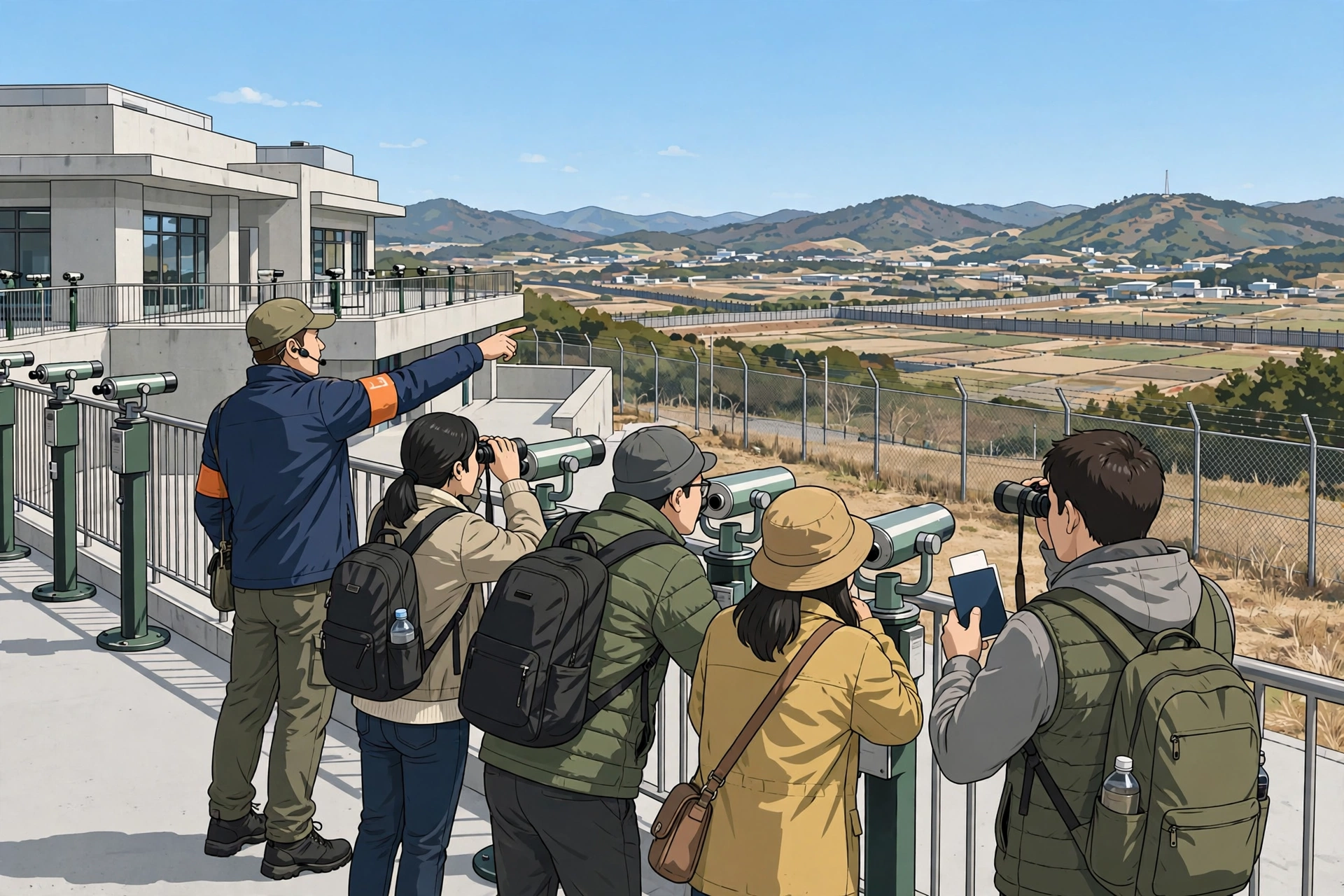
Imjingak is the first stop on the standard route. The 3rd Tunnel is the underground stop: discovered in 1978, about 1.6 km long and about 73 m deep. Dora Observatory is the viewing stop on the route, and Dorasan Station completes the standard circuit.
If the DMZ leaves you wanting more of Korea beyond the standard sights, Hidden Korea: off-the-beaten-path destinations worth visiting covers places most itineraries skip.