Mount Fuji day trip: the Hakone loop vs Kawaguchiko, decided

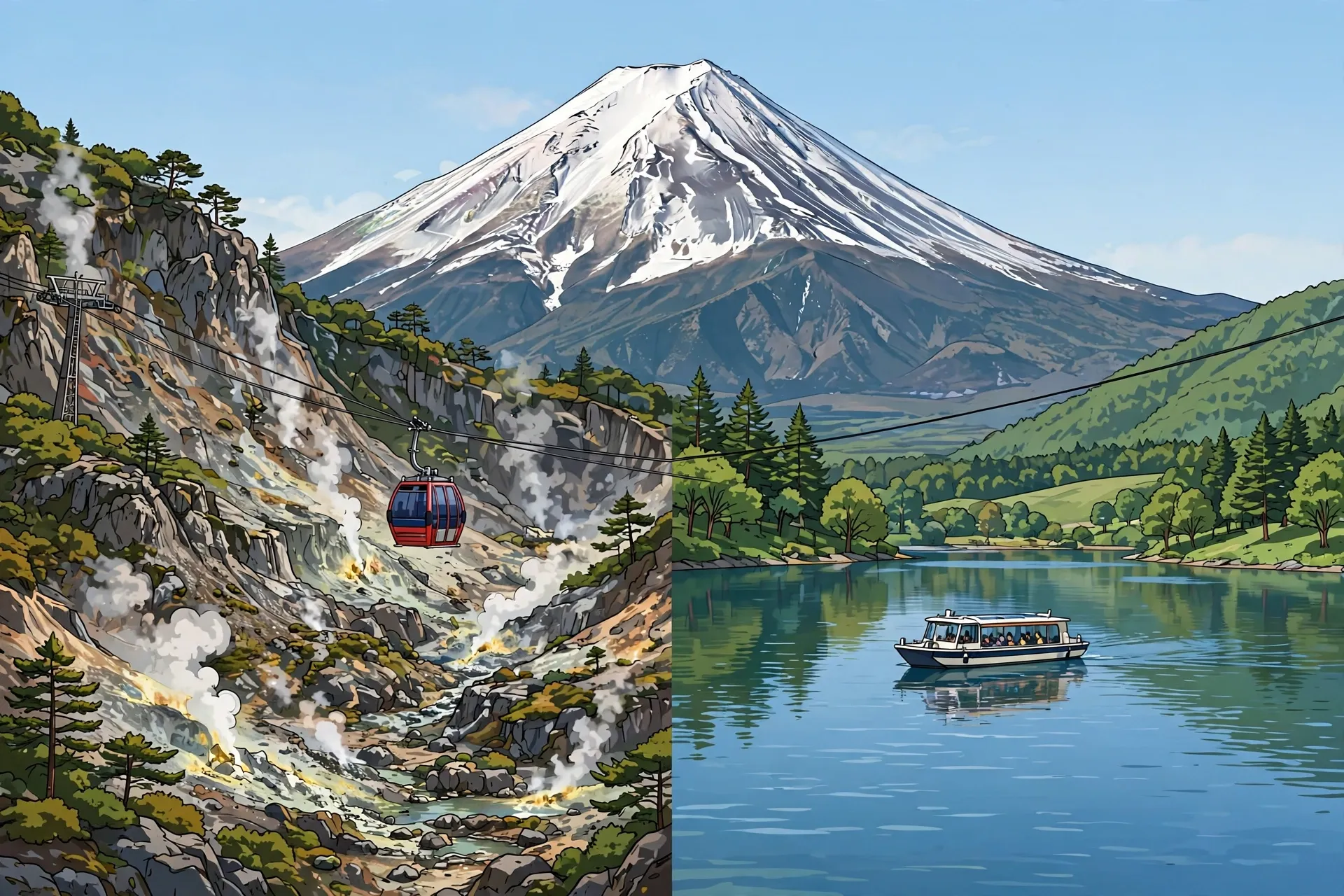
Standing in Shinjuku with one free day, the Mount Fuji choice looks simple and is not. Hakone and Kawaguchiko both put the mountain in front of you, but they sell different days. Hakone is a moving circuit of mountain railway, ropeway, and lake cruise, with hot springs waiting at the end. Kawaguchiko is a straight line to the postcard view across the lake. Weather decides more than taste does, because cloud can erase the mountain from either side without asking. This guide prices both routes from Tokyo with operator fares, shows where each plan can break, and ends with a verdict by traveler type, so you can book the day that matches the Fuji you actually want.
The decision in one table: photo goal vs activity day
Start with what the day is for. The Hakone Freepass offers unlimited travel around Hakone, chaining the mountain railway, cable car, ropeway, lake cruise, and buses into one loop. The pass also brings extra savings at 70+ spots around Hakone, from hot springs to museums. Kawaguchiko plays a different game: Fujikyu Railway calls itself the closest railway to Mt. Fuji, and the Fuji Excursion ends at Kawaguchiko Station on Lake Kawaguchi.
| If the day is about | Choose | Why |
|---|---|---|
| The classic Fuji photo across a lake | Kawaguchiko | Trains and buses end at the station on Lake Kawaguchi |
| Moving through the mountains all day | Hakone | One pass chains rail, ropeway, cruise, and bus into a single circuit |
| Ending the day in an onsen town | Hakone | The loop finishes in Hakone-Yumoto, a hot spring town |
Neither side wins on scenery alone. The real difference is structure: Hakone rewards travelers who enjoy the journey itself, while Kawaguchiko rewards travelers who want the mountain, the lake, and little else in between.
Hakone loop transport: the Free Pass math and Romancecar
From Shinjuku, the Hakone Freepass costs 7,100 yen for 2 days and 7,500 yen for 3 days. If you are already near Odawara, the area-only pass from Odawara costs 6,000 yen and skips the Tokyo leg entirely.
The direct Romancecar ride from Shinjuku to Hakone-Yumoto takes about 80 minutes. The Romancecar is not included: its reserved-seat limited express ticket adds 1,200 yen one way to Hakone-Yumoto. Every Romancecar seat is reserved, so the add-on also buys you a guaranteed seat on the busiest leg of the day.
Run the loop in one direction: mountain railway up from Hakone-Yumoto, cable car and ropeway across the volcanic valley, sightseeing cruise across the lake, then bus back down. The pass turns that chain into a single ticket, which is where its value comes from — pay-as-you-go legs add up quickly, and the pass also discounts the stops along the way.
Kawaguchiko transport: highway bus vs Fuji Excursion train
The highway bus from Shinjuku to Kawaguchiko Station costs 2,200 yen, discounted to 2,000 yen when you pay online. Buses run more than 65 times a day and reach Kawaguchiko Station in about 1 hour 45 minutes.
The rail alternative is the Fuji Excursion. The Fuji Excursion limited express costs 4,200 yen one way from Shinjuku to Kawaguchiko Station. The Fuji Excursion is a non-stop train from Shinjuku, with a fastest time of 1 hour 53 minutes to Kawaguchiko.
Put side by side, the bus is the value pick: it undercuts the train on price and, on the fastest timings, even arrives sooner. The train earns its fare differently — one seat from Shinjuku with no transfer, and a route built for Fuji viewing rather than highway traffic. If the bus sells out on a holiday morning, the train is the backup worth paying for.
Fuji visibility: when and how to check
We could not verify a primary-source visibility statistic, so this guide gives a checking procedure instead of odds.
The procedure that replaces odds is simple. Check the forecast for both Hakone and Kawaguchiko on the morning of the trip, not the night before — mountain weather turns overnight. If cloud covers the summit from one side, take the other route; the two areas sit on opposite sides of the mountain, so a blocked view in one is not proof of a blocked view in the other. If both sides are covered, swap the Fuji day with a Tokyo day instead of riding out and hoping. When the morning is clear, go early: the mountain tends to cloud over as the day warms, so the first hours carry the best chance.
What can go wrong in Hakone (and the backup plan)
The loop's weakness is that it is a chain. If a Hakone section is suspended or cancelled because of inclement weather, the unused section is refunded. That refund applies to passes bought online, and it does not apply when alternative transportation is available — so a suspension softens the cost, but it does not rescue the day.
Plan the backup before you need it. If the ropeway or cruise stops, the same pass still covers buses around Hakone, and the hot springs of Hakone-Yumoto do not depend on the weather at all. If the whole mountain closes in, cut losses and switch sides: Kawaguchiko is a separate route from Shinjuku, and a clear morning there is worth more than a stubborn loop in the fog.
The verdict by traveler type
Photographers: choose Kawaguchiko, go on the earliest departure you can manage, and spend the day around the lake. Activity-first travelers and families: choose Hakone and the loop — the journey is the attraction, and Fuji is the bonus when it appears. Onsen-first travelers: Hakone again, because the loop ends in a hot spring town. Budget-first travelers: the online bus fare to Kawaguchiko is the cheapest seat toward the mountain in this guide.
With the Romancecar in both directions, the transport total from Shinjuku is 9,500 yen. That single comparison settles most decisions: if the loop's variety is worth roughly double the bus fare to you, Hakone is your day; if not, Kawaguchiko is.
Spending more days around Tokyo after the Fuji run? Our guide to buying baseball tickets as a foreign visitor covers another classic day out from the capital.