Golden Week in Japan: What It Is and How to Survive Traveling During It

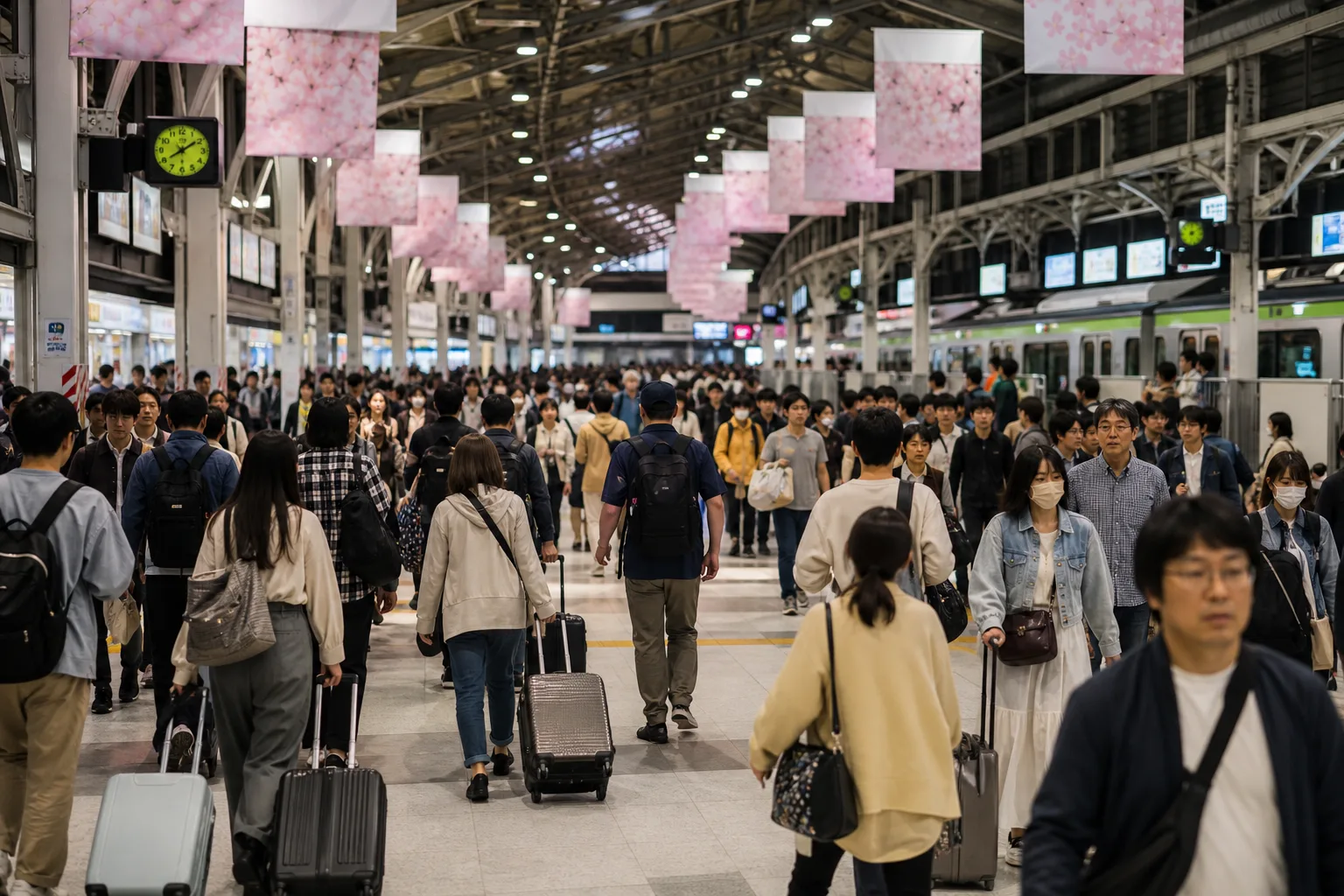
Golden Week is the easiest time to make a Japan trip feel more complicated than it should. Trains fill up, hotels tighten their cancellation policies, popular attractions get busier, and local travel can become a puzzle if you do not understand the holiday pattern before you arrive.
Introduction
Golden Week compresses several public holidays into one of Japan's busiest travel windows, so trains, hotels, and popular sights fill faster than usual. If you visit then, the trip still works, but only when you book early, move slowly, and expect crowding everywhere.
At a practical level, Golden Week is not just “Japan gets busy.” It is a cluster of public holidays that encourages domestic travel, pushes up demand for trains and hotels, and changes how locals move around the country. The good news is that you can still travel well during it. The key is to make a different kind of plan: one that accepts crowding, locks in the critical pieces early, and chooses your destinations with more care than usual.
If you are still comparing months for a first trip, it also helps to compare Golden Week with the rest of the year. For a broader seasonal decision, read Best Time to Visit Japan: Sakura, Autumn Leaves & Winter Snow Guide.
What Golden Week Is and Why It Matters
Golden Week is a stretch of Japanese public holidays that runs from late April into early May. The core holidays are Showa Day on April 29, Constitution Memorial Day on May 3, Greenery Day on May 4, and Children's Day on May 5. In some years, weekends and substitute holidays can make the break feel even longer. In practice, many workers and students take additional paid leave, turning the calendar window into a major domestic travel period.
This matters for travelers because Golden Week changes the country in three ways at once. First, transportation demand rises sharply, especially on long-distance rail routes, domestic flights, and highway buses. Second, hotels in major cities and resort areas book faster than usual, which can shrink your options and raise prices. Third, attractions and shopping districts are simply more crowded, so activities that normally feel relaxed can become time-consuming or tiring.
The holiday is also important because it is predictable. That makes it easier to plan around than a surprise event or a sudden weather issue. If you know Golden Week exists and you understand the pattern, you can make smart tradeoffs: arrive before the rush, stay in one region, choose base cities with strong transit, or go in with a slower pace. The issue is not that travel becomes impossible. The issue is that spontaneous travel becomes expensive in time and energy.
The basic holiday pattern
The simplest way to think about Golden Week is this: it is not one holiday, but a chain of holidays. That chain creates a long behavioral shift in the country. Some people leave Tokyo, Osaka, and other major cities for their hometowns. Others take short trips inside Japan. Families prioritize multi-day travel because schools and offices are closed or quiet. The result is a stronger-than-normal movement of people in both directions, which is why major stations feel full and why reservation systems matter more than usual.
Why visitors feel the pressure so quickly
Foreign travelers often feel Golden Week pressure before they even notice the holiday itself. A hotel that would normally have many room types left may be nearly sold out. A simple day trip that would normally work with a same-day train reservation may require advance booking. Even restaurant seating can shift from “walk in and wait a few minutes” to “booked out unless you arrive early.” In other words, the trip does not only get crowded; it gets less flexible.
How to Plan Around Golden Week Without Ruining the Trip
The best way to survive Golden Week is to decide, in advance, which parts of the trip must be fixed and which parts can remain loose. Travelers who try to keep everything open often end up paying more for last-minute substitutions. Travelers who lock in the essentials early usually have a much calmer experience.
Choose your base city carefully
Your base city matters more during Golden Week than during a normal week. If you stay in Tokyo, Osaka, Kyoto, or Fukuoka, you will be close to transport but also closer to crowds. If you stay in a smaller city that still has good rail connections, you may get more breathing room, but you may need to book earlier to secure a good hotel and convenient arrival time.
The strongest strategy is usually to pick one or two bases and avoid changing hotels too often. Every hotel move during Golden Week adds risk: checking out at a busy time, hauling luggage through crowded stations, and depending on reserved seats that may be hard to find. If your route does not truly need frequent relocation, do not force it.
Build a slower itinerary than usual
Golden Week rewards slower, more selective travel. Instead of trying to visit three cities in three days, give yourself time buffers and reduce the number of “must-do” activities. That way, if a train is full, a restaurant is booked out, or a line is longer than expected, your entire trip does not fall apart.
Slow itineraries also help with the less obvious parts of travel stress. Crowded platforms, longer ticket lines, and delayed meal breaks all take more energy than they do on a quiet week. If you pack your schedule too tightly, you will feel every delay. If you leave open space, you can absorb the holiday friction without losing the point of the trip.
Treat reservations as protection, not inconvenience
During Golden Week, reservations are not a sign that you are overplanning. They are a way to protect your time. This is especially true for intercity trains, major domestic flights, airport transfers, and hotels that are near a key station or tourist district. If a booking will remove uncertainty from the trip, it is usually worth making.
This is also where a good travel logistics plan pays off. If your Japan trip already includes airport arrival, IC card use, rail planning, luggage strategy, and phone connectivity, then Golden Week is much easier to manage. If you need a refresher on the basics, see Japan Travel Planning: Visa, IC Card, Rail Pass & Essential Logistics Guide.
Use Golden Week as a reason to narrow your goals
Golden Week is not the best time to chase a long checklist. It is a better time to focus on one travel theme and make it easy to enjoy. For example, you can center a trip around food neighborhoods, one region’s scenery, a spa stay, a family-friendly city break, or a single rail corridor. What you should avoid is a route that depends on last-minute improvisation at every step.
Practical Guide
Golden Week is a planning problem before it is a sightseeing problem. The practical details below matter because they determine whether you spend the trip moving smoothly or reacting to crowds.
Hours, admission, and prices
There is no single Golden Week admission policy because every attraction handles the holiday differently. Major museums, theme parks, observation decks, aquariums, and special exhibitions often use timed tickets or advance booking. Smaller temples, public parks, and neighborhood sights may remain open, but they can be much busier than usual.
Prices also vary by category. Public transport fares generally do not change just because it is Golden Week, but the cost of the trip can rise indirectly if you need a better hotel, a more convenient train departure, or a backup transport option. Attractions sometimes keep standard admission prices while becoming harder to enter at the time you want. In practical terms, the price of “traveling badly” during Golden Week is usually not a higher ticket price. It is the time and stress you lose when you have not booked ahead.
For that reason, treat opening hours as a thing to verify for the exact place you plan to visit, especially if it is a ticketed or seasonal venue. Holiday weeks can also affect restaurant hours, convenience store traffic, and the time you need to budget for transfers between stations.
How to get there
The best way to move around Japan during Golden Week is usually the same as on any other week: use the most direct option that matches your route, then reserve it if you can. But because demand is higher, you should expect less room for error.
If you are traveling between major cities, book trains earlier than you normally would. If you are flying domestically, leave more buffer time for airport access and security. If you are using highway buses, understand that the cheapest option may also be the least forgiving. If you are moving between a hotel and an airport, assume traffic can be slower than the map suggests.
For local travel inside cities, the subway and urban rail systems are usually still the most reliable choice. Taxis can be useful when a station is packed or you are moving luggage, but they are not a fix for poor planning. The real goal is to reduce the number of times you need to improvise in the middle of a crowd.
Booking priorities
If you are short on time, book in this order:
- Your hotel or base accommodation.
- Intercity transport.
- Airport transfers.
- Any timed-entry attractions or special exhibitions.
- Restaurant reservations for high-demand meals.
That sequence works because each step depends on the next one being stable. Once your overnight base is secure, you can plan transport around it. Once transport is secured, you can estimate how much sightseeing time is realistic. Once the core schedule is stable, you can decide whether a restaurant booking is worth the effort.
What to expect at stations and airports
Stations can feel especially intense during departure windows. People arrive early, move with luggage, and crowd the ticket gates in waves. If you are using a reserved-seat train, do not assume you can wander in at the last minute and still sit with your group. If your plan requires a specific departure, build in enough time to handle the station calmly.
Airports can be equally busy, but in a different way. The main stress there is usually not just queue length; it is the chain reaction created when road traffic, check-in timing, baggage handling, and gate crowding all compress into the same window. Golden Week is a strong argument for arriving early rather than “on time.”
Tips & Common Mistakes
The biggest Golden Week mistakes are predictable, which is good news. Once you know them, they are easy to avoid.
Mistake 1: Booking the trip and hoping the rest works itself out
The most common failure pattern is to book flights and a hotel, then assume that transport, attractions, and meals will be easy to improvise. That can work in low season. During Golden Week, it often means you are forced into less convenient times and weaker choices. A trip can still succeed this way, but it becomes more tiring than it needs to be.
The fix is simple: lock down the backbone of the itinerary first, then decide what flexibility you can keep.
Mistake 2: Changing cities too often
Frequent hotel changes are one of the worst things to add during Golden Week. Every move takes time, and every transfer creates another point of failure. Even if each leg is short, the total friction can be high. Many travelers would be better off staying put and making smaller day trips from one stable base.
Mistake 3: Assuming “holiday” means “everything is closed”
Golden Week is not a shutdown. Many businesses stay open, especially in tourist-heavy districts, shopping areas, and transit-connected neighborhoods. The issue is not that Japan becomes unavailable. The issue is that demand becomes uneven. Some places are packed, some are normal, and some are harder to reach. Knowing that difference helps you plan better.
Mistake 4: Ignoring timing inside the holiday week
Golden Week is busy across the whole window, but not every day feels the same. Departure and return days are often especially intense. Popular sightseeing areas can also be busiest when local residents are off work and school. If your schedule is flexible, it is usually smarter to travel outside the most obvious peak windows or to use those days for lower-stress activities.
Mistake 5: Packing too many “top sights”
It is tempting to build a dream list for a Japan trip and assume the holiday mood will carry you through. In reality, Golden Week is when big-ticket sightseeing tends to cost the most energy. A better approach is to mix one or two major sights with neighborhood walks, food stops, parks, or a relaxed evening plan. That keeps the trip from turning into a queue-management exercise.
What most guides miss
Most Golden Week advice focuses on crowds, but the deeper issue is decision fatigue. When every transport choice, hotel move, meal timing, and attraction entry requires more thought than usual, travelers burn energy faster. The best antidote is not just booking early. It is reducing the number of decisions you need to make while on the road.
That means writing your priorities down before you leave. Decide which city matters most, which activities are non-negotiable, and where you are willing to compromise. Once those choices are made, the holiday becomes much easier to handle.
FAQ
Is Golden Week a good time to visit Japan?
It can be, but only if you know what you are signing up for. Golden Week is good for travelers who can plan ahead, tolerate crowds, and enjoy a trip with a more structured rhythm. It is not ideal for travelers who want maximum flexibility, last-minute hotel changes, or a very quiet experience.
When is Golden Week in Japan?
The core Golden Week period centers on late April and early May, with the major public holidays clustered around April 29 through May 5. The exact travel pressure can extend beyond those dates because many people take additional leave before or after the official holidays.
Do trains and hotels sell out?
Popular trains and hotels can sell out, especially on the most desirable routes and in major tourist destinations. That does not mean there is no availability at all. It means the best options disappear first, and the remaining options may be less convenient or more expensive.
Should I avoid Tokyo and Kyoto during Golden Week?
Not necessarily. You can still visit major cities during Golden Week, but you should expect heavier crowds and plan more carefully. If you stay in one city longer, use reservations, and pick lower-stress neighborhoods or activities, Tokyo and Kyoto can still work. If you want a calmer trip, smaller bases or less obvious destinations may be easier.
What is the smartest Golden Week strategy for first-time visitors?
The smartest strategy is to simplify. Choose one base city, book your transport and accommodation early, leave buffer time between activities, and keep expectations realistic. A calm Golden Week trip is usually built on fewer moving parts, not on trying to outsmart the holiday.
Conclusion
Golden Week is one of those travel periods where preparation changes everything. If you understand the holiday pattern, reserve the critical pieces early, and resist the urge to overpack your itinerary, you can still have a strong Japan trip during one of the busiest weeks of the year.
The best mindset is not “how do I avoid the crowds completely?” It is “how do I make the crowds irrelevant to the quality of my trip?” That usually means choosing the right base, moving less often, and planning around the pressure points instead of pretending they will not exist.
If you want the broader context for when to visit, revisit the seasonal planning guide above. If you want to make the trip smoother from start to finish, the logistics guide is the next thing to read before you book anything else.