Design and Architecture Spotting in Seoul: From Zaha Hadid to Local Studios

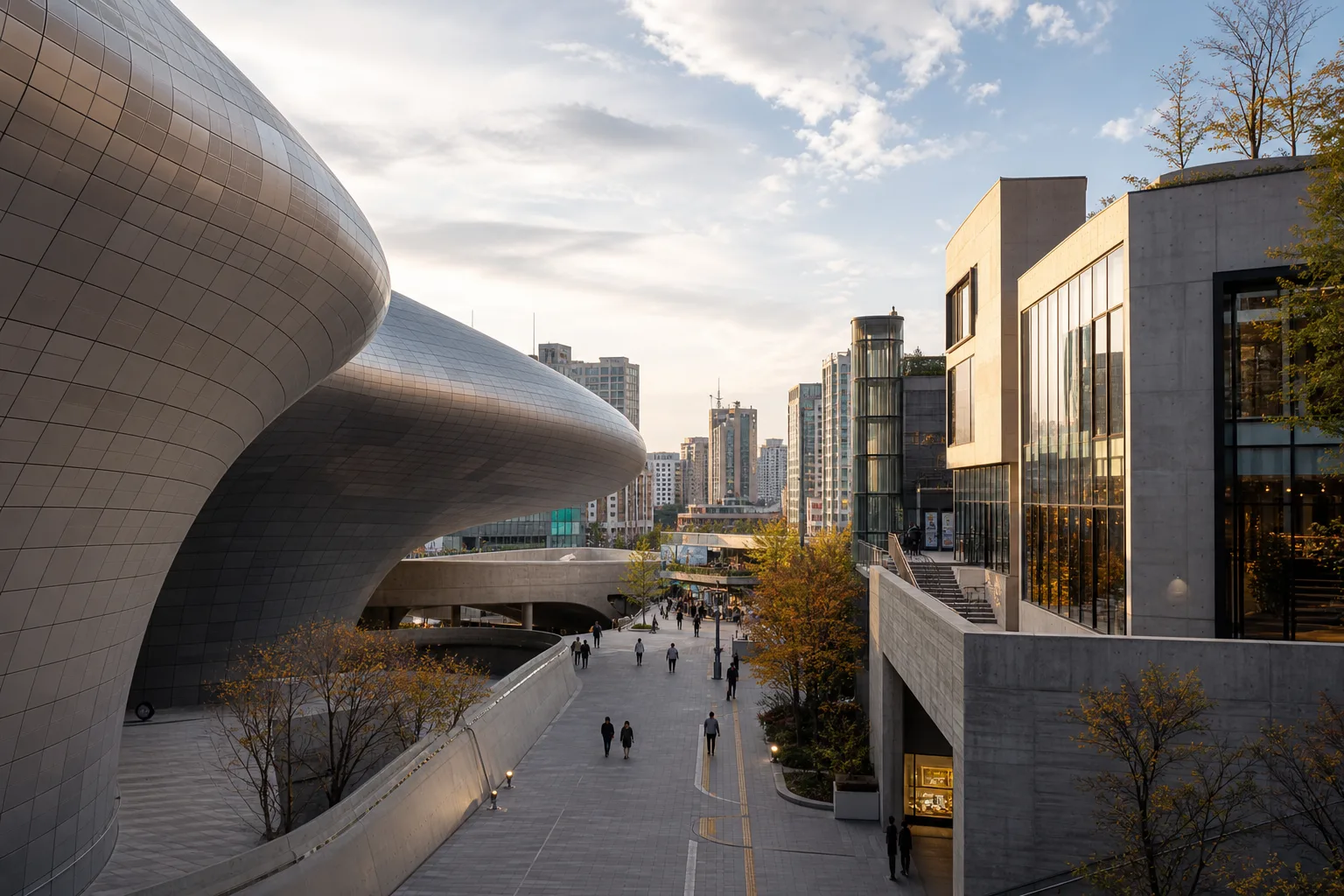
Seoul is one of the easiest cities in Asia for architecture travelers to enjoy without turning the trip into a specialist tour. You can stand in front of Zaha Hadid's most famous Seoul landmark, then cross to a civic exhibition hall, a restored modern house, and a neighborhood café that feels like a small studio project. The city rewards people who keep looking up, slowing down, and noticing how new buildings sit beside older layers.
Why Seoul Works So Well for Architecture Spotting
Seoul is a good architecture city because it is never visually settled. The skyline keeps changing, but it does not change in a smooth, internationalized way. Instead, it is layered. A palace wall can sit near a glass tower. A quiet courtyard can sit behind a busy retail street. A major public building can become a destination on its own, while a small studio café or gallery can be just as memorable because it reveals how local designers work with light, material, and circulation.
For first-time visitors, the key is not to treat architecture as something separate from travel. In Seoul, architecture often determines how a neighborhood feels, how a route unfolds, and how long you want to stay in a place. A design-focused day can begin with a large civic icon, continue through a museum or public exhibition hall, and end in a low-key district where independent studios, renovated houses, and carefully built interiors show what contemporary Korean design looks like at human scale.
That is why the city is especially good for travelers who like a mix of landmark sightseeing and slow wandering. If you are already building a larger trip around food, museums, and neighborhood walks, pair this guide with The Ultimate 10-Day South Korea Itinerary for First-Timers. If you want a museum-heavy day as part of your route, Best Art Museums and Galleries in Seoul and Beyond: A Complete Guide is the better companion. And if your travel style leans toward stylish interiors and photo-friendly stops, 10 Most Instagrammable Cafes in Seoul (2026 Edition) fits naturally into the same circuit.
What to look for
Architecture spotting in Seoul is most rewarding when you pay attention to three things: scale, material, and public use. Scale tells you whether a project is meant to dominate a district or quietly support it. Material tells you whether the building is trying to look futuristic, tactile, civic, or domestic. Public use tells you whether the building is a closed object or a place designed for movement, gathering, and repeat visits.
The strongest Seoul buildings often combine all three. They can be bold without feeling empty. They can be modern without erasing local context. They can be photogenic without becoming purely decorative. That balance is one reason travelers keep returning to the same handful of sites and still find something new.
Zaha Hadid and the Big-Form Seoul
If you want the clearest introduction to Seoul's architecture identity, start with Dongdaemun Design Plaza, or DDP. It is the city's most recognizable design landmark and one of the easiest places to understand why Seoul became such an interesting architecture destination in the first place. The building is dramatic from every angle: curved, metallic, asymmetrical, and intentionally unlike the grid-based buildings that surround it. It is the kind of project that makes people stop mid-walk even if they were not planning to think about architecture that day.
DDP matters because it represents a particular moment in Seoul's urban story. The city was not trying to freeze itself in nostalgia. It was trying to make design itself part of everyday civic life. That is why DDP works as more than a photo stop. It hosts exhibitions, programs, and public circulation spaces that make the building feel active rather than ceremonial.
From an architecture-spotting perspective, DDP is also useful because it teaches you how to read contrast. The plaza is large, but the building's curves keep your eye moving. The skin is futuristic, but the site is embedded in a district with dense commercial history. The result is a place where old and new do not cancel each other out. They sharpen each other.
Why DDP still matters in 2026
DDP remains one of the most practical architecture stops for travelers because it is both iconic and operationally useful. You can go for the exterior, but you can also spend real time inside the complex. As of 2026, the official DDP architecture tour runs Tuesday to Sunday with three daily start times: 10:30 in Korean, 13:30 in English, and 15:30 in Korean. The tour is free, runs for about 60 minutes, and is closed on Mondays and major holidays. That makes it an unusually low-friction way to learn how the building was conceived and how the wider Dongdaemun area fits into Seoul's design history.
The best thing about the tour is not that it gives you a lecture. It gives you a framework. If you take the tour early in your trip, you will start seeing the city differently. You will notice how public buildings create movement, how underpasses and stairways affect pedestrian flow, and how design in Seoul often has to negotiate dense urban pressure rather than isolated open land.
How to photograph it
DDP is easy to photograph badly and hard to photograph well. The mistake many visitors make is standing too close and trying to capture the whole shape at once. That usually produces a flat image with too much distortion and too little context. A better strategy is to back away, use the curves as framing devices, and include human scale in the scene. If people are moving through the plaza, let them stay in the frame. The building is more interesting when it looks lived in.
Early morning and blue hour are the best times if you want softer reflections. Midday can still work if you focus on lines, shadow, and the contrast between polished surfaces and open public space. At night, DDP becomes a very different object. It reads less like a sculpture and more like an illuminated urban event. If your schedule allows, it is worth seeing the same building twice.
Local Studios and Seoul's Smaller-Scale Design Culture
The real surprise in Seoul is not only the famous icons. It is the smaller, neighborhood-scale design work that sits underneath them. This is where the city becomes more interesting for repeat visitors. Once you have seen the headline buildings, start paying attention to renovated houses, public galleries, café interiors, low-rise creative offices, and the kind of streets where local studios quietly shape the city without demanding attention.
In Seoul, local studio work often shows up in places where old and new meet without much ceremony. A compact building might use a traditional courtyard logic but a very contemporary material palette. A gallery might preserve a modest footprint while solving circulation with clean, almost invisible moves. A café might feel memorable not because it is extravagant, but because it uses a small plan so well that every table, threshold, and window feels deliberate.
That is why architecture travelers should not limit themselves to the major institutions. The city's design culture is distributed. It appears in streets, interiors, adaptive reuse projects, and civic spaces that are not always marketed as architecture attractions. You have to bring your attention with you.
Where this is easiest to see
If you want a manageable route, start in districts where public design and local creative work overlap. Euljiro, Seongsu, parts of Jongno, and the area around city-run museums are all useful starting points. You do not need a checklist of famous buildings to enjoy them. What matters is the density of encounters. One building leads to another. A café leads to a gallery. A gallery leads to a block with a beautifully handled facade or a reused industrial shell.
The advantage of this kind of architecture spotting is that it feels less like ticking off landmarks and more like reading the city in real time. You can understand how local designers respond to narrow lots, high foot traffic, mixed-use buildings, and the need to make public-facing spaces visually appealing without losing functionality.
What local studios tend to do well
Local studios in Seoul often excel at compression and clarity. They know how to do a lot with relatively little space. They are also good at making transitions feel deliberate. That might mean a subtle change in ceiling height, a carefully framed view, a material shift between the street and the interior, or a threshold that tells you when you are leaving the public zone and entering a quieter one.
Another common strength is restraint. Some of the most effective Seoul spaces do not try to be iconic at all. They are simply well ordered. They make good use of daylight. They create intuitive movement. They balance concrete, wood, metal, and glass without overexplaining the concept. For travelers, that restraint can be more memorable than spectacle because it feels usable rather than merely impressive.
Practical Guide: What to Visit and How to Plan It
The most efficient architecture day in Seoul usually combines one major icon, one civic exhibition space, and one smaller-scale neighborhood stop. That pattern gives you enough variety to see how the city works at different scales without spending the day in transit.
1. Dongdaemun Design Plaza
DDP should be your anchor stop if you want to start with the city's most famous contemporary landmark. It is especially useful for travelers who want both an exterior spectacle and a structured way to understand the site. The official architecture tour is free, runs Tuesday through Sunday, and starts at fixed times. Because the English session is at 13:30, it works well as a midday anchor between a morning café stop and an afternoon neighborhood walk.
If you are planning around the tour, arrive early enough to give yourself time to walk the perimeter, take exterior photos, and find your way to the meeting point without rushing. Since the tour is free, it is also one of the best-value architecture experiences in the city. The biggest mistake is treating it like a quick photo stop and leaving too soon.
2. Seoul Hall of Urbanism & Architecture
The Seoul Hall of Urbanism & Architecture is one of the best follow-up stops if you want something more civic and less monumental. It is free to enter, open Tuesday to Sunday from 10:00 to 18:00, and the last entry is at 17:30. It is closed on Mondays and New Year's Day. This makes it easy to place in the same itinerary as City Hall, Gwanghwamun, or a walk through the Sejong-daero area.
What makes this stop valuable is the way it connects architecture to city-making. The exhibitions are not just about form. They are about how Seoul is built, governed, preserved, and imagined. That helps travelers move beyond the idea that architecture is only about pretty facades. It is also about policy, infrastructure, and public space.
3. Kim Joong-up House of Architectural Culture
If you want a smaller, more intimate stop, the Kim Joong-up House of Architectural Culture is a useful example of how Korean architecture can blend domestic scale with careful design thinking. It is open daily from 10:00 to 17:00, closed on Sundays and Mondays, and does not allow entry during the lunch break from 12:00 to 13:00. The site is outside the city-center landmarks, so it works best if you are already planning a broader northern Seoul day.
This is the kind of stop that rewards slower visitors. Rather than giving you a giant signature silhouette, it gives you a closer read of how a house can become an architectural object. It is especially useful if you want to understand Korean modernism and the more personal side of design culture.
A realistic one-day architecture route
If you only have one day, keep it simple. Start at DDP in late morning or early afternoon. Take the architecture tour if the timing works. Move to lunch nearby. Then head to the Seoul Hall of Urbanism & Architecture for the civic and urban planning side of the story. If you still have energy, finish with a neighborhood walk where you can look for small studios, renovated storefronts, and well-designed cafés.
If you have two days, use the second day for a more relaxed route that includes a house museum or a district with a higher concentration of independent design spaces. That way you will not exhaust yourself trying to turn Seoul into a checklist. Architecture in this city is more rewarding when it feels like part of the trip rather than the entire trip.
How to get around
The subway is the easiest way to stitch architecture stops together. Seoul's transit system makes it possible to move between major districts without relying on taxis for every leg. For architecture spotting, that matters because the space between landmarks is often where the city becomes legible. A five- or ten-minute walk can expose an entire shift in density, age, and street life.
Build in buffer time for walking. Many of the best details in Seoul are not visible from inside a station or through a car window. They appear in stairwells, side streets, rear entrances, corner façades, underpasses, and the edges of major blocks.
How to Read Buildings Like a Local Design Visitor
The best architecture travelers do not just identify famous names. They ask what problem the building was trying to solve. In Seoul, that question is especially useful because the city often forces architecture to negotiate difficult conditions: tight sites, intense pedestrian use, multiple layers of history, and a strong demand for public accessibility.
Look at the threshold first
Before you study the whole facade, look at the entrance. Seoul buildings often reveal their logic at the threshold. Is the entry recessed or direct? Does it create a pause, or does it pull you straight in? Is the ground floor open and civic, or does it feel like a sealed object? These choices tell you a lot about how the building thinks about public life.
Look at daylight and shadow
Many of the most memorable Seoul spaces use daylight carefully. That might mean deep shade in a courtyard, narrow shafts of light in a gallery, or a bright interior that is softened by material texture. When you notice how light is handled, you begin to understand why some spaces feel calm while others feel restless.
Look at how people move
Architecture is easiest to judge when you watch people use it. In public buildings, do visitors linger, cut across, or move through quickly? In a café, do people cluster near the window or spread out in the back? In a gallery, does the circulation feel obvious or slightly exploratory? Good design usually makes movement feel intuitive, even when the plan is compact.
Look at what is preserved
Seoul is full of buildings that make a decision about the past. Some preserve facades. Some preserve fragments. Some keep the overall mass but change the interior. Others do the opposite. That variation is one of the city's great strengths. It means you can see not just new architecture, but different attitudes toward memory.
Tips and Common Mistakes
Travelers who are new to Seoul's design scene usually make the same mistake: they expect all the interesting architecture to be concentrated in a single museum district. That is not how the city works. Seoul is better understood as a network of nodes. A major landmark anchors one node, but the meaningful experience often comes from the walk between nodes.
Common mistakes to avoid
Do not overschedule the day. Architecture spotting looks simple on paper, but the best experiences come from pauses, detours, and time spent standing still. If you try to stack too many stops, everything starts to feel interchangeable.
Do not ignore neighborhood context. A building in Seoul is rarely just an object. It is part of a street, a block, a district, and often a much broader social change. If you only look at the building itself, you miss the point.
Do not assume the boldest building is the best one. Some of the city's smartest design work is modest, adaptive, or interior-focused. A quiet renovation can tell you more about Seoul than a flashy facade.
Do not forget to check operating rules before you go. Free admission does not mean always open. The official pages for DDP, the Seoul Hall of Urbanism & Architecture, and the Kim Joong-up House all list regular closures and specific entry windows. Those details matter because architecture days often fail for boring reasons like missed lunch breaks or Monday closures.
Tips that help
Start early if you want clean exterior photos and quieter interiors.
Use one landmark as the anchor and let the rest of the day grow around it.
Leave room for a café stop, because Seoul's café culture is one of the easiest ways to see local design thinking in action.
If you like drawing or photography, carry a small notebook. Sketching a facade, an entrance sequence, or a stair detail helps you notice relationships that a quick photo might flatten.
If you are traveling with non-architecture companions, pick places that are visually rewarding even for casual visitors. DDP and the Seoul Hall of Urbanism & Architecture both work well because they are interesting without requiring specialist knowledge.
FAQ
Is Seoul good for architecture beginners?
Yes. Seoul works well for beginners because many of the city's most interesting architecture sites are public, accessible, and visually legible. You do not need a degree in architecture history to enjoy them. Start with DDP, then move to a civic exhibition space like the Seoul Hall of Urbanism & Architecture. That gives you a strong foundation without overwhelming detail.
How much time should I set aside for an architecture day?
Half a day is enough for one major landmark and one smaller follow-up stop. A full day is better if you want to include walking time, coffee, lunch, and some neighborhood exploration. If you are serious about architecture spotting, give yourself at least two separate days so you can compare icon buildings with more intimate, local-scale spaces.
Do I need to book anything in advance?
For the free DDP architecture tour, booking is a good idea because the tour uses fixed time slots. The official Seoul travel pages also describe the Seoul city walking-tour system as reservation-based in many cases. For independent museum or house visits, check the current official page before you go, because schedules can change around holidays and special events.
What is the best area for spotting contemporary design?
There is no single best area, but DDP and the surrounding Dongdaemun district are the strongest starting point for contemporary landmark architecture. For smaller-scale local design, neighborhoods with a mix of creative offices, cafés, galleries, and renovated buildings are more useful. Seoul rewards mixed itineraries rather than one-neighborhood concentration.
Can I make this a food-and-design day?
Absolutely. That is one of the easiest ways to enjoy the city. Start with an architecture site in the morning, take a lunch break in a district with good cafés or design-forward restaurants, and then continue with an exhibition hall or a smaller neighborhood walk. Seoul is especially good at turning a practical lunch stop into part of the design experience.
Conclusion
Seoul is one of those cities where architecture travel becomes more rewarding the less rigidly you approach it. The iconic works matter, especially DDP and the other civic spaces that anchor the city’s design identity. But the local studios, renovated houses, public exhibition halls, and neighborhood interiors are what make the experience feel complete.
If you want a quick summary, the formula is simple: start with a major landmark, add one civic or educational stop, then leave space for local-scale design in the neighborhoods around it. That approach gives you both the spectacle and the texture. It also helps you understand why Seoul is not just a city with interesting buildings. It is a city where design is part of how urban life is organized.
For most travelers, that is the real payoff. You do not just see architecture. You use it to move through the city more intelligently. And once you start doing that, Seoul begins to feel less like a place you are visiting and more like a place you are reading.