China vs Southeast Asia Budget Travel: Real Cost Comparison

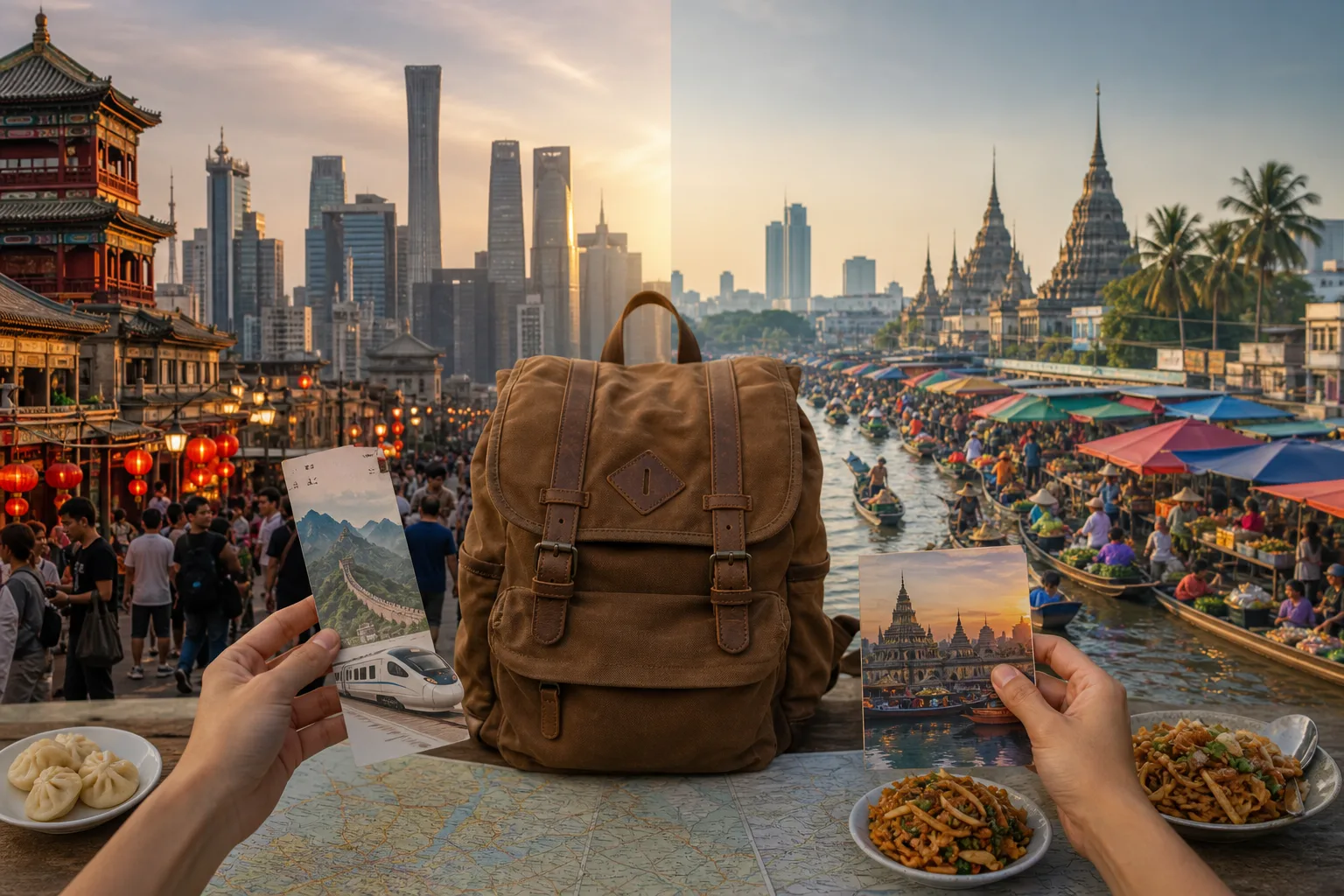
If you are trying to decide between China and Southeast Asia for a budget trip, the real question is not which region is cheaper in theory. It is which mix of cities, transport, and trip style gives you the lowest total cost without making the trip feel exhausting. This guide breaks the comparison down by the spending categories that actually matter: beds, meals, local transport, intercity travel, entry friction, and everyday convenience.
The short answer
For most budget travelers, China is cheaper than Southeast Asia in long-distance transport and often similar in midrange hotels, but Southeast Asia still wins on ultra-cheap street food and short-hop flights. The cheapest trip depends on whether you move by rail or by air.
Here is the simplest way to think about it. China rewards travelers who like structure, fast trains, and city-to-city trips that can be planned precisely. Southeast Asia rewards travelers who want flexible routing, cheap hostel beds, and easy cross-border hopping. If you are optimizing for the lowest daily spend, you can make either region cheap. If you are optimizing for the least planning friction, China and Southeast Asia fail in different ways.
The biggest mistake is comparing an expensive city in one region with a cheap city in the other and calling that a regional verdict. Shanghai is not the same as Guilin. Bangkok is not the same as Singapore. Shenzhen is not the same as Chiang Mai. Real budget travel is a route problem, not a country label problem.
Quick comparison by category
| Category | China | Southeast Asia | What it usually means for a budget trip |
|---|---|---|---|
| Hostel bed | Moderate | Very low to moderate | SEA often has the absolute cheapest beds |
| Budget hotel | Moderate | Moderate | China can be surprisingly competitive outside top-tier cores |
| Street food | Low to moderate | Very low | SEA usually wins on the cheapest meal possible |
| Local transport | Low | Low | China is often more predictable and faster in big cities |
| Intercity transport | Often lower on rail | Often lower on bus or budget flight | China wins when rail replaces domestic flying |
| Visa and entry friction | Higher for many passports | Often lower, but varies by country | China can add cost and planning time |
| Booking convenience | More app-dependent | More mixed, but often easier for casual routing | China rewards prep; SEA rewards improvisation |
The takeaway is not that one region is universally better. China is often the better value once you add up time saved on rail and the lower cost of moving between major cities. Southeast Asia is often the better value for the bare-minimum backpacker who wants the absolute cheapest bed and meal in the widest range of countries.
What China really costs
China has a reputation for being expensive because first-time visitors often land in Beijing, Shanghai, or Shenzhen, then spend money like they are in a premium business trip. That is not a fair test. A budget trip in China is usually built around local food, metro systems, and high-speed rail, not taxis and international hotels.
If you travel in a practical way, China can be very cost-efficient. The rail network is mature, the cities are large enough to support cheap daily food, and local transit is usually inexpensive once you understand the system. The budget challenge is not raw prices. The budget challenge is navigation: tickets, apps, language, and payment setup.
Accommodation in China
Budget accommodation in China is usually more affordable than many first-time travelers expect, especially outside the very top-tier business districts. Hostels, guesthouses, and simple business hotels can all fit a moderate backpacker budget. In a major city, a clean dorm bed or basic private room often costs more than the cheapest options in parts of mainland Southeast Asia, but less than what many people assume for a giant country with major urban centers.
In practical terms:
- Dorm beds can be cheap in second-tier cities and still reasonable in major hubs.
- Simple private rooms are often the sweet spot for couples or travelers with heavy luggage.
- Business hotels can be a better value than they look if you want a private bathroom and a predictable room standard.
The important point is that China’s budget accommodation market rewards advance planning. If you wait until the last minute in a central district on a holiday weekend, you can lose the value advantage quickly.
Food in China
Food is one of China’s strongest budget advantages. Local meals can be extremely good value, and you do not need to chase tourist-only street stalls to eat well. Noodles, rice dishes, dumplings, buns, skewers, hot pot lunch sets, and casual regional specialties can all be affordable if you eat where locals eat.
The real cost pattern looks like this:
- Cheap breakfast or snack: very low
- Simple lunch from a local place: low
- Casual sit-down dinner: still manageable
- Tourist-heavy restaurant in a famous district: much more expensive
That means China can be cheap if your food habits are simple and local. It gets expensive only when you turn every meal into a search for the "best" or most famous place. Budget travelers should think in terms of repeatable, reliable meals rather than daily food hunts.
Local transport in China
Local transport in China is one of the quiet wins of the trip. Metro systems in major cities are efficient, usually inexpensive, and built for volume. Buses are cheap, taxis are not outrageous for short hops, and ride-hailing can be convenient once your payment methods are set up.
This matters because transport mistakes are one of the fastest ways to blow a budget. If you rely on repeated airport taxis, private car hires, or long rides across the city at peak times, the trip starts to feel expensive fast. If you use metro lines, walkable neighborhoods, and rail-linked hotels, the day-to-day cost drops quickly.
Intercity travel in China
China is where budget travel becomes a logistics story. The country’s high-speed rail system is a genuine value advantage because it can replace domestic flights on many routes without turning the trip into an endurance test. As of 2026, the official 12306 booking system remains the core rail platform, and it has an English interface for foreign travelers.
That matters for cost in two ways:
- You often save money compared with flying once baggage, airport transfers, and booking timing are considered.
- You save time, which is not a cash expense but still changes the value of the whole trip.
For a budget traveler, rail is not just a transport choice. It is a routing strategy. If your China itinerary is built around cities with strong HSR connections, the country can feel much cheaper than Southeast Asia because you are paying less for movement and wasting less time in transit.
Entry friction and hidden costs in China
China’s budget story is affected by entry friction. Depending on your passport and routing, visa requirements can add both direct fees and indirect costs such as extra paperwork, longer planning, and the possibility of resubmitting documents. China also offers visa-free transit options for eligible travelers through designated ports, which can reduce friction for certain short itineraries.
That does not make China hard to visit, but it does mean the budget equation is broader than hostel-plus-noodle math. A cheaper daily spend can be offset by visa costs, eSIM setup, app preparation, or extra transfer steps if your itinerary is not designed properly.
What Southeast Asia really costs
Southeast Asia is the default budget benchmark for a reason. In many parts of the region, the cheapest bed, cheapest meal, and easiest cross-border trip are all immediately available without much planning. That is why budget travelers often think of Southeast Asia as the obvious winner.
But the region is not one price. Thailand, Vietnam, Cambodia, Laos, Indonesia, the Philippines, and Malaysia all price travel differently. Add Singapore to the comparison and the story changes again. A fair comparison therefore needs to separate the ultra-cheap backpacker core from the more polished, tourist-heavy nodes.
Accommodation in Southeast Asia
Hostels are usually where Southeast Asia shines. Dorm beds can be very low cost, especially in backpacker cities and secondary towns. Private rooms are also easy to find, and the range is wide enough that you can trade location for price almost anywhere.
The region’s advantage is not only cost. It is access. In many places, budget rooms are built around walk-in tourism and short stays. You can often book a room with less friction, fewer payment requirements, and less pressure to master a local super-app ecosystem.
That flexibility matters for travelers who prefer to move spontaneously. If you do not want to lock in a detailed itinerary weeks in advance, Southeast Asia makes that style cheaper and easier.
Food in Southeast Asia
Street food is one of the region’s most famous budget advantages, and in many cities it deserves the reputation. A solid meal can be very cheap, especially if you are happy with rice, noodles, soups, grilled items, or local snacks rather than imported ingredients and sit-down Western menus.
Still, there is a subtle point many travelers miss. Southeast Asia can be cheap if you eat like a local, but tourist neighborhoods and beach zones can push prices up quickly. In some places, breakfast and lunch remain cheap while dinner near the waterfront or in a nightlife district becomes noticeably more expensive.
This is why Southeast Asia feels cheap in memory but not always on a daily spreadsheet. A few cheap meals can hide a couple of expensive nights in the wrong neighborhood.
Local transport in Southeast Asia
Local transport is usually affordable across the region, but the real pattern is uneven. Big cities with good metro systems are cheap and manageable. Smaller cities may require tuk-tuks, ride-hailing, scooters, or informal vans. Those options are often still inexpensive, but they create variability.
For the budget traveler, the practical question is not whether transport is cheap. It is whether transport is predictable. Southeast Asia often wins on low headline prices, but China often wins on system reliability once you are inside the city network.
Intercity travel in Southeast Asia
This is where Southeast Asia can be cheaper or more expensive depending on the route. Long-distance buses are usually the lowest-cost option. Budget flights are common and can be very competitive when you book early. Ferries, sleeper buses, and cross-border vans are part of the routing mix.
The catch is that low sticker prices do not always equal low real cost. A cheap flight can still require airport transfers, checked bag fees, and time lost to fragmented schedules. A cheap bus can save cash but cost you a night of sleep. A ferry can be scenic but slower than it looks on paper.
Compared with China, Southeast Asia often has a lower entry price for movement but a less efficient movement system once the itinerary gets ambitious. If your trip includes several long hops, the "cheap" region can quietly become the pricier one because you keep paying in days, energy, or convenience.
Visa and planning friction in Southeast Asia
Most travelers find Southeast Asia easier to assemble. That does not mean visa-free access is universal, because policies vary by passport and country, but the region often has simpler short-trip routing than China. For a budget traveler, that reduces hidden cost in two ways:
- Less time spent on pre-trip paperwork
- Less need to build the itinerary around a single entry rule
This is one of Southeast Asia’s main advantages over China. Even if the daily spend is not always lower, the trip can be simpler to launch.
Where China is cheaper, and where Southeast Asia is cheaper
The best way to compare the two regions is by category, not by stereotype.
China is often cheaper when:
- You travel between multiple big cities by high-speed rail instead of flying.
- You eat mostly local food and skip imported or tourist-heavy restaurants.
- You book a practical hotel near a metro line rather than a prime entertainment district.
- You stay long enough to use your setup efficiently, rather than losing money to one-off transport mistakes.
Southeast Asia is often cheaper when:
- You want the lowest possible bed price and are happy in dorms.
- You prioritize street food and simple neighborhood dining.
- Your route is short, loose, and built around one or two cities.
- You want to move across borders with minimal itinerary complexity.
The real deciding factor: trip style
China and Southeast Asia reward different kinds of budget discipline.
China rewards:
- Structure
- Advance booking
- Rail-first routes
- A willingness to use local payment and transport systems
Southeast Asia rewards:
- Flexibility
- Last-minute changes
- Cross-border improvisation
- Backpacker-friendly booking patterns
That is why a traveler who is good at planning can make China feel surprisingly affordable, while a traveler who values spontaneity can make Southeast Asia feel dramatically cheaper than China.
Sample trip comparison
Think about a 7-day city trip with one or two intercity moves.
In China, you might spend more up front on preparation, then save on rail, efficient city transport, and stable midrange accommodation. Your budget is protected if your route is rail-heavy and your sightseeing stays near transit.
In Southeast Asia, you might save more on the cheapest bed and the cheapest meal, but lose some of that edge if you take multiple flights, long van transfers, or route changes that leave you stranded in a tourist zone.
Now imagine a 14-day trip.
China’s advantage tends to grow if the route is well designed. The longer you stay, the more the rail network and repeatable city routines help you reduce friction. Southeast Asia can remain cheaper on a pure day-rate basis, especially if you stay in lower-cost countries, but the savings depend more on discipline around transportation and tourist-area markups.
Practical Guide
How to get the lowest real cost in China
The cheapest China trip is not the one with the cheapest hotel. It is the one with the least waste.
Use this checklist:
- Pick cities that are linked by rail rather than by short flights.
- Stay near a metro station instead of paying for daily taxis.
- Eat in neighborhoods where people actually live and work.
- Book trains through the official 12306 platform so you are not paying extra platform markups.
- Keep your route compact enough that you do not lose money to too many transfers.
If you want a deeper China-specific budget playbook, read How to Travel China on a Budget: Cheap Transport, Food & Stays and China Travel Planning: Visa, WeChat Pay, High-Speed Rail & Practical Guide.
How to get the lowest real cost in Southeast Asia
The cheapest Southeast Asia trip is usually the one where you keep the route simple and avoid prestige tourism zones.
Use this checklist:
- Pick a country or two instead of trying to "do the whole region" on one budget.
- Use hostels or basic guesthouses in neighborhoods with easy transport.
- Eat local food consistently rather than alternating cheap meals and expensive tourist dinners.
- Compare bus, ferry, and flight prices against the time cost, not just the ticket price.
- Avoid booking every night in the same famous district if you are price-sensitive.
The biggest budget trap in Southeast Asia is assuming the sticker price is the full price. A cheap fare can still cost more once you add airport transfers, baggage, late-night arrivals, or a forced meal in a transit zone.
Budget assumptions that make the comparison fair
If you compare China and Southeast Asia honestly, use the same assumptions in both places:
- Similar trip length
- Similar room type
- Similar comfort level
- Similar number of city moves
- Similar appetite for paid attractions
Once you do that, the comparison becomes clearer. China is often not the expensive outlier people imagine, especially if the itinerary is rail-based. Southeast Asia is often not as cheap as the lowest hostel price suggests, especially if the route is scattered across multiple countries.
Booking and payment
China generally asks more of the traveler up front. The reward is a smoother trip once the system is set up. Rail booking is centralized, and the official 12306 platform is the right place to start for trains. That does not eliminate all friction, but it does reduce the risk of buying from random intermediaries when the official route is available.
Southeast Asia often lets you book more casually, but that casual style can hide poor-value routing. If you are not careful, you can spend less time planning and more money moving.
For budget travelers, the best rule is simple: book the expensive decisions first. That means rail corridors in China and long intercity segments in Southeast Asia. Once those are set, the rest of the trip becomes much easier to control.
Tips & Common Mistakes
Mistake 1: Comparing capital cities only
A lot of travelers compare Beijing to Bangkok and call it a regional verdict. That is too shallow. Capital-city comparisons are distorted by business demand, tourist demand, and premium hotel supply. A fair comparison should include secondary cities and actual transit patterns.
Mistake 2: Ignoring transport architecture
China’s transport system and Southeast Asia’s transport system are not built the same way. China is rail-centric in a way that can lower total spend when the itinerary is designed properly. Southeast Asia is more fragmented, which can be cheaper on a route-by-route basis but less efficient for long circuit trips.
Mistake 3: Treating visa friction as separate from cost
Visa costs, entry rules, and pre-trip time are part of the budget. If one destination is cheaper every day but harder to enter or more demanding to prepare for, the real cost is not as low as the daily rate suggests.
Mistake 4: Using tourist neighborhoods as the baseline
In both regions, tourist districts distort budget travel. The city center around a famous attraction is rarely the cheapest place to sleep or eat. The best value usually sits one or two transit stops away.
Mistake 5: Failing to define your comfort floor
Some travelers want the lowest possible spend. Others want a private room, easy transit, and one "nice" meal a day. Those are different budgets. China often becomes a stronger value once you ask for comfort, while Southeast Asia often wins at the absolute low end. Know which game you are playing before you compare prices.
Tips that consistently save money
- Stay near transit, not near the most famous street.
- Move by rail in China whenever the route makes sense.
- Use buses and budget flights in Southeast Asia only when the time tradeoff is worth it.
- Eat in ordinary neighborhoods.
- Build one or two slower days into the trip so you do not pay for panic transport.
FAQ
Is China cheaper than Southeast Asia for budget travelers?
Sometimes yes, sometimes no. China is often cheaper for intercity travel and can be very competitive on food and practical hotels. Southeast Asia is often cheaper at the absolute lowest end, especially for hostel beds and simple meals. The cheaper region depends on your route and comfort level.
Is Southeast Asia always the cheapest region in Asia?
No. It is often the cheapest for backpacker-style travel, but not always for efficient city-to-city travel. If a trip includes several flights or tourist-zone markups, Southeast Asia can stop being the budget winner very quickly.
Why do some travelers say China feels expensive?
Because they compare premium neighborhoods, take taxis everywhere, and plan as if China were a casual walk-in destination. China can feel expensive when the trip is poorly routed. It can feel very affordable when it is rail-based, local-food focused, and booked with some care.
What is the biggest hidden cost in China?
Usually planning friction rather than daily spending. Visa handling, payment setup, app learning, and route design can create hidden cost if you do not prepare before arrival.
What is the biggest hidden cost in Southeast Asia?
Transport leakage. A cheap room or meal can be offset by long airport transfers, multiple border crossings, baggage fees, or repeated trips through tourist districts that charge more than local neighborhoods.
Which region is better for a first-time budget traveler?
If you want the easiest low-friction trip, Southeast Asia is usually simpler. If you want the better long-distance transport system and are willing to plan more carefully, China can deliver stronger value.
Conclusion
China and Southeast Asia are both budget-friendly, but they are cheap in different ways. China is strongest when you build the trip around rail, local food, and efficient city routines. Southeast Asia is strongest when you want the lowest-cost bed, cheap casual meals, and flexible movement across nearby destinations.
If you only look at headline prices, Southeast Asia often appears to win. If you look at the whole trip, China can close the gap or even win once you factor in transport efficiency, route simplicity, and the cost of wasted time. The smart move is to choose the region that matches your travel style, then design the route to avoid the usual budget traps.
If you are still deciding, use this rule of thumb: choose Southeast Asia for maximum spontaneity and minimum starting cost, choose China for better rail value and a more structured trip, and choose neither until you have mapped the route. Budget travel is won in the itinerary, not at checkout.