Buyeo: Ancient Baekje Kingdom Capital with Almost No Tourist Crowds
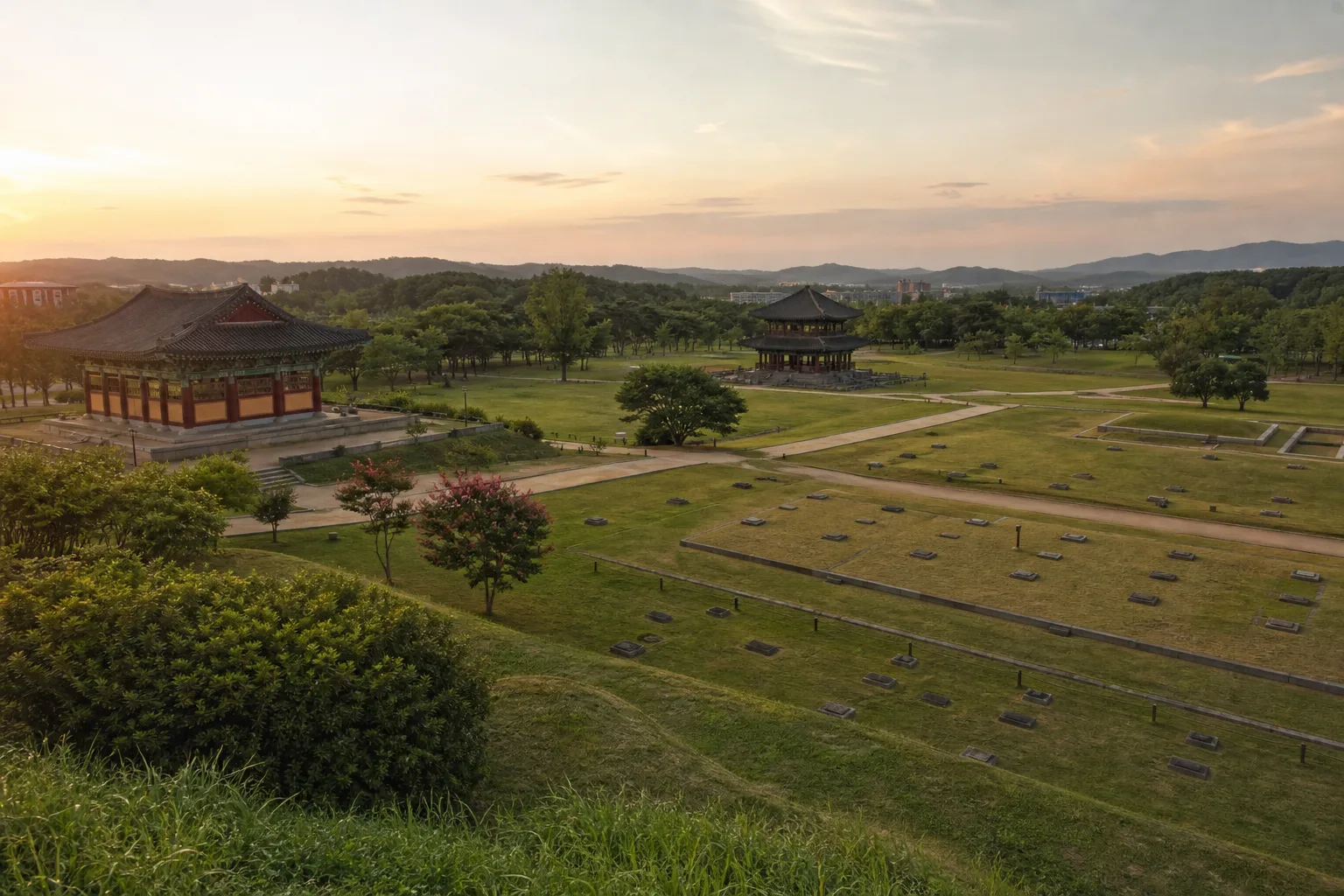
If you want ancient Korean history without the shoulder-to-shoulder pacing of the big-name cities, Buyeo is one of the smartest detours you can make. The former Baekje capital feels calm, spacious, and unusually easy to enjoy at human speed. It is the kind of place where you can stop, look, and actually absorb the landscape instead of managing a crowd.
That matters because Buyeo is not a theme park pretending to be history. It is a real historical landscape with layered sites, river views, tombs, fortress traces, temple foundations, and a museum that gives the Baekje story structure. If you already like the logic of Hidden Korea: Off-the-Beaten-Path Destinations Worth Visiting, Buyeo fits that same quieter travel style. It rewards curiosity, not rushing.
Introduction
Buyeo is one of the easiest places in South Korea to understand why a former royal capital can still feel alive. The city is compact, the heritage sites are close enough to combine, and the atmosphere stays calm even when the weather is good. You are not fighting for a viewpoint or waiting your turn to stand in front of every stone marker.
For travelers who want history, walking, and low-friction planning, Buyeo is compelling because it compresses a lot of Baekje context into a manageable route. You can see royal, religious, and funerary sites in one trip, then use the museum to connect the dots. The result is a destination that works for history fans, photographers, slow travelers, and anyone trying to build a more varied Korea itinerary than just Seoul-plus-day-trip templates.
For a broader Korea trip that mixes capital cities, heritage stops, and first-time essentials, the route-building logic in The Ultimate 10-Day South Korea Itinerary for First-Timers pairs well with a Buyeo detour. Buyeo is not where you go to “check a box.” It is where you go to slow the whole trip down in a useful way.
What this guide covers
This article is organized to help you decide whether Buyeo belongs in your trip, what to prioritize once you are there, how to handle the practical logistics, and which mistakes most visitors make when they treat Buyeo like a quick stop instead of a destination with its own rhythm.
Why Buyeo Matters
Baekje in context
Buyeo was the last capital of Baekje, one of the Three Kingdoms of Korea. That alone makes it historically important, but the real value of the city is how legible the history still feels on the ground. You are not just looking at a single museum case or a lone surviving structure. You are moving through a network of sites that help explain what Baekje was, how the capital functioned, and why the kingdom mattered to Korean cultural development.
Baekje is often described as the most outward-looking of the three kingdoms, especially in its exchanges with China and Japan. In practice, that means the architecture, Buddhist history, and urban planning ideas associated with Baekje shaped a broader regional story. Buyeo is one of the best places to experience that without needing a specialist background first.
Why it still feels quiet
Buyeo is less crowded than the most famous heritage cities for a few reasons. It is not the first stop for all first-time visitors. It is not built around a single megasight that produces constant tour-bus turnover. And it is not a place where people usually arrive by accident. That combination works in your favor if you prefer room to breathe.
The quiet is also structural. The sites are spread out enough that visitor flow disperses naturally. Even at the busier stops, you are more likely to encounter families, seniors, and history-minded travelers than dense clusters of fast-moving tour groups. This is a destination where the background sound is often wind, birds, footsteps, and the occasional bus engine rather than constant crowd noise.
Who Buyeo is best for
Buyeo works especially well for travelers who:
- Want Korean history beyond the most obvious palaces and museums
- Prefer self-paced sightseeing over packed, photo-driven itineraries
- Like UNESCO-style heritage routes and archaeological landscapes
- Enjoy walking between sites without needing a car at every step
- Want a destination that feels under-visited but still substantial
It is less ideal if you want nightlife, shopping density, or a destination that can be “done” in a single hour. Buyeo is rewarding precisely because it asks for a slower pace.
Ancient Capital Landscape
Busosanseong Fortress and the river landscape
One of the most memorable things about Buyeo is how the fortress landscape and the river reinforce each other. The defensive geography matters here. Buyeo is not just “where some old ruins are located.” It is a capital site shaped by the river, the height of the fortress terrain, and the strategic logic of the Baekje state at the end of its history.
Busosanseong Fortress is the key starting point for understanding that geography. Even if you are not a military-history specialist, the fortress makes the city’s position feel concrete. You can see why the site was chosen, how the topography supports the story, and why the area still feels contemplative rather than urban.
The best approach is not to sprint through every marker. Move slowly, pause at overlooks, and let the site explain itself. Heritage landscapes like this are easy to underread if you are only thinking in terms of “what should I photograph?” Instead, think in terms of orientation: where was the city protected, where did the power sit, and how does the river shape the memory of the capital?
Jeongnimsaji Temple Site and the Buddhist layer
Baekje’s Buddhist heritage is one of the reasons the kingdom continues to matter in East Asian art and religion. In Buyeo, the temple site makes that layer visible in a way that feels restrained rather than reconstructed. You are looking at absence as much as presence, which is actually useful. It tells you that this was once a serious religious center without turning the place into a fantasy set.
If you have seen enough reconstructed heritage spaces to feel skeptical, Jeongnimsaji is a good corrective. It is not trying to overwhelm you with spectacle. It is trying to preserve a sense of scale and memory. That is often more powerful. The site invites you to imagine the relationship between court, temple, and state without having to fill every blank with decoration.
Neungsan-ri tombs and the funerary dimension
The tombs at Neungsan-ri add another essential piece of the Baekje picture. Royal and elite burial sites help explain how a kingdom wanted to be remembered, what it valued, and how it expressed status in death. In Buyeo, the tombs also remind you that historical cities are not only about palaces and temples. They are about the full ecosystem of power.
If you like archaeological sites, this is one of the strongest reasons to include Buyeo. Tomb landscapes are often overlooked because they can seem visually simple at first glance. But that simplicity is misleading. The open space, the mound forms, and the repetition of the site together create one of the clearest impressions of Baekje state culture.
Gungnamji and the atmosphere of the city
Gungnamji is where many visitors feel the pace of Buyeo shift from “historical itinerary” to “pleasant place to spend time.” Even if you are mostly in the city for the fortress and museum circuit, the pond area gives you a softer, more reflective break in the day.
That is useful because not every heritage stop should feel intense. Good travel days need a rhythm. Buyeo works because it gives you exactly that: monument, museum, walk, rest, repeat. Gungnamji helps make the city feel livable rather than only instructive.
Secondary Site Strategy
Start with the museum
If you only have limited time in Buyeo, start with the museum before you visit the outdoor heritage sites. That sequence gives the landscape meaning. Once you have seen artifacts, models, inscriptions, and interpretive material, the fortress and temple sites stop being abstract old stones and start becoming parts of a political and cultural system.
The Buyeo museum experience is especially valuable if you are not already deeply familiar with Baekje history. It compresses the background you need into a manageable form, so the rest of the day becomes easier to interpret. Without the museum, many visitors look at Buyeo as a set of isolated stops. With the museum, the city becomes a connected story.
Why the reconstructed elements still matter
Some travelers are skeptical of reconstructed historical environments, and that skepticism is reasonable. Rebuilds can be overdone. They can also flatten complexity if they are treated as substitutes for archaeology. But in Buyeo, the reconstructed or interpretive spaces are most useful when you treat them as context rather than proof.
Baekje Cultural Land is the clearest example. It is not the same experience as walking through an untouched ruin. It is a curated historical environment built to evoke capital life, architecture, and cultural memory. That means it works best for visitors who want a spatial impression of the kingdom and are comfortable distinguishing between historical reconstruction and original remains.
For some travelers, that makes it a must-visit. For others, it is an optional add-on after the core heritage sites. The right answer depends on how much you value atmosphere versus authenticity. If you want the strongest “what did a Baekje capital feel like?” impression, it can be worthwhile. If you only want the most direct archaeological sites, it may be lower on the priority list.
How Buyeo differs from other heritage cities
Buyeo is often compared to other historic Korean cities, but the comparison should be handled carefully. Its appeal is not based on density or spectacle. It is based on coherence. The sites relate to each other, the city remains modest in scale, and you can still move through the day without the sense that you are on a conveyor belt.
That makes Buyeo especially strong for travelers who are already willing to appreciate landscape and context. If you only want one famous object and then to leave, you may underappreciate it. If you want a place that explains a kingdom through terrain, ruins, and museum interpretation, Buyeo is unusually satisfying.
Practical Guide
Hours, admission, and prices
For 2026 planning, assume that Buyeo’s heritage sites operate on normal museum-and-park logic: some are free, some are ticketed, and some vary by season or special program. The safest strategy is to verify the current hours and admission rules for each stop before you leave your hotel, especially if you are visiting on a Monday, on a holiday, or during a festival period.
The general pattern is simple:
- The national museum is the best place to expect clear, visitor-friendly access
- Outdoor heritage sites are more likely to have seasonal hours or limited staffed facilities
- Larger cultural complexes may charge admission and offer bundled access to multiple spaces
- Special performances, exhibitions, or night openings can change the timetable
If you are planning a one-day visit, do not build the day around a single exact opening time unless you have confirmed it on the official site that morning. That is especially important for Busan- or Seoul-style habits where visitors assume every place has identical scheduling. Buyeo is calmer, but quiet places still change operational details.
When in doubt, plan with margin rather than precision. Aim to arrive early enough that a schedule shift does not break your day. If one site is closed or crowded, Buyeo gives you alternatives nearby, which is another reason the city is easier to handle than a more compressed urban route.
Suggested pacing by time available
If you have half a day
Focus on the museum plus one outdoor site. That combination gives you enough historical grounding to understand Buyeo without rushing through multiple stops. If the weather is good, choose the outdoor site that best matches your interests: fortress geography, temple remains, or the pond area.
If you have a full day
Use the museum in the morning, then move into the core heritage route in the afternoon. This is the most balanced way to experience the city because it gives you a conceptual frame first and a landscape experience second. You will also avoid the common mistake of arriving at ruins without enough context to read them.
If you have an overnight
An overnight is the sweet spot for slower travelers. It lets you visit late in the day when the pace softens, eat without watching the clock, and return the next morning for a second round of walking or photography. Buyeo benefits from this. It is not a city that becomes more meaningful the faster you try to finish it.
How to get there
The simplest public-transport strategy is usually to travel by intercity bus into Buyeo and then use local buses or taxis for the final connections between sites. Because the city is not a major rail hub, many visitors build their route around bus access from a larger city rather than expecting a direct train-to-site flow.
If you are already in the central region of Korea, Buyeo fits well into a wider heritage loop. That can mean combining it with other historical stops in Chungcheong or using it as a quiet midpoint between more urban destinations. If you are driving, the route becomes more flexible, but you do not need a car to make the trip work.
For first-time visitors, the main thing to remember is that “easy to reach” and “easy to navigate once you arrive” are not the same thing. Buyeo is manageable if you plan the site sequence in advance. Decide whether you are prioritizing the museum, the fortress, the temple site, the tombs, or the pond area, and then move in a logical order instead of zigzagging.
Booking and ticket strategy
If a site offers advance booking, use it only when the booking rule clearly improves your day. For most travelers, Buyeo is not a place where you need aggressive reservation behavior. The exception is special performances, package admissions, or busy seasonal periods when bundled tickets or timed entries may save time.
If you are comparing booking channels, check the official site first and then compare with a trusted platform such as Klook or MyRealTrip if you want convenience or a packaged deal. The main question is not which platform is loudest. It is which one gives you the cleanest combination of price, access, and flexibility for the specific site you want to see.
This is especially true for families or mixed-interest groups. If one person wants reconstructed architecture and another only wants original heritage, a bundled ticket might not be the right move. In that case, separate the priorities and buy only what you will actually use.
Tips & Common Mistakes
Do not treat Buyeo as a “quick stop”
The biggest mistake is compressing Buyeo into a brief in-and-out visit with no breathing room. If you do that, you will get the superficial version of the city and miss the reason it is appealing in the first place. Buyeo is strongest when you allow the sites to speak to each other.
Do not skip the museum
Some travelers head straight for the outdoors because they want to “see the real thing.” That instinct is understandable, but in Buyeo it is often backward. The museum turns the outside stops into a coherent story. Without it, you may enjoy the views but miss the kingdom.
Do not assume all heritage sites are equally rewarding
Not every stop will be equally interesting to every traveler. That is normal. The right way to visit Buyeo is to choose your emphasis. If you love archaeology, give the tombs and temple site more time. If you like scenic atmosphere, prioritize the fortress and pond. If you want a broad understanding of Baekje, make the museum central.
Do not arrive hungry and underplanned
Buyeo is relaxed, but that does not mean you should wing the logistics. Lunch timing matters more in smaller destinations because there are fewer backup options if you wander too far from the main circuit. Eat before the deepest sightseeing block, carry water, and know where you are ending the day so you do not waste energy improvising.
Do not confuse quiet with empty
“Almost no tourist crowds” does not mean “nothing is happening.” Quiet sites can still have local visitors, school groups, seasonal programs, and older travelers who move at a different pace. That is part of the charm. Respect the slower rhythm and the place will feel even better.
A practical visitor mindset
The best Buyeo trip comes from the right mindset: less checklist, more sequence. Start with context, move into the landscape, then leave enough time to sit, look, and let the city settle. If you are tempted to maximize volume, resist it. The city is most rewarding when you leave some of it unconsumed.
FAQ
Is Buyeo worth visiting if I have already seen Gyeongju?
Yes, because the experience is different. Gyeongju is larger, more layered in the modern-tourism sense, and easier to treat as a major destination. Buyeo is quieter and more focused. If Gyeongju gives you scale, Buyeo gives you calm and concentration. Many travelers need both at some point.
Can Buyeo work as a day trip?
Yes, but a day trip is better if you keep the itinerary tight. The museum plus one or two outdoor sites is a reasonable target. If you try to see everything in one rushed push, the city starts to feel fragmented. Buyeo is worth more than a drive-by, so build the day to include pauses.
What is the best season to visit?
Spring and autumn are the easiest seasons because walking is more comfortable and the outdoor sites feel pleasant for longer. Summer can be humid, and winter can make open-air sightseeing feel stark. That said, Buyeo’s quieter character means there is usually still room to enjoy it in any season if you dress appropriately and keep your pace realistic.
Is Baekje Cultural Land necessary?
Not necessary, but possibly useful depending on your interests. If you want a more immersive historical environment and do not mind reconstructions, it can add texture to the trip. If you prefer only original ruins and the clearest archaeological stops, you may want to focus on the museum, fortress, temple site, and tombs first.
Do I need a car?
No, but a car makes sequencing easier. Without one, you can still visit Buyeo by bus and use local transport or taxis for site hopping. The tradeoff is simple: a car gives flexibility, but public transport is enough if you plan the route rather than trying to improvise it on arrival.
Conclusion
Buyeo is one of the best arguments for traveling more slowly in Korea. It does not overwhelm you with scale, and it does not try to compete with the busiest heritage destinations by brute force. Instead, it offers a concentrated Baekje experience: fortress, temple, tombs, museum, pond, and a town that still leaves room for quiet.
That is why it works so well for travelers who want depth without stress. You can learn a lot here without needing to race. You can build a meaningful day out of just a few sites. And you can leave with a stronger understanding of Baekje than many visitors get from much larger, more famous itineraries.
If you are planning a broader Korea route, make Buyeo one of the quiet anchors in the middle of the trip rather than a rushed side note. The city is small, but the historical payoff is real. If your trip is still in the planning stage, use a wider South Korea route framework to decide where a slower heritage stop adds the most value.