100-Yen Shops (Daiso, Seria): The Budget Traveler's Secret Weapon

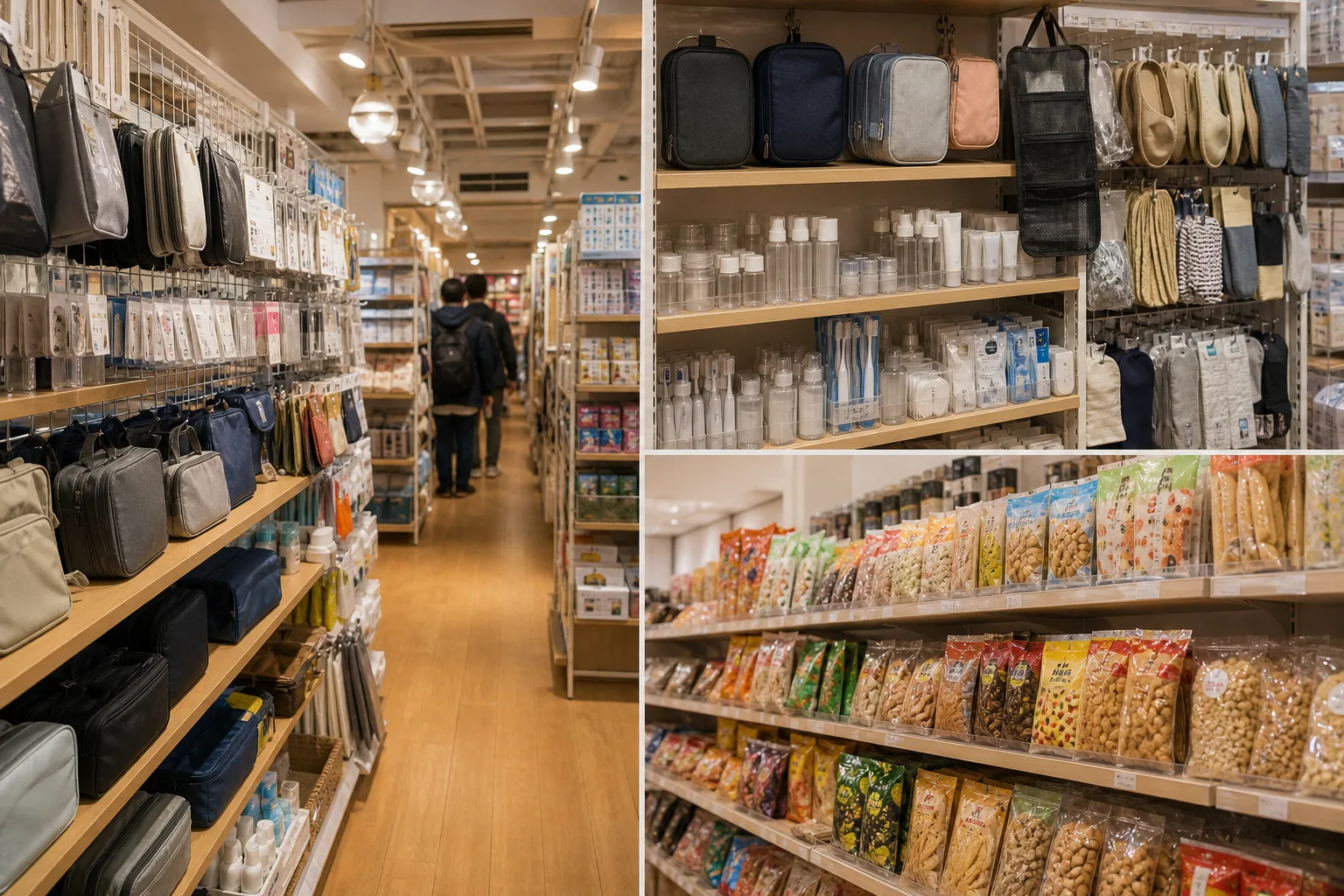
If you are trying to travel Japan cheaply without turning every small problem into a convenience-store tax, 100-yen shops are one of the easiest wins. They solve the ordinary friction points that eat budget and time: forgotten toiletries, broken chargers, last-minute laundry gear, snack containers, rain protection, and small souvenirs that do not feel like junk.
Introduction
The underrated trick is not simply that items are cheap. It is that 100-yen shops reduce decision fatigue. In Japan, where you may move between trains, hotels, luggage lockers, and day trips several times in one day, being able to buy a functional item quickly and predictably matters more than people expect.
For many travelers, Daiso and Seria become the same kind of travel tool as the IC card or the hostel laundry room. You do not need to be a hardcore saver to benefit. You just need to know what these stores are good at, where they differ, what is worth buying, and what should stay on the shelf.
This guide is written for travelers who want practical value, not a shopping haul fantasy. If you are already planning routes, rail passes, and airport transfers, a short stop at a 100-yen shop can lower your trip cost in a way that feels almost invisible but shows up clearly by the end of the week. If you want the broader money-saving framework, start with How to Travel Japan on a Budget: Cheap Eats, Transport & Stays and then use this article as the “micro-optimization” layer.
The same logic applies if you are still sorting out the basic trip mechanics. Once your visa, IC card, rail strategy, and arrival logistics are set, it becomes much easier to use cheap retail strategically instead of impulsively. The planning guide Japan Travel Planning: Visa, IC Card, Rail Pass & Essential Logistics Guide pairs well with this one because the savings from 100-yen shops work best when the bigger trip structure is already under control.
Why 100-Yen Shops Matter for Budget Travel
100-yen shops sit in a useful middle zone between convenience stores and full supermarkets. Convenience stores are fast but expensive. Supermarkets are cheaper but not always near your hotel, station, or sightseeing route. 100-yen shops give you a reliable price floor for many small, useful purchases without requiring a detour across town.
The real value is not the sticker price
The first mistake travelers make is assuming the appeal is only “cheap stuff.” In reality, the big advantage is predictability. You can buy a laundry bag, travel pouch, umbrella, phone cable, snack container, or desk organizer and know the price before you walk to the register. That sounds trivial, but on a multi-city trip it removes a lot of low-level friction.
For budget travelers, those small wins add up in several ways:
You can replace items instead of overpaying at a hotel gift shop.
You can avoid buying overpriced emergency supplies at airport or station kiosks.
You can create a cleaner packing system while you are already on the road.
You can pick up tiny housewares and storage items that make a capsule hotel, business hotel, or apartment stay feel much more functional.
You can buy inexpensive souvenirs that are useful instead of disposable clutter.
The traveler who ignores 100-yen shops often ends up spending more on “problem solving” than on actual sightseeing. That does not mean you should shop for the sake of it. It means these stores are practical infrastructure for independent travel.
What makes Japan's version different
Outside Japan, dollar stores often feel chaotic, low-trust, or dominated by disposable junk. In Japan, the category is more refined. The merchandise tends to be better organized, the store layouts are more deliberate, and the product categories are clearly labeled. That makes it easier to shop quickly when you are tired, jet-lagged, or carrying bags.
The other difference is breadth. A good 100-yen shop may carry items that help with:
Toiletries and personal care.
Kitchen and food storage.
Laundry and cleaning.
Stationery and cables.
Travel organization and small repair.
Rain and weather protection.
Seasonal events and gifting.
For a traveler, that means you can solve a hotel-room problem, a packing mistake, and a souvenir need all in one stop.
Daiso and Seria are not identical
Daiso and Seria both belong to the same broad travel category, but they are not interchangeable. Daiso is usually the more expansive “there is probably a solution somewhere in here” store. Seria is often the more design-conscious, curated, and visually tidy option. Travelers who know the difference can save time by choosing the right shop for the right job.
Daiso vs Seria: Which One Should You Choose?
If you only have time to visit one store, your choice should depend on what you need, not on the name recognition. Both can be excellent. The best one for you depends on whether you are buying basics, visual items, home-style conveniences, or gifts.
Daiso: the broadest problem-solver
Daiso is the store most travelers picture when they hear “100-yen shop.” In Japan it is the chain most likely to feel like a full retail toolbox. Larger branches can be huge and can include kitchenware, storage bins, office supplies, travel items, seasonal goods, hobby materials, cosmetics accessories, and small household tools.
The reason Daiso is so useful for travelers is that it scales with uncertainty. If you forgot a thing, damaged a thing, or suddenly realize a thing would make your trip easier, Daiso is often the place most likely to carry some version of it.
Use Daiso when you want:
More variety and broader category coverage.
Practical travel gear.
Cheap household-style items for a longer stay.
Spare items for packing, laundry, and transit.
Seasonal supplies, such as cold-weather accessories or rain gear.
Do not assume every Daiso branch is enormous, though. Some are compact and feel almost like a neighborhood essentials store. Others are multi-floor monsters. The store locator matters more than the brand name.
Seria: better for design, consistency, and giftability
Seria has a slightly different personality. Its official site describes it as a 100-yen shop and states that goods are 110 yen, with food at 108 yen. That pricing clarity is part of the appeal. Seria often feels more curated, less cluttered, and more suitable for items where appearance matters as much as function.
Seria is especially good when you want:
A cleaner, more cohesive look.
Storage and desk items that feel less visually noisy.
Kitchen and home goods with a calmer aesthetic.
Small accessories or craft items that could pass as gifts.
Everyday items that look thoughtful rather than purely utilitarian.
If you are staying in Japan for more than a few days, Seria can be the better stop for making your temporary living situation feel a little more intentional. If you are on a short city-hopping trip, its better organization can also make it easier to find what you need fast.
How to choose in practice
Here is the simplest rule:
Choose Daiso when you need breadth, utility, and odds-on coverage.
Choose Seria when you want tidier design, calmer presentation, and nicely matched accessories.
If you have time, visit both once on your trip. Then you will know which chain fits your preferences for the rest of the itinerary. In many cities, the nearest branch is the one that matters most, but if you are near both, the comparison is worth making.
What about prices?
The term “100-yen shop” is still useful, but it is no longer a literal promise that every item costs exactly 100 yen. Travelers should treat the category as “budget variety retail” rather than “single-price store.”
At Seria, the official site makes the current structure explicit: many goods are 110 yen, and food items are 108 yen. Daiso is more mixed, with the chain long since moving beyond a single-price model in many categories. In practical terms, that means you should always check the shelf label instead of assuming every product sits in the same band.
That is not a disadvantage. It is simply the modern reality of Japanese discount retail. The value proposition remains strong because even multi-price items are usually cheap relative to airport shops, hotel lobbies, and last-minute specialty stores.
What to Buy and What to Skip
The best 100-yen shop purchases are the ones that remove a real travel inconvenience. If a product saves you a detour, a bigger store visit, or a higher-priced purchase later, it is doing its job.
Best buys for travelers
1. Packing and organization items
These are some of the highest-value buys for any independent traveler. A small trip bag, cable pouch, laundry pouch, compression-style storage bag, reusable zip case, or divider can make your backpack or carry-on much easier to live out of.
The best use case is not “look how much I bought.” It is “my luggage is finally not a pile of loose objects.” If you are moving between Tokyo, Kyoto, Osaka, Fukuoka, or Sapporo, that matters more than people admit.
Useful examples:
Mesh pouches for chargers and toiletries.
Plastic cases for tiny items that would otherwise disappear.
Foldable totes for convenience-store runs or extra snacks.
Document sleeves for tickets, receipts, and reservation printouts.
2. Laundry and hotel-life items
Longer Japan trips often involve laundromats, hotel sinks, or a small amount of hand-washing. 100-yen shops are excellent for the mundane side of that reality.
Look for:
Mini detergent packs or wash helpers.
Foldable hangers.
Clothes pegs and clips.
Travel-sized drying lines.
Small laundry bags for delicates.
If you are mixing city stays with rural guesthouses or staying in compact rooms, these tiny accessories can make daily routines easier than relying on whatever your hotel happened to provide.
3. Rain and weather protection
Japan’s weather can change quickly, and a cheap umbrella or rain poncho is often enough to save a day from being annoying. Even if you already packed one, buying a backup can be worth it if you are doing long walking days or train transfers.
This is especially useful in:
Tsuyu, the rainy season.
Typhoon-prone periods.
Shoulder-season travel with unpredictable weather.
Winter when unexpected snow or sleet can interrupt a city day.
4. Snacks and simple food-support items
You can find snack containers, lunch accessories, reusable cutlery, bottle accessories, and basic food-prep tools. For travelers staying in apartments or hotels with microwaves, these items can make supermarket food feel more comfortable and less messy.
This is also where 100-yen shops pair well with convenience-store purchases. You can buy a ready-made meal elsewhere and then use a cheap container, spoon, or chopstick set to make eating in your room easier.
5. Small giftable items
If you want souvenir volume without souvenir regret, 100-yen shops are one of the easiest places to shop. The best purchases are not the obvious novelty trinkets; they are the elegant low-cost items that feel useful or aesthetically coherent.
Think:
Stationery.
Mini notebooks.
Compact kitchen items.
Travel-safe beauty accessories.
Tiny seasonal décor pieces.
These make sense for friends, family, or coworkers because they are easy to carry and easy to explain.
6. Emergency replacements
This category is boring, but it is the one that often saves the most time. If you lose or break one of these items during a trip, you do not want to spend an hour hunting for an electronics store or pharmacy:
Phone cable.
Plug adapter case.
Earbuds case.
Hair ties.
Socks.
Umbrella.
Notebook and pen.
Travel lock or strap.
The best budget travel hack is often not a bargain. It is replacing a missing item cheaply, locally, and immediately.
What to skip
Not every cheap item is a good purchase. Some items are cheap in the wrong way because they do not last long enough to justify carrying them or because better versions are available elsewhere.
Be cautious with:
Cheap tech accessories that handle power delivery or charging if the specs look unclear.
Overly fragile kitchenware if you are flying home with limited packing protection.
Bulky decor items that consume luggage space faster than they add value.
One-use novelty items that feel clever in store and annoying later.
Random souvenirs that you would not buy if they were not cheap.
The guiding question should be simple: will this item make the rest of the trip easier, or will it become extra baggage?
A smart shopping mindset
Try to shop with a list, even a short one. The point is not to prevent spontaneity. The point is to stop your eyes from doing all the deciding. A traveler who enters a 100-yen shop with a purpose often spends less and ends up with better items than the traveler who is just browsing for “Japanese stuff.”
If you have a longer stay, think in categories:
What do I need for the hotel room?
What do I need for transit days?
What do I need for laundry and repacking?
What do I need as small gifts?
That framing helps keep your spending proportional to the trip.
Practical Guide
Hours, prices, and real-world expectations
Most 100-yen shops do not have a universal schedule. Hours vary by branch, especially if the store is inside a mall, station complex, or department store. Some standalone locations may open and close on a fairly standard retail rhythm, but you should never assume that is true everywhere.
The practical rule is:
Check the official store locator before you go.
Treat mall branches as subject to mall hours.
Do not count on late-night access unless the branch listing explicitly says so.
Go earlier in the day if you want the widest selection and the least stress.
Seria’s official site offers a store search and confirms its current pricing language, including 110-yen goods and 108-yen food items. Daiso’s official site also provides store search, which is the best way to handle branch-level differences rather than relying on generic advice.
For travelers, the safest assumption is that the useful answer is branch-specific. A Tokyo station-area Daiso, a suburban Seria, and an airport-adjacent branch will not behave the same way.
How to get there
The easiest way to locate a shop is to search from your phone while you are already near a transit node. In Japan, 100-yen shops are often attached to places travelers naturally pass through:
Train stations.
Shopping malls.
Commercial streets.
Large mixed-use buildings.
Suburban retail centers.
If you are staying in a major city, it is usually not worth building a special trip around a 100-yen shop unless you need a specific item. Instead, use one of these strategies:
Stop on the way back from dinner.
Visit after checking into your hotel.
Combine the visit with a pharmacy, supermarket, or department store run.
Use it as a quick pre-departure purchase before a day trip.
That way, the store works around your itinerary rather than pulling you off route.
Booking links and comparison thinking
There is no booking process for 100-yen shops, but there is a travel-planning equivalent: decide what type of convenience you are buying before you enter. That mindset is similar to choosing between passes, tickets, transfers, and local transport tools. Budget travel gets cheaper when each purchase has a clear job.
If you are already thinking in terms of route design, spending control, and practical trip structure, 100-yen shops fit naturally into the same mental model as transit planning. The difference is that they solve the “last 10 percent” of the trip instead of the big-ticket items.
A sample traveler workflow
Here is a simple way to use a 100-yen shop intelligently on a Japan trip:
On arrival day, buy only what you immediately need, such as a charging cable, toiletry replacement, or umbrella.
After the first hotel night, check whether your packing system is actually working.
If the room is cluttered, pick up a pouch, hanger, storage box, or laundry item.
If you are doing day trips, buy a small bag or case to keep snacks and transit accessories together.
Before the flight home, buy a few useful souvenirs instead of random last-minute gifts from the airport.
That sequence keeps the store aligned with the trip, not your impulse.
Tips & Common Mistakes
1. Do not treat every branch the same
Branch size matters a lot. A huge Daiso can feel like a treasure warehouse. A tiny one may have only the essentials. Seria branches also vary by mall and neighborhood. If you need a specific item, use the store locator and, when possible, choose a larger branch.
2. Check labels carefully
The old instinct to assume “everything is 100 yen” will lead you astray. Current 100-yen shop shopping is about label reading, not nostalgia. Look at the shelf tag, not the brand name.
3. Avoid overbuying because items are cheap
Cheap items still become expensive if they add weight, clutter, or unnecessary decision fatigue. The trap is not overspending on one item. It is buying twelve items that each seem harmless and then carrying them across three cities.
4. Prefer utility over novelty
Many 100-yen shops offer seasonal items, themed accessories, and clever-looking gadgets. Some are genuinely useful. Others are the retail equivalent of a joke that stops being funny after the train ride back to your hotel. Utility wins almost every time.
5. Use the store to support, not replace, good planning
If your trip is organized well, 100-yen shops amplify that organization. If your trip is chaotic, they only help so much. It is better to arrive with a rough list than to rely on cheap retail to fix a badly packed itinerary.
6. Remember luggage constraints
This is the mistake that catches even experienced travelers. People love buying inexpensive organizers, containers, and small home goods in Japan, then discover they have created a packing problem on the way home. If you think something will be hard to carry, it probably will be.
7. Buy backups for things you are likely to lose
The best backup candidates are small, light, and annoying to replace mid-trip. Hair ties, plug pouches, cable holders, compact umbrellas, and foldable tote bags fall into this category. That is where the store quietly saves time and money.
FAQ
Are 100-yen shops still worth it in 2026?
Yes. The format is still one of the most practical budget-travel tools in Japan. Even though pricing is no longer a literal single-number model across every item, the stores still deliver strong value for travel essentials, organization, and cheap replacements.
Is Daiso better than Seria?
It depends on what you need. Daiso is usually better for breadth and utility. Seria is often better for design, calm presentation, and cohesive small goods. If you only want one answer, Daiso is the safer “first stop,” but Seria can be the better “finished result” store.
Can I rely on one of these stores for all my travel supplies?
You can rely on them for many small travel problems, but not for everything. They are excellent for organization, minor replacements, weather items, and small accessories. They are not a substitute for proper electronics, high-quality outerwear, or specialty gear.
What is the best time to shop?
Earlier in the day is usually better if you care about selection. If you wait until late evening, the most useful items may already be gone or picked over, especially at compact branches near busy transit areas.
Should I shop before or after I start sightseeing?
Usually after arrival and before the trip fully settles into a routine. That gives you time to notice what you actually need. If you shop too early, you may buy things you never use. If you shop too late, you may overpay elsewhere for an emergency replacement.
Conclusion
100-yen shops are not just a place to buy cheap souvenirs. For budget travelers in Japan, they are a fast, reliable way to fix the small, annoying, expensive parts of the trip. They help with packing, laundry, weather, organization, and last-minute replacements in a way that feels far more useful than their price suggests.
If you remember only three things, make them these:
Use Daiso for breadth and practical problem-solving.
Use Seria for cleaner design and well-curated everyday items.
Treat the stores as travel infrastructure, not impulse entertainment.
The better your itinerary, the more valuable these shops become because they keep little problems from turning into time drains. That is why they deserve a place in any serious Japan budget plan. When your big logistics are already set, a 100-yen shop can be the easiest way to make the trip feel smoother, lighter, and cheaper all at once.