Tokyo station transfers without tears: exits, signs, and rush-hour strategy

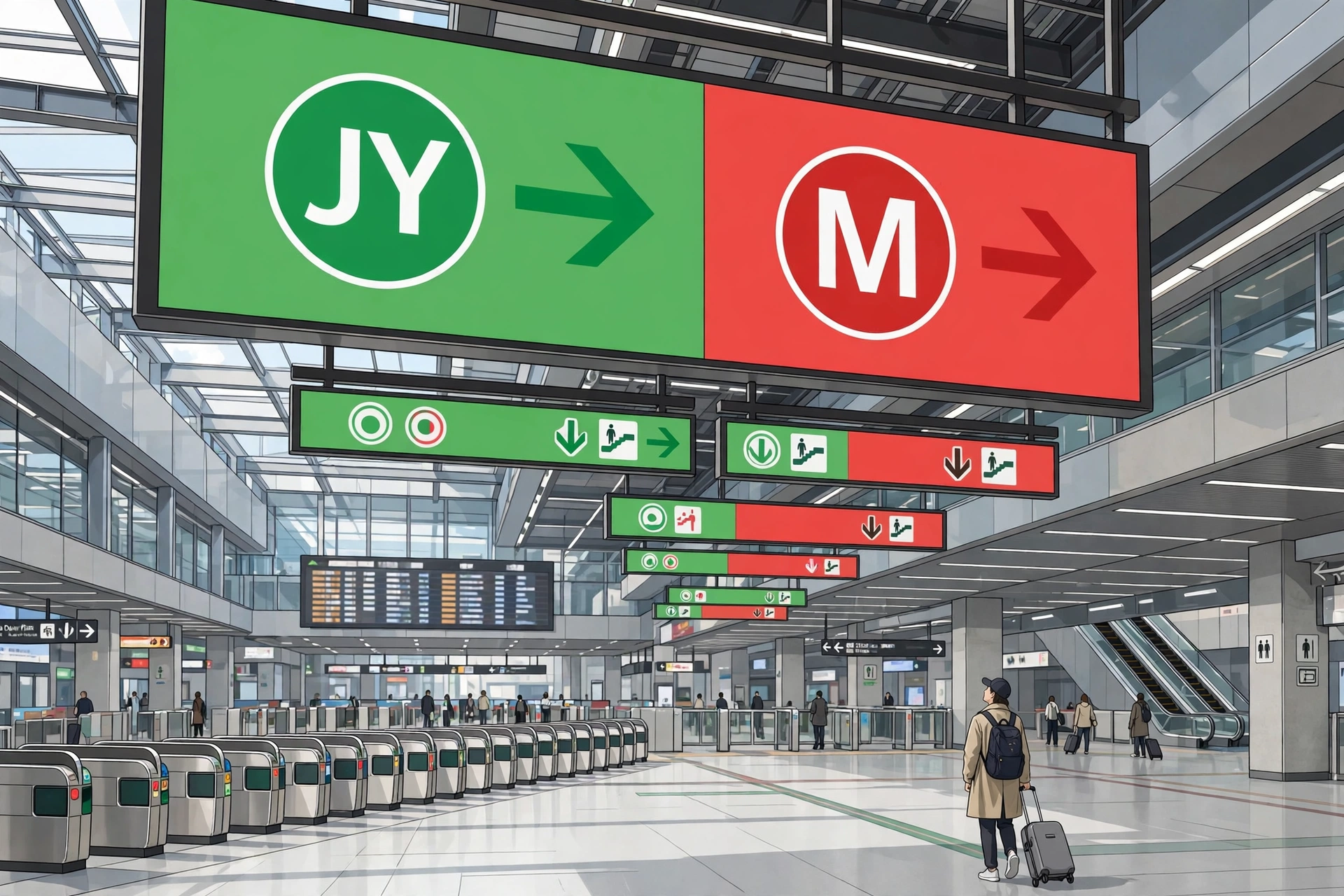
Tokyo's big stations feel like cities underground: several railway companies share one building, platforms stack across levels, and exits surface blocks apart. The system is learnable without reading Japanese, because it runs on visual cues. Each line has a color and a letter-number code, transfer signs are color-coded in English and Japanese, and phone apps show platform numbers and walking times between gates. The method is simple: follow colors and letter codes, budget 10–15 minutes for a transfer at Tokyo or Shinjuku station, and pick your exit by landmark before you surface. If you are still sorting the basics, our Japan planning guide covers visas, IC cards, and rail passes.
Why Tokyo stations break first-time visitors
A Tokyo mega-station is not one station. Several railway companies run lines through the same building, their platforms sit on different levels, and the exits lead to different streets blocks apart. A first-time visitor tries to read the whole place at once — the map, the Japanese signs, the crowd — and that is what breaks them.
The fix is to stop treating the station as a map and start treating it as a set of colors and codes. You do not need to understand the station. You need to follow one color to one platform, then one color to the next. Everything else — the shops, the corridors, the crowds — is scenery you can ignore until you are standing on the right platform.
Reading the signs: colors, numbers, and exit codes
Each Tokyo line has a color and a letter-number code. The Yamanote Line is green JY; the Marunouchi Line is red M. Transfer signs use those same colors, in English and Japanese, so you can navigate by matching colors instead of reading Japanese text.
Pick your line by its color and code before you move. When you reach a junction, look for the color of the line you are changing to, not for a station name in Japanese. The letter-number code does the same job as the color: JY tells you Yamanote, M tells you Marunouchi, and the number tells you the station. Follow the pair and you will arrive at the right platform even if you cannot read a single Japanese character.
The transfer math: same-station vs cross-station changes
Walking between platforms takes 10–15 minutes at Tokyo or Shinjuku station. That is the number to plan around. A transfer inside one station is not a two-minute hop, and a change that crosses to another operator's platforms can take the full 15 minutes.
Budget the full 10–15 minutes whenever you change lines at a mega-station, and add buffer time when you are connecting to a Shinkansen. A tight connection that looks fine on a timetable fails the moment the walk takes longer than the gap between trains. The apps help here: NAVITIME Japan Travel, Jorudan Norikae Annai, and Google Maps show platform numbers, the best car for transfers, and the walking time between gates, so you can see the transfer before you make it.
Rush-hour reality: when to travel and when to wait it out
A packed platform is information, not a challenge. When the crowd is shoulder to shoulder and the next train is minutes away, waiting for the following train costs less than forcing your way onto a full car with luggage. The 10–15 minute transfer budget is what buys you that choice: with buffer built in, a missed train is a short wait, not a missed connection.
Check the next departure on your app before you commit to a platform. If the board shows another train soon, let the packed one go. If you are heading to a Shinkansen, protect the buffer instead — arrive early and wait on the platform rather than racing through a crowded station.
Exit strategy: picking the right gate for your destination
Pick your exit by landmark before you surface. Exits in a mega-station are not interchangeable: they put you on different streets, and the wrong one can add a long walk back around the block.
Shinjuku station is the clearest example. The West Exit leads to the Metropolitan Government Building, the East Exit to Isetan and Kabukicho, and the South Exit to Takashimaya. Decide which landmark is closest to your destination while you are still on the train, then follow the signs for that exit. If you are unsure, ask at an information center — they have English-speaking staff.
Station facilities: lockers, restrooms, and transfer shortcuts
The two facilities that matter most during a transfer are the information center and your phone. Information centers have English-speaking staff who can point you to the right exit or platform when the signs stop making sense. The apps — NAVITIME Japan Travel, Jorudan Norikae Annai, and Google Maps — show platform numbers, the best car for transfers, and the walking time between gates, which is the closest thing to a shortcut a mega-station offers.
For lockers and restrooms, follow the pictogram signs instead of hunting by memory; they are marked the same way in every station. And the real shortcut is the one from the earlier sections: know your line's color and code, know your exit's landmark, and keep the 10–15 minute budget. A transfer planned that way rarely needs rescuing.