Seoul subway and Tmoney for first-timers: the card, the lines, and the transfer rules

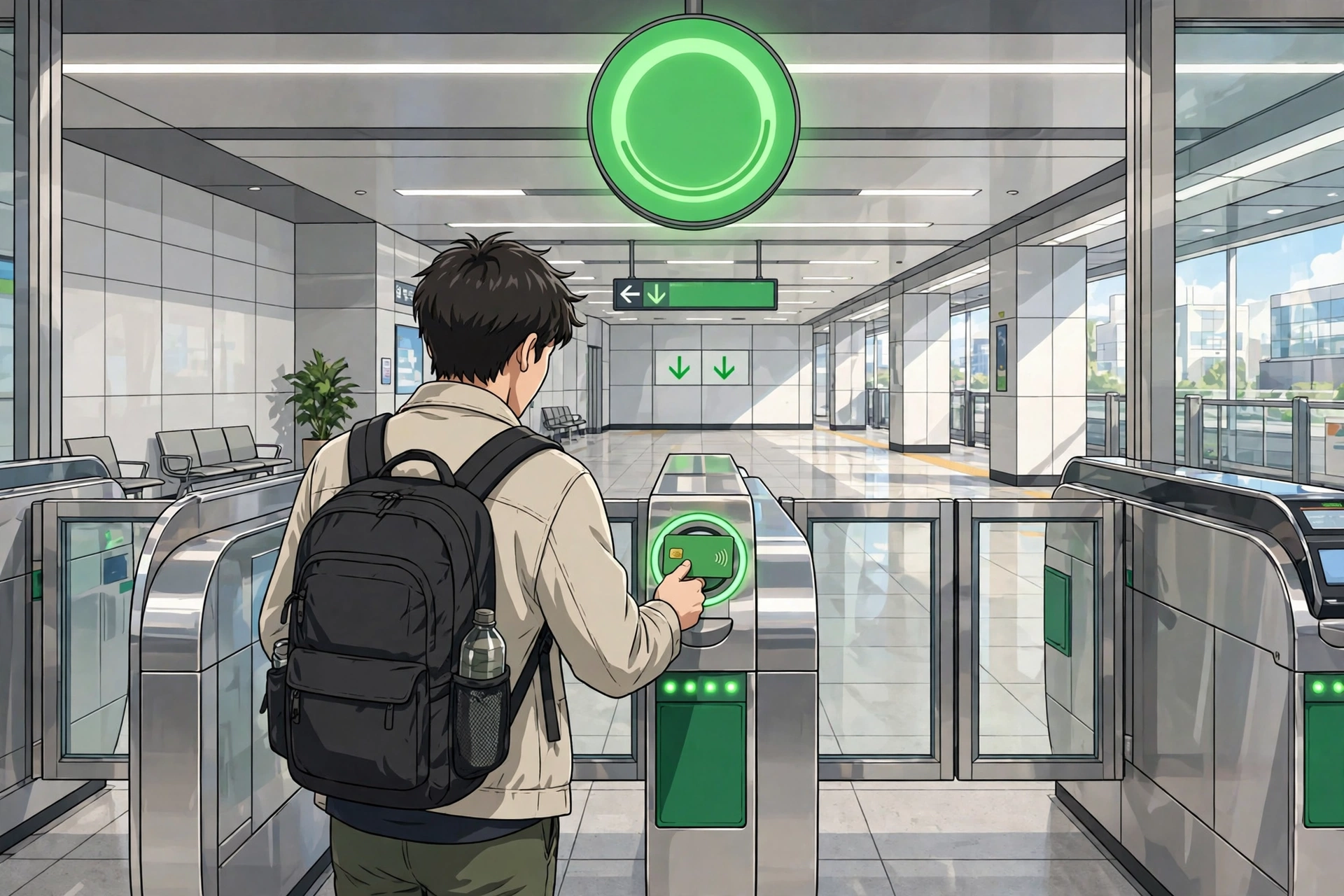
Buy a Tmoney card the moment you land, load it with Korean won cash, and the Seoul subway becomes the cheapest and simplest way around the city. A plain card costs ₩3,000–5,000, and the card price buys no balance — you load money onto it separately. One ride costs ₩1,550 with the card for the first 10 km, and transfers between subway lines and buses are free if you board within 30 minutes of tapping out. The two rules that catch first-timers are tapping out on every ride and checking the last train: forget to tap out and you can lose the transfer discount or get blocked at re-entry, and last trains pass central stations around 00:45–01:00 on weekdays. This guide covers the card, the fares, the transfer rules, the lines you will actually use, and when a pass beats pay-per-ride.
Buy a Tmoney card first: where, what it costs, and how to load it
Tmoney cards are sold at convenience stores nationwide — GS25, CU, 7-Eleven, emart24 — and at Seoul subway station information centers on Lines 1 to 8. A general card costs ₩3,000–5,000. Buy one at a convenience store in the airport arrivals hall before heading to the platform, so you are ready to ride the moment you reach the city.
Load it with Korean won cash at a station ticket vending machine or the store counter. You can recharge up to a ₩500,000 maximum balance. The card works on all public transportation and at affiliated stores displaying the Tmoney logo. Whether you can top up a regular card with a foreign card at the ticket machines is still unsettled in 2026 reports — load with cash to be safe.
For leftover balance, smaller amounts can be refunded at convenience stores, while refunds over ₩50,000 are only possible at Tmoney Town near Seoul Station Exit 10. Under-18s must register their date of birth at a convenience store to receive youth discount fares.
How fares work: the base fare, distance charges, and the single-journey ticket
The adult Seoul subway base fare with a transit card is ₩1,550 for the first 10 km, then ₩100 per additional 5 km up to 50 km and ₩100 per 8 km beyond that. Fares are distance-based and calculated automatically from tap-in and tap-out, so you never need to work out the price yourself — just keep the card loaded.
The ₩1,550 fare took effect on 28 June 2025, so guides quoting ₩1,400 or lower are out of date. A single-journey paper ticket costs ₩1,650 plus a ₩500 refundable deposit, refunded at a deposit-refund machine near the exit gates. The single ticket makes sense only if you are riding once and do not want a card; for anything more, the card is cheaper and unlocks the transfer discount.
Transfers: the 30-minute window, the four-transfer limit, and tap in and out
Seoul's transfer discount joins subway and bus rides into one trip: board the next ride within 30 minutes of tapping out — 60 minutes between 21:00 and 07:00 — up to four transfers across five legs, and you pay only the single highest base fare among the vehicles used plus distance surcharges.
Three conditions decide whether the discount applies. It requires a transit card, one card per rider, and tapping off every ride; cash and single-journey tickets get no transfer discount. You cannot transfer for free back onto the same subway line or bus number you just exited, and exiting the fare gate and re-entering at the same station starts a new fare. So tap in at the gate, tap out at the gate, every single ride — that tap-out is what starts the 30-minute window.
The lines first-timers actually use: Line 2, Line 3, Line 4, and the AREX airport train
Seoul's subway lines are numbered 1 to 9 and colour-coded. Line 2 (green) is the circle line through Hongdae, Gangnam, Jamsil, and Dongdaemun History & Culture Park, and it is the line visitors use most. Line 3 (orange) serves Gyeongbokgung and Apgujeong. Line 4 serves Myeongdong and Dongdaemun. Between those three lines you can reach most first-trip sights without learning the rest of the map.
From Incheon Airport, take the AREX all-stop train to Seoul Station. It costs ₩4,750 with a Tmoney card from Terminal 1 (about 59 minutes) and ₩5,350 from Terminal 2 (about 66 minutes), stopping at Gimpo Airport, Hongik University (Hongdae), and Gongdeok on the way. The non-stop AREX Express costs ₩13,000 and does not accept Tmoney. The last all-stop train that reaches Seoul Station leaves Terminal 1 at 23:38 — land after that and you need another way into the city.
Hours, last trains, and finding your way with Naver Map
First trains leave about 05:20–05:45. Last trains pass central stations about 00:45–01:00 on weekdays and 23:45–23:58 on weekends, and late trains often end partway along the line, so check the station timetable or Naver Map on the day — last-train times vary by station and direction, and engineering work can end service early on individual nights.
For navigation, Naver Map or KakaoMap are essential, because Google Maps transit directions are unreliable in Korea. Use Naver Map for the route and the last-train check together: it tells you which line, which direction, and whether you will make the connection. Since March 2026, new ticket machines on Lines 1 to 8 accept foreign Visa and Mastercard for single tickets and Climate Card short-term passes, with a service fee of about 3.7%.
Tmoney or a pass: Climate Card short-term passes and the Mpass for heavy riders
If you ride four or more times a day, a Climate Card short-term pass beats pay-per-ride. It gives unlimited rides on Seoul subways and city buses, excluding the Shinbundang Line and GTX, for 1 to 7 days: 1-day ₩5,000, 2-day ₩8,000, 3-day ₩10,000, 5-day ₩15,000, 7-day ₩20,000, plus a ₩3,000 physical card. The pass activates the moment the card is loaded and cannot be changed or reloaded until it expires, and it is limited to use within Seoul. The 30-day Climate Card was discontinued effective 1 October 2026 — the change most older guides still get wrong — so only the 1-to-7-day passes exist now.
The Mpass Card is a foreigner-exclusive Tmoney card offering up to 20 rides a day on Seoul subways, city buses, and AREX (excluding express trains): 1-day ₩15,000, 2-day ₩23,000, 3-day ₩30,500, 5-day ₩47,500, 7-day ₩64,500, cash only, issued and returned at Tmoney Town near Seoul Station Exit 10. It is valid for 30 days from the issue date, and buying after 17:00 gives an automatic ₩3,000 discount. Those are VisitKorea's listed prices with no late-2026 confirmation found, so confirm them at Tmoney Town before buying.
One thing to sort before you land is cover for the trip itself — the Korea, Japan, and China travel insurance guide explains what to check before you buy.